

200T CNC Press Brake for Stainless: Selection and Setup Guide
Stainless steel is notoriously difficult to form compared to mild steel, characterized by its high tensile forming resistance and a tendency to fight back against the ram. When transitioning to stainless production, many fabrication teams are surprised to find that their standard machine capacity is suddenly insufficient.
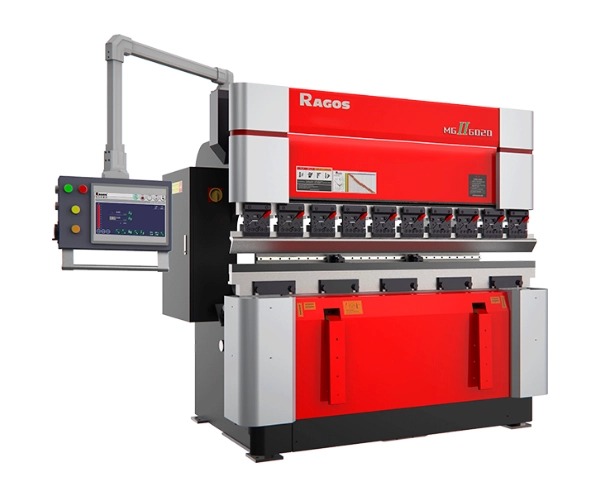
This behavior stems from the material's unique metallurgical properties, which demand significantly higher pressure to achieve the same results as carbon steel. In many professional shops, the 200T class machine is the entry point for serious stainless work because it provides the necessary force buffer to handle the forming pressure spike zones inherent in this material.
Bending stainless steel requires a strategic approach due to several material-specific challenges:
- Surface Work Hardening: Stainless becomes harder and stronger as it is deformed, increasing the load mid-stroke.
- Elastic Recovery: High yield recovery springback force means the part will "open up" significantly once the pressure is released.
- Bend Radius Stress: Stainless is prone to cracking if the bend radius stress concentration is too tight for the grade.
- Tooling Friction: The material's toughness can lead to surface galling, requiring specialized die interfaces.
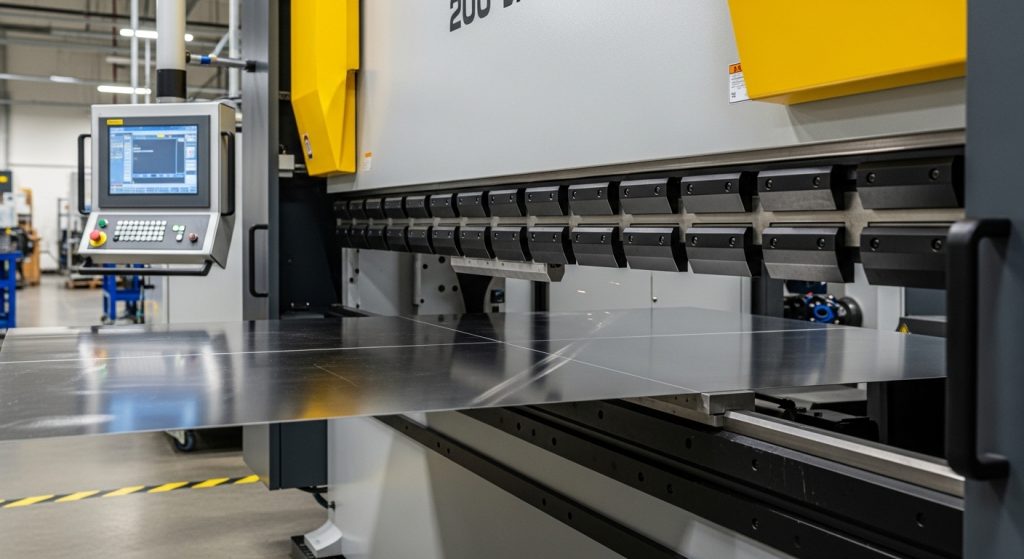
Why Stainless Steel Bending Pushes Shops Toward 200T CNC Press Brake Capacity
The primary driver behind the 200T requirement is the plastic deformation resistance rise found in the 300 and 400 series stainless alloys. While mild steel has a predictable yield point, stainless steel possesses a yield plateau extension behavior that requires sustained and increasing force to reach the desired angle. Generally, stainless steel requires 50% to 60% more tonnage than mild steel of the same thickness.
- Tensile Resistance: Higher chromium and nickel content increases the material stress absorption threshold, requiring more raw power to initiate the bend.
- Load Scaling: A 4mm mild steel sheet might bend easily on a 100T machine, but a 4mm stainless sheet will push that same machine to its absolute limit, risking hydraulic overheat or frame fatigue.
- Safety Margin Planning: Operating at the top 10% of a machine's capacity leads to inconsistent angles. A 200T machine allows for a forming pressure escalation curve that stays within the machine’s "comfort zone," ensuring repeatable precision.
Real Stainless Jobs Where 200T CNC Press Brake Becomes Minimum Requirement
In industrial fabrication, certain sectors rely on the 200T platform because the combination of material thickness and part length makes lower tonnage machines obsolete.
- Food Grade Equipment Panels: Thick stainless countertops and large-scale sinks used in commercial kitchens require clean, long bends in 3mm+ material.
- Chemical Processing Housings: Vessels and shells made from 316L stainless must maintain industrial hygiene fabrication tolerances, which requires the steady, high-pressure control of a 200T ram.
- Structural Stainless Enclosures: Outdoor electrical kiosks or corrosion resistant structural casing often use 5mm stainless to ensure longevity, demanding high tonnage for even short flange lengths.
These applications require more than just raw force; they demand the sanitary equipment forming requirements where the bend must be smooth, without the micro-fractures that can harbor bacteria or invite corrosion.
Springback Behavior That Changes Stainless Press Brake Setup
One of the most frustrating aspects of stainless is its "memory." The elastic modulus recovery shift in stainless is much more pronounced than in carbon steel, leading to a significant post bend angle memory effect.
- Cause: High yield strength allows the material to retain more elastic energy during the bend.
- Effect: A part bent to 90° under pressure may spring back to 95° or 100° once the ram retracts.
Stainless Setup Rules Box:
Rule 1: Always program for an angle overbend compensation margin (often 5° to 10°).
Rule 2: Use a CNC with "Springback Calculation" to adjust the neutral axis shift deviation automatically.
Rule 3: Ensure the die opening ($V$) is at least 10–12 times the material thickness to lower the pressure and reduce springback.
How Tooling Selection Changes for Stainless on 200T CNC Press Brake
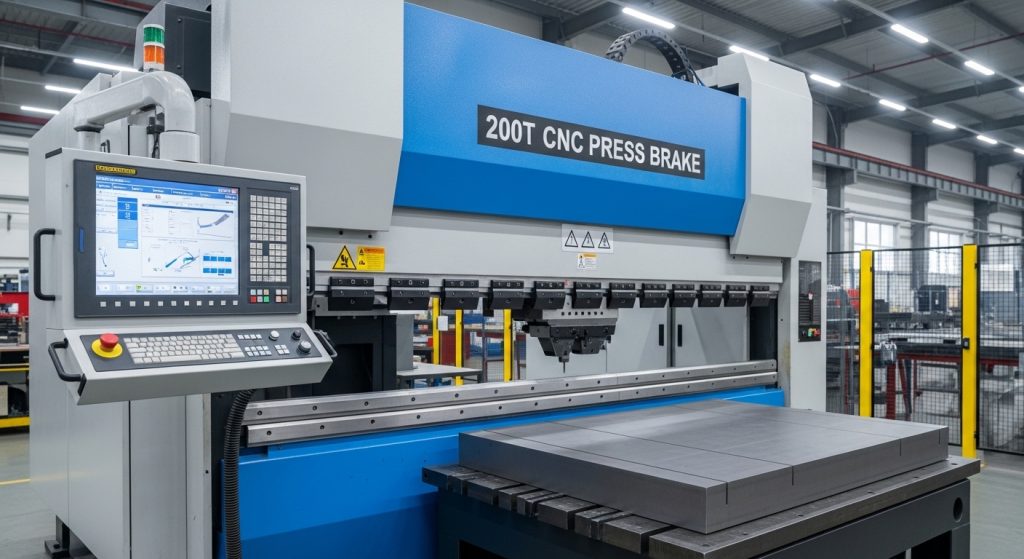
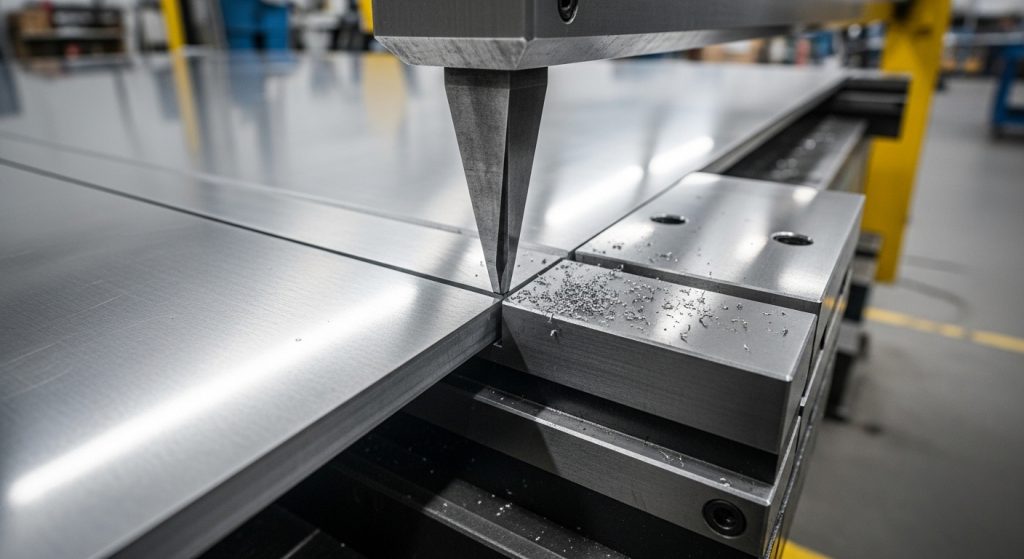
Using standard tooling for stainless on a 200T machine is a recipe for disaster. The die shoulder pressure concentration can cause standard dies to deform or "mark" the expensive stainless surface.
- Hardened Tooling: Tools should have a tool hardness wear resistance rating of HRC 50 or higher to withstand the abrasive nature of stainless steel.
- Surface Protection: To avoid a surface galling prevention interface, many shops use "No-Mark" film or specialized synthetic dies to prevent carbon transfer from the tool to the stainless.
- Die Opening Stress: On a 200T machine, the contact friction heat generation zone is intense. Using a larger V-opening spreads this heat and pressure, protecting both the tool and the part's finish.
How Stainless Thickness Rapidly Multiplies Load Demand
The physics of bending dictate that as thickness increases, the required force grows exponentially, not linearly. This plate deformation resistance scaling is the reason why a 200T machine is often the minimum requirement for plates over 4mm.
- Thickness Squared Rule: Bending force is proportional to the square of the material thickness ($S^2$).
- Force Escalation: Doubling your stainless thickness from 3mm to 6mm doesn't double the load—it quadruples it.
- Overload Risk: Without a forming force exponential curve calculation, it is easy to accidentally trigger a machine's hydraulic relief valve.
| Stainless Thickness | V-Die Opening | Tonnage per Meter (Approx) |
| 3mm | 24mm | 35 Tons |
| 4mm | 32mm | 48 Tons |
| 5mm | 40mm | 62 Tons |
| 6mm | 50mm | 75 Tons |
Setup Mistakes That Cause Stainless Cracking or Tool Damage
The material grain flow resistance in stainless makes it sensitive to the direction of the bend and the sharpness of the tools.
- Wrong Die Opening: Using a V-opening that is too narrow creates a localized stress spike failure, which can snap a punch or split the material.
- Too Sharp Punch Radius: If the punch tip is too sharp, it acts like a knife, creating grain boundary rupture risk and visible cracking on the outside of the bend.
- No Tonnage Buffer: Running a 190-ton job on a 200T machine leaves no room for the material hardening stage response, potentially stalling the machine mid-bend.
Watch for micro fracture propagation zones—if you see "whitening" or small lines on the outside of the bend, your punch radius is too small or your material is too hard.
When Stainless Bending Needs More Than 200T Capacity
While a 200T CNC press brake is a powerhouse, it has its limits, especially as the plate grade hardness escalation increases in specialized alloys like Duplex or high-nickel grades.
| Factor | Stay with 200T | Move to 300T - 600T+ |
| Material Thickness | Up to 6mm (Full length) | 8mm - 20mm+ |
| Bend Length | 3200mm to 4000mm | Over 4000mm or Tandem |
| Alloy Type | 304, 316, 430 | Duplex, Super Duplex, Inconel |
If your production mix is shifting toward heavy gauge stainless deformation force requirements, the 200T frame will eventually become the bottleneck. For these high-yield alloys, the high alloy yield resistance threshold is so great that only a machine with significantly more "reserve" tonnage can provide the stable, repeatable results required for industrial certification.
When Tandem Press Brakes Replace Single 200T Machines
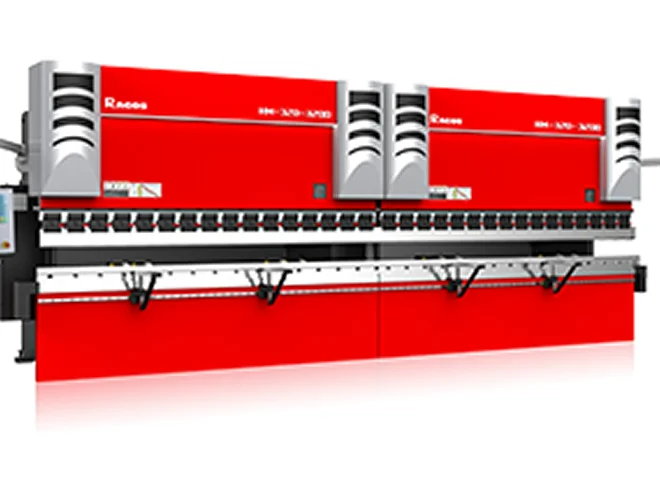
For long stainless panels that require both high tonnage and extreme length, tandem press brakes offer a unique solution. By using multi machine synchronized forming, two machines can work together to share the load. This dual frame bending coordination is perfect for lighting poles or long architectural sections that would otherwise require a massive, custom-built single machine.
How 10mm Stainless Sheet Bending Changes Force Planning
Bending 10mm stainless is a high-stakes operation. The medium thickness stainless forming pressure required is massive, often necessitating a sheet forming load transition zone analysis. At this thickness, the bend radius stress amplification becomes a major factor, and you must use significantly larger V-dies to manage the material hardening stage response. Learn about 10mm Stainless Bending
When Stainless Plate Moves Into 600T–3000T Range
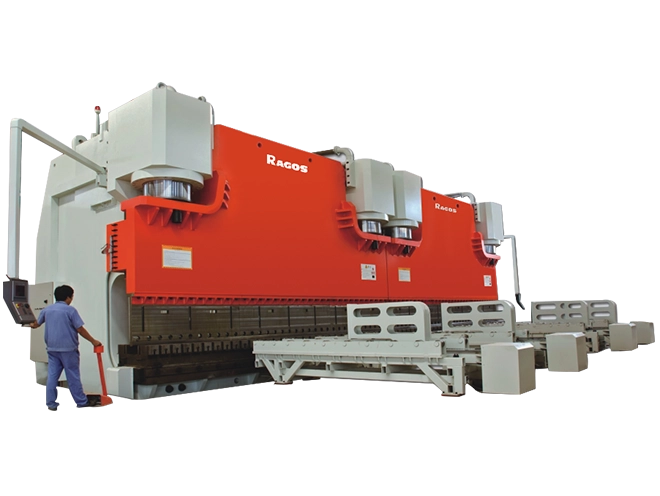
Heavy industrial plate fabrication, such as for the oil and gas or maritime industries, requires a 600T–3000T hydraulic press brake. These machines manage the thick alloy section deformation pressure needed for pressure vessels and hulls. When the ship grade stainless forming demand is high, these heavy-duty machines provide the necessary compression load to shape high-strength alloys.
3200 vs 4000 Length Choice When Bending Stainless Panels
The length of a stainless panel affects its "stiffness" during the bend. Our 3200mm vs 4000mm comparison explains how the panel length stainless stiffness factor influences the long panel stainless rebound effect. Choosing the right bed length is essential for managing the span related forming accuracy shift across the entire part.
When Stainless Jobs Need 4000mm CNC Press Brake Length Plus Tonnage
If your job involves 4-meter stainless panels, you need both the bed space and the power. A 4000mm CNC press brake ensures high tonnage long panel forming balance. This setup is critical for maintaining long edge stress distribution uniformity, preventing the ends of the panel from springing back differently than the center.