

Hydraulic Press Brake 600T–3000T: Heavy-Forming Use Cases and Risks
The transition into ultra-high tonnage hydraulic press brakes (600T–3000T) represents a fundamental shift from sheet metal bending to heavy plate forming. At these scales, the physics of air bending are dominated by massive resistance forces where the material's internal crystalline structure dictates machine behavior more than the operator's control interface. Precision in this echelon is not merely a matter of linear accuracy but a complex battle against frame deflection, material springback, and the energy required to initiate a plastic hinge in high-tensile alloys. Failure to respect the load physics of these machines doesn't result in a scrapped part; it results in catastrophic structural compromise of the tooling or the machine frame itself.
- Ultra-tonnage necessity: Driven by global infrastructure, shipbuilding, and energy sectors requiring monolithic plate integrity.
- Plate physics dominance: Beyond 600T, through-thickness stress gradients make standard K-factor calculations obsolete.
- Structural load paths: Tonnage ratings are secondary to the machine's ability to channel energy without torsional twisting.
- Catastrophic failure risk: Energy storage in a deflected 3000T frame turns minor tool fractures into high-velocity projectiles.
The Load Physics Envelope Above 600 Tons: What Changes in Metal Behavior
When processing heavy plates on a 600T to 3000T machine, the material no longer behaves as a uniform plane. A triaxial stress field develops at the point of contact, where the plastic zone penetration depth must reach the neutral axis before any permanent deformation occurs. In thinner materials, this transition is nearly instantaneous; however, in ultra-heavy plates, the yield front propagation moves slowly, creating a massive buildup of internal resistance.
Material Behavior Under Ultra-High Tonnage
| Metric | 600T Threshold | 3000T Threshold | Engineering Impact |
| Stress Field Type | Biaxial dominant | Triaxial dominant | Increased risk of internal delamination. |
| Neutral Axis Shift | Minimal | Significant | Calculation of blank length becomes nonlinear. |
| Shear Band Propagation | Surface-level | Full-thickness | Requires slower ram speeds to prevent cracking. |
| Strain Energy Storage | Moderate | Extreme | Machine must dissipate massive recoil energy. |
Structural Frame Stress Distribution in 600T–3000T Hydraulic Press Brakes
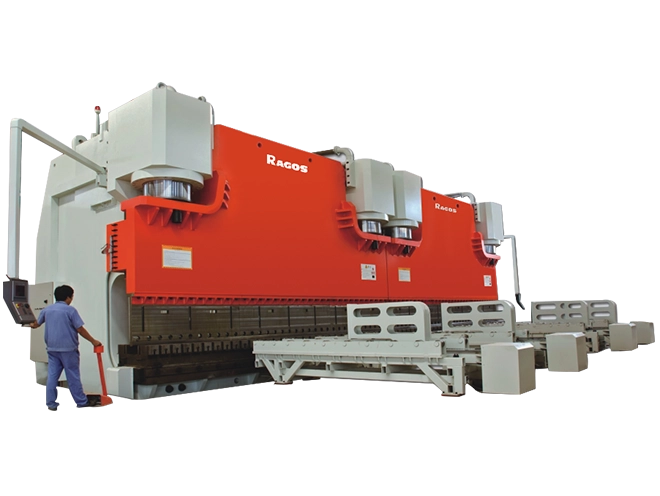
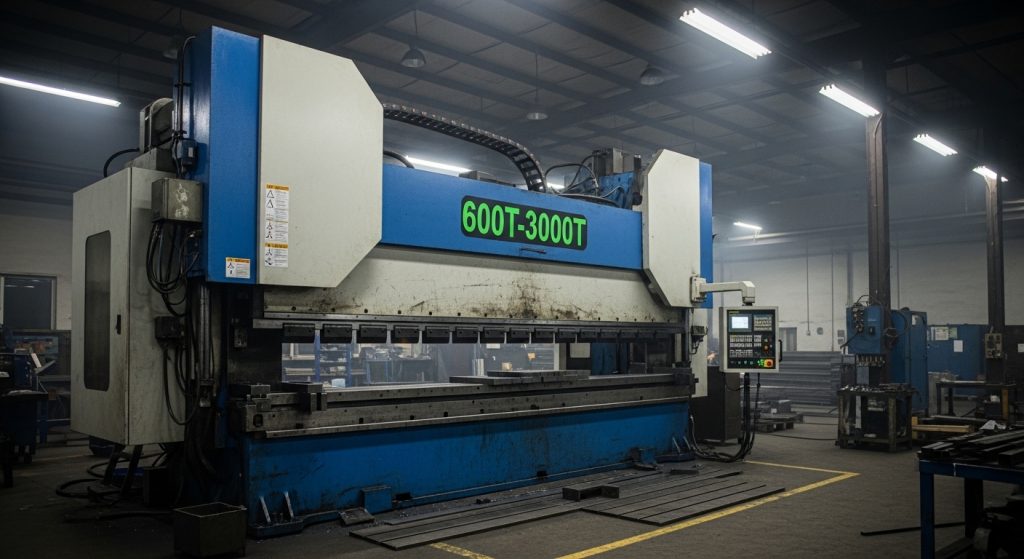
At the 3000T limit, the press brake frame acts more like a bridge than a machine tool. The longitudinal beam stress flow must be meticulously managed to prevent "banana" deflection. Manufacturers utilize heavy-duty C-frame or box-structure tie-rod designs to ensure column compression load transfer remains vertical. If the frame torsional distortion resistance is exceeded, the ram will lose parallelism, leading to uneven flange lengths and localized tool overloading.
- Bed Deflection: Even with crowning systems, the bed undergoes significant elastic deformation that must be compensated for in real-time.
- Hydraulic Cylinder Symmetry: Force must be delivered with absolute synchronicity; a millisecond of lag at 3000T creates a massive side-load on the ram guides.
- Ram Parallelism: Achieved through high-resolution linear encoders that monitor the hydraulic cylinder force symmetry against the frame's structural feedback.
Hydraulic Pressure Behavior at Ultra-High Tonnage Levels
Managing hydraulics at this scale requires more than just high pressure; it requires sophisticated flow control logic. Fluid compressibility becomes a tangible variable—at 300 bar, hydraulic oil can compress by nearly 1% of its volume. This creates a "spring" effect in the cylinders that must be managed by servo proportional valve modulation to prevent erratic ram movement during the transition from fast approach to pressing speed.
- Pressure Spike Damping: High-speed valves prevent pressure wave propagation that could burst seals during the moment of plate fracture or breakthrough.
- Thermal Load Behavior: The sheer volume of oil moved generates significant heat; hydraulic thermal expansion drift can affect stroke accuracy if not managed by active cooling.
- Multi-cylinder Synchronization: Large-format machines often use 4 or more cylinders, requiring a dedicated PLC to balance flow based on real-time load cell data.
Failure Modes Unique to Ultra-Tonnage Forming Machines
In the 600T–3000T range, "wear and tear" is replaced by "fatigue and fracture." The most dangerous failure mode is the localized stress singularity, where a microscopic defect in the tool or the plate becomes a point of total structural failure under load.
Ultra-Tonnage Failure Matrix
| Failure Mode | Root Cause | Severity | Warning Signs |
| Frame Fatigue Fracture | Cyclic stress fatigue accumulation | Critical | Paint flaking at joints; audible "pings" during load. |
| Tool Catastrophic Fracture | Fracture toughness threshold breach | Extreme | Micro-cracking on V-die shoulders. |
| Plate Snap-Back | Sudden release of strain energy | High | Rapid vibration of the plate after the stroke. |
| Hydraulic Seal Blowout | Pressure wave propagation | Moderate | Hydraulic mist or sudden ram drop. |
Heavy forming failures are rarely gradual. Once the micro crack propagation lattice reaches a critical state, the final fracture occurs at the speed of sound within the material.
Plate Thickness vs Force Curve: When Forming Becomes Exponential
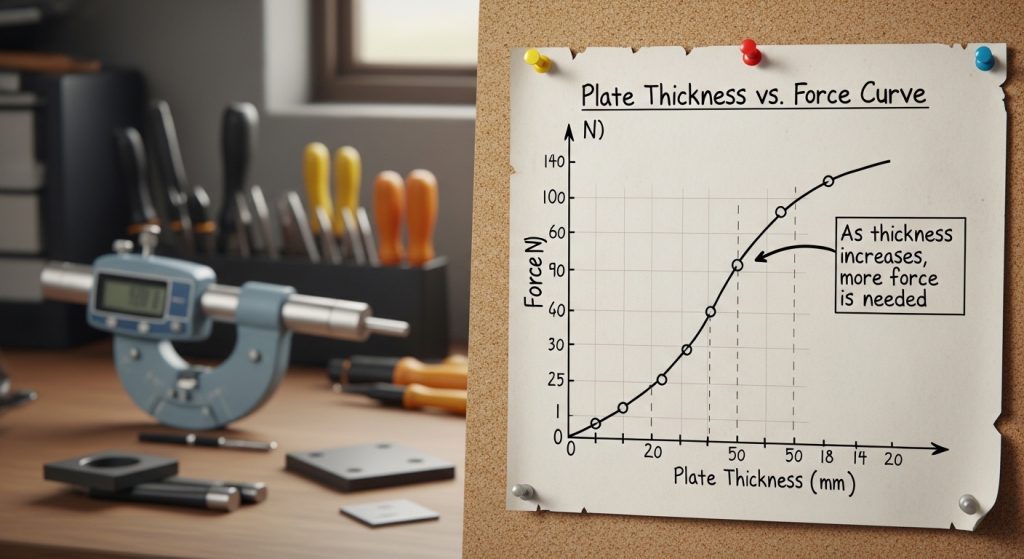
The relationship between plate thickness and required force is not linear; it is approximately a thickness-squared relationship. As you move from 20mm to 100mm plate, the section modulus resistance escalation is massive. This creates a load amplification gradient where a small increase in plate thickness requires a disproportionately larger machine.
- Elastic-Plastic Crossover: The point where the plate stops resisting and starts deforming.
- Plastic Hinge Formation: The localized area of the bend where the material reaches ultimate tensile strength.
- Strain Energy Absorption: The total energy held by the plate; higher tonnages must dwell at the bottom of the stroke to allow this energy to dissipate.
Facility Engineering Constraints Above 1000T Machines
A 3000T press brake cannot simply be placed on a standard factory floor. The foundation load dispersion slab must be engineered to prevent the machine from sinking or tilting over time.
- Foundation Reinforcement: Deep-pile foundations with heavy rebar grids are required to handle the static weight (often >200 tons) and the dynamic pressing force.
- Vibration Isolation: Vibration harmonic isolation prevents the massive energy of the stroke from damaging nearby precision machinery.
- Electrical Demand: These machines require high-current power feeds to drive multiple 50HP+ hydraulic pumps simultaneously.
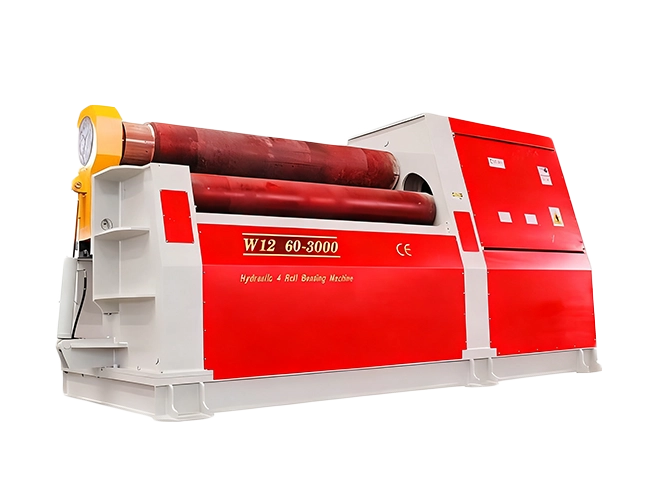
When Heavy Plate Forming Should Switch to Rolling Instead of Bending
At extreme thicknesses or tight radii, a press brake becomes inefficient. A decision matrix is required to determine when to move from a press brake to a plate rolling machine.
| Factor | Use Press Brake | Use Plate Roller |
| Min. Radius | Determined by V-die ($>3t$) | Can achieve tighter continuous curves. |
| Plate Length | Limited by machine width. | Can handle extremely long cylinders. |
| Thickness | Generally up to 100mm-150mm. | Can exceed 200mm for specific vessel work. |
| Complexity | Best for multiple angles/flanges. | Best for 360° cylindrical forming. |
Economic Risk Modeling for Ultra-High Tonnage Machine Ownership
Investing in a 2000T or 3000T machine is a 20-year capital commitment. The ROI model must account for more than just "parts per hour."
- Utilization Break-even: These machines often need only 30-40% utilization if the project value-added is high.
- Tooling Lifecycle: Custom V-dies for 2000T machines can cost tens of thousands of dollars.
- Project Density: The risk is high if the machine is dependent on a single government contract or industry sector.
ROI Scenario Table
| Metric | High Utilization (Infrastructure) | Low Utilization (Custom R&D) |
| Payback Period | 3–5 Years | 8–12 Years |
| Downtime Risk | Critical (Revenue Loss) | Manageable (Schedule Shift) |
| Maintenance Profile | Preventive/Aggressive | Condition-based |
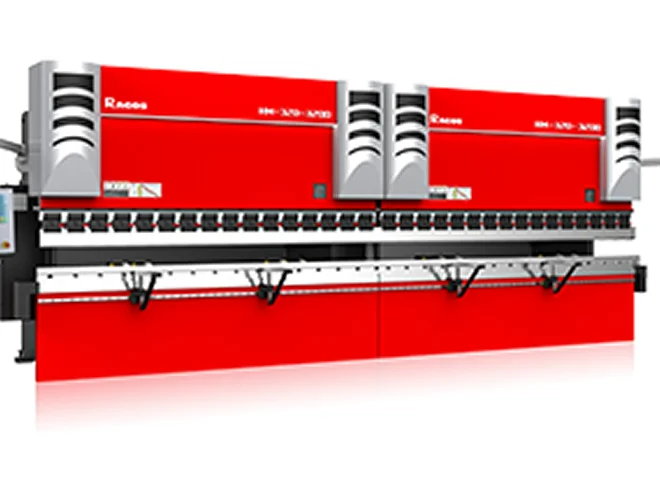
Understanding the 3200mm vs 4000mm capacity differences is essential for projects that sit on the edge of heavy fabrication territory. While a 3200mm press brake serves as the backbone for mid-range structural work, the 4000mm press brake often marks the entry point into heavy infrastructure. For ultra-long components that exceed the bed length of a single unit, tandem press brake systems provide a synchronized alternative to monolithic machines. It is also worth noting that the physics of the lower end, such as 10mm sheet bending, provide the baseline data used to extrapolate the extreme forces required for the 600T–3000T range.
Final Thought: Ultra-high tonnage forming is as much an exercise in civil engineering as it is in metal fabrication. Success requires a holistic view of the machine, the material, and the facility it inhabits.