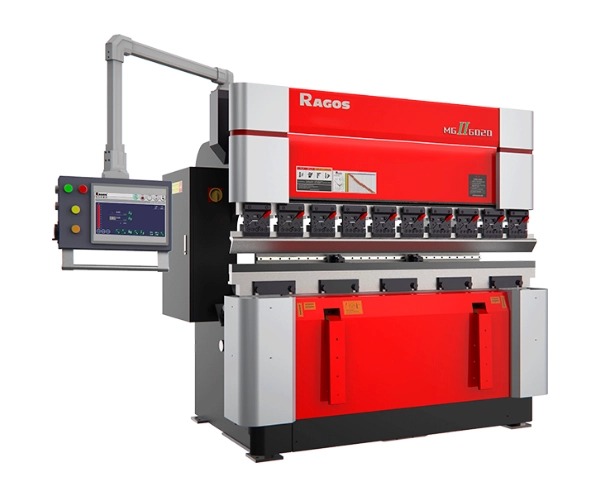
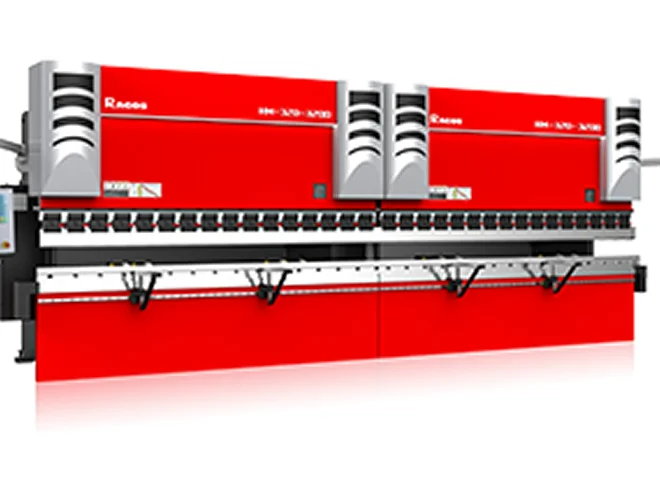
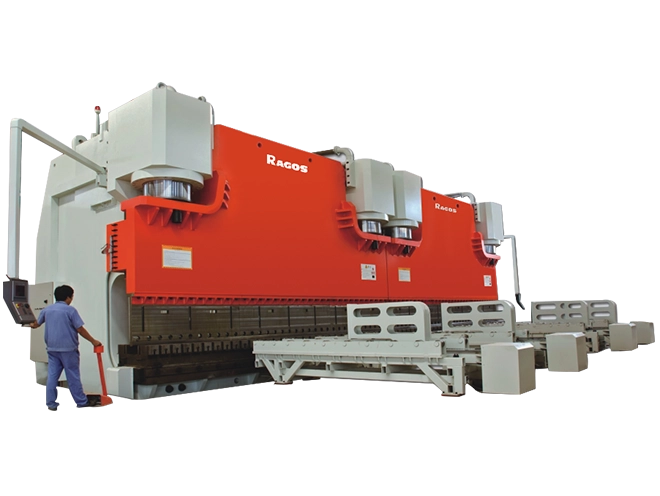


산업용 CNC 프레스 브레이크: One-Pass Angle Control For Heavy Plate Bending
Industrial CNC Press Brake buyers need stable bend accuracy on thick materials without driving up energy use, 설치 시간, or operator risk. For many overseas buyers, tonnage alone no longer defines machine value. The real priority is one-pass accuracy, lower rework, and reliable performance in long production cycles.
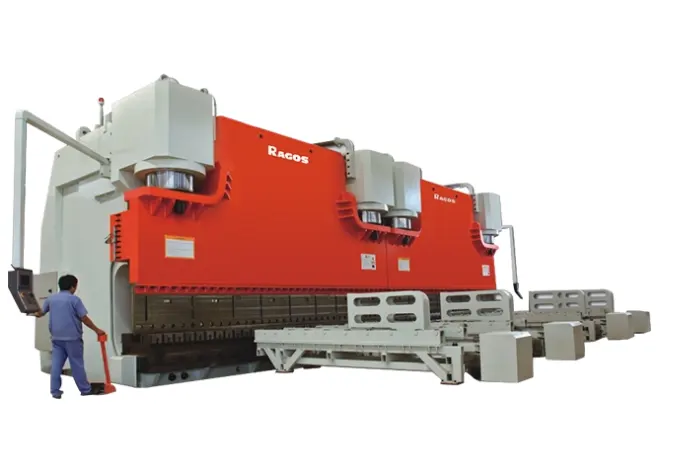
JS RAGOS addresses this with laser-based angle measurement for closed-loop correction, supported by servo-driven hydraulics, CNC 급식, 크라운잉 보상, and thermal control. This combination fits current market demand for higher precision, better efficiency, and more predictable heavy-duty bending.
The Real Bottleneck Is Not Force
Heavy-duty bending projects often fail to meet expectations for a simple reason: more tonnage does not automatically mean better parts. On long workpieces or thicker plate, small variations in material properties, 스프링백, 프레임 편향, oil temperature, and setup discipline can all push the final angle away from target. Once that happens, production slows down.
For buyers serving industries such as construction machinery, energy equipment, transport, enclosure fabrication, or structural steel processing, the downstream cost is serious:
• More trial bends before approval
• More operator intervention during production
• Higher scrap risk on expensive material
• Longer machine occupation per job
• Greater inconsistency between shifts
Modern control platforms are clearly moving toward simulation-driven setup and more intelligent process preparation. Delem's DA series and Profile-T software, 예를 들어, focus on automatic bend sequence calculation, 충돌 감지, feasibility checks, and offline programming, while Cybelec's VisiTouch platform supports 3D visualization, CAD import, and dynamic collision checking. That direction reflects what buyers increasingly want: less trial-and-error at the machine and more predictability before the first sheet is bent.
Why Laser Angle Measurement Matters More Now
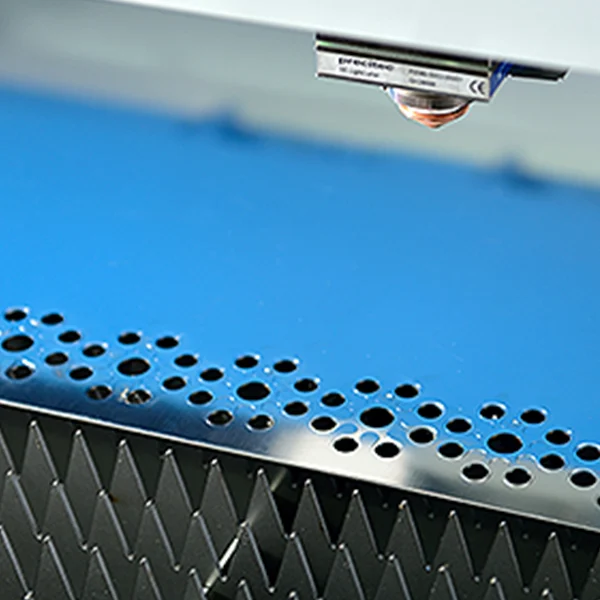
JS RAGOS has a strong story to tell when the topic is first-part accuracy. Its Laser Check angle measurement system is the most compelling feature to lead with because it addresses the most expensive part of heavy bending: correction after the first hit.
The system measures the actual bend angle during operation and automatically compensates for springback and force deviation. 실질적인 면에서, that means the machine does not rely only on theoretical programming values. It verifies the result and helps the control system adjust toward the target angle with far greater confidence. For overseas procurement teams, this matters because it connects directly to three commercial outcomes:
• Faster approval of the first workpiece
• Lower rework on thick or high-value material
• More stable repeatability across batches
JS RAGOS states angle precision beyond ±0.1°, which aligns with the market demand for tighter tolerance control in more complex bending work. When paired with advanced controllers that support 2D and 3D programming, the machine moves closer to a closed-loop production model instead of a manual correction workflow. That is especially valuable in mixed production, where parts change often and setup time must stay under control. Delem and Cybelec both position 3D programming and simulation as tools for improving feasibility, 설정, 그리고 운영자 효율성, which supports this overall direction.
Accuracy Needs More Than One Feature
A serious Industrial CNC Press Brake cannot depend on angle measurement alone. Precision becomes sustainable only when several machine subsystems support each other.
JS RAGOS strengthens that logic in a useful way.
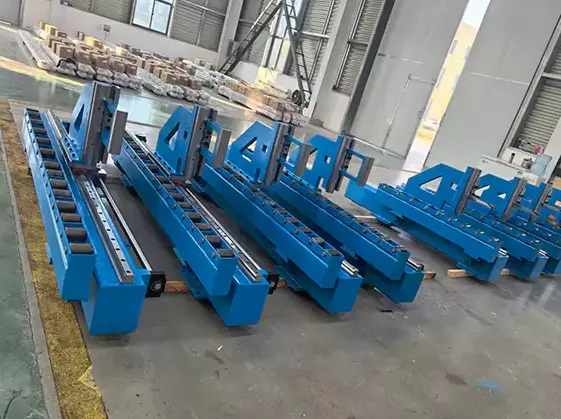
• Crowning For Long-Part Consistency
A crowning table helps offset deflection during bending so the angle remains more uniform across the workpiece length. It is particularly valuable when bending long or heavy parts, as angle variation across the length can create downstream assembly problems and extra manual correction.
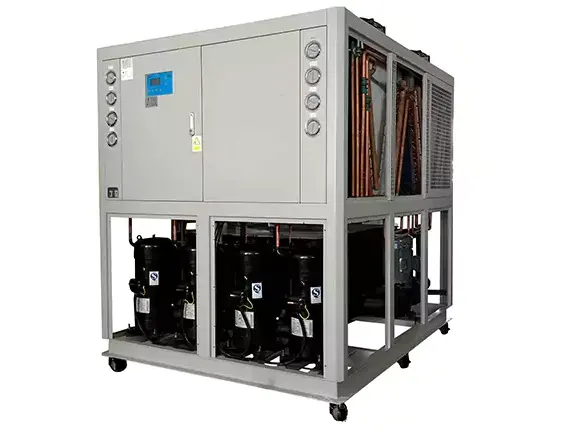
• Stable Temperature For Stable Results
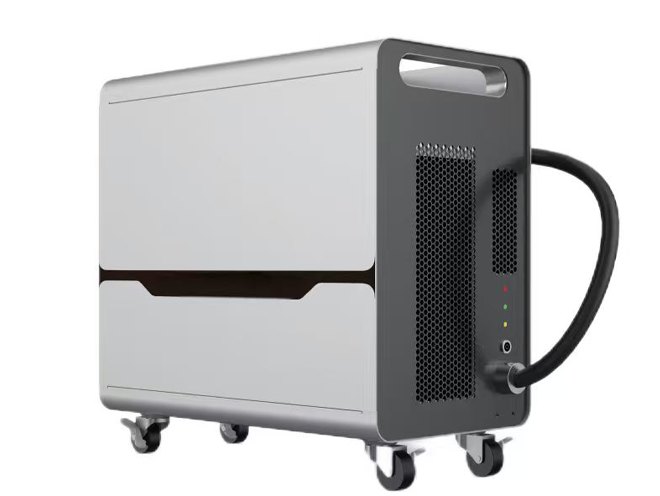
JS RAGOS also offers an industrial cooling unit for hydraulic oil and servo motors. That may sound like a supporting detail, but buyers in hot-climate regions or continuous production environments understand its importance quickly. Thermal drift can reduce consistency, shorten component life, and make precision harder to hold over time. A controlled thermal environment supports repeatable machine behavior during extended production.
• Flexible Tooling For Mixed Orders
The Vario's adjustable die system offers yet another additional practical benefit. Thanks to internal hardened rollers, the system is designed to reduce bending force, fast V-opening changes, and multiple V sizes on one die, thus providing greater versatility for mixed part demands. JS RAGOS observes a 25-30% bending force reduction due to a roller-assisted design, 즉,, in turn, should reduce stress on the machine while increasing efficiency in flexible manufacturing.
함께, these features show that JS RAGOS is not only selling force capacity. It is building a process package around repeatability, 유연성, and machine stability.
Efficiency Is Now A Procurement Issue
Energy performance is no longer a secondary talking point for heavy equipment. Bosch Rexroth's recent materials on press brake drive systems make clear that energy-efficient press brake design and modernization are active priorities in the market. In that context, JS RAGOS's DSVP system is commercially relevant, not just technically interesting.
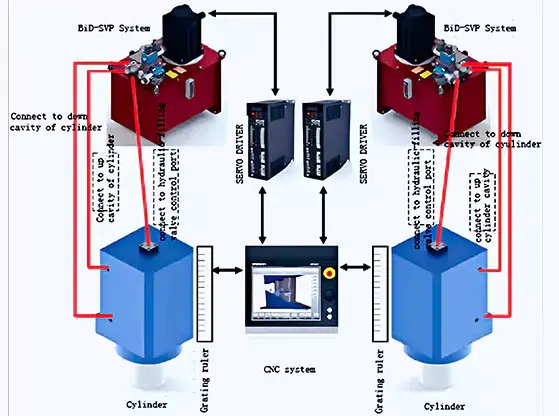
Its double servo valve pump system is designed for large press brakes and is presented as a way to cut electric consumption by 60–70% compared with conventional motor-driven hydraulic solutions, while also improving response, lowering noise, and simplifying maintenance through fewer hydraulic components.
For buyers comparing total cost of ownership, this changes the discussion. Machine price still matters, but so do:
• Daily power consumption
• Workshop noise level
• Hydraulic maintenance burden
• Long-run reliability in demanding schedules
That is why JS RAGOS fits current market expectations well. The industry is moving toward machines that deliver high tonnage without accepting the old penalty of high running cost.
자동화 and Safety Must Move Together
Another reason the JS RAGOS configuration feels current is that it does not treat automation and safety as separate topics.
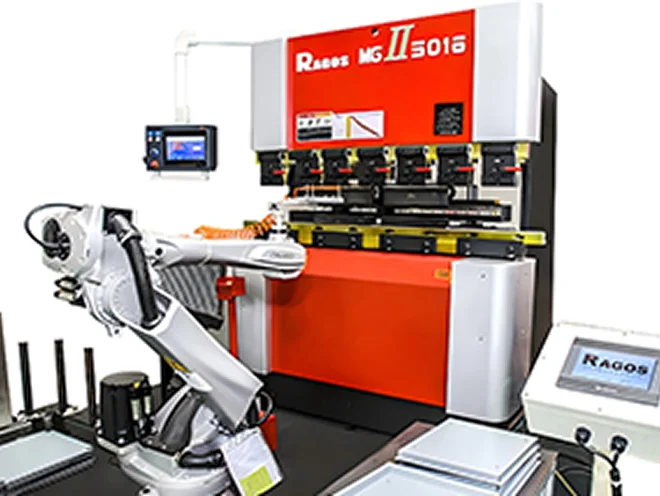
Its CNC plate feeding device supports automatic sheet handling and can connect with controllers such as Delem, 그, 그리고 사이벨렉. In high-volume environments, automated feeding helps reduce manual handling, improve consistency, and shorten the gap between cycles.
동시에요, DSP laser protection and laser check systems support safer machine use. OSHA's guidance on press brake safeguarding and machine guarding makes clear that point-of-operation hazards require reliable protective measures, while ANSI B11 standards remain a key reference family for machinery risk reduction, including power press brakes. For procurement teams, this means safety technology should be considered as part of machine architecture, not as an afterthought.
This is one of the stronger parts of the JS RAGOS offer. The company is aligning productivity upgrades with the safety expectations of modern fabrication plants.
Why JS RAGOS Fits the Direction of the Market
The strongest position for JS RAGOS is not simply "heavy duty." Many suppliers can make that claim. A better position is this: a heavy-duty press brake built for first-part accuracy, 에너지 소비가 저감, flexible setup, and more stable all-day production.
That matches what today's buyers are actually screening for:
• Accurate parts without repeated correction
• 2D/3D programming for faster setup
• Lower energy use for better operating economics
• Cooling and crowning for long-run consistency
• Automation options for higher throughput
• Safety systems suited to modern workshop expectations
For companies buying an Industrial CNC Press Brake for demanding plate work, the best machine is the one that reduces uncertainty. JS RAGOS answers that need by combining laser angle control, servo-efficient hydraulics, adjustable tooling, controller flexibility, and thermal stability into one production-oriented platform. In a market that values uptime, 정밀, and controllable cost, that is exactly the kind of technical direction buyers are looking for.