

Industrial Metal Plate Roller For Sale: 3-Roll vs 4-Roll Explained Clearly
Industrial metal plate roller for sale selection can look straightforward on paper. In practice, 3-roll and 4-roll rollers deliver very different results at plate ends, during squaring, and in repeat production. A mismatch increases repositioning time and correction work. The following sections clarify the differences that decide outcomes.
What a Plate Roller Really Does in Production
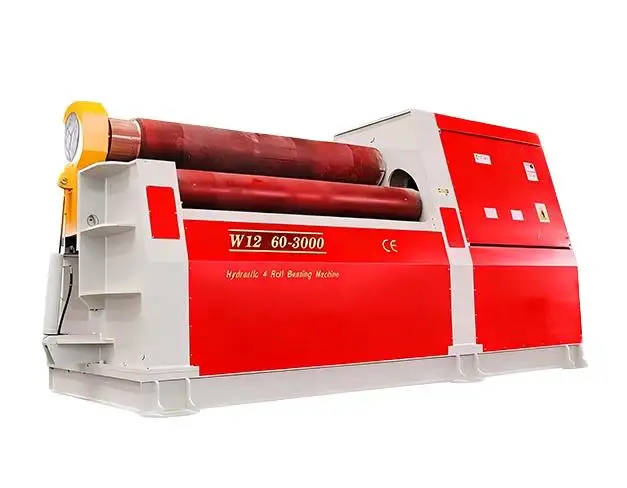
An industrial plate roller forms flat metal plate into cylinders, cones, and curved shells. You see these parts in ducting, tanks, pressure vessels, ship sections, structural columns, and many custom fabrication projects. The machine must do two things well: hold the plate steadily and bend it gradually without creating flat spots or uneven roundness.
For buyers comparing an industrial metal plate roller for sale, the decision is not only about “power.” It is about workflow. The best choice is the one that matches your daily tasks, your operator skill level, and the precision you need after welding.
3-Roll Plate Roller Basics
A 3-roll design uses three rollers to bend the plate. Most 3-roll machines are configured as either a pyramid type or an initial pinch type. In simple terms, the plate is pressed and rolled between three points. This structure is widely used because it is efficient for many general rolling tasks and can be cost-effective for workshops that run varied jobs.
In real operation, 3-roll machines may require more operator technique for pre-bending the plate ends (reducing the “flat ends” that appear before the plate becomes fully round). Many workshops handle this well with experienced operators, correct rolling sequences, and careful setup.
Where 3-Roll Fits Best
✅ General cylinders and curved sections where small flat ends are acceptable or can be managed later
✅ Workshops that already have skilled operators and stable rolling procedures
✅ Buyers who want strong value and a proven structure for common fabrication jobs
A 3-roll machine can be a smart entry point if your product mix is wide and your tolerances are not extremely strict on every part.
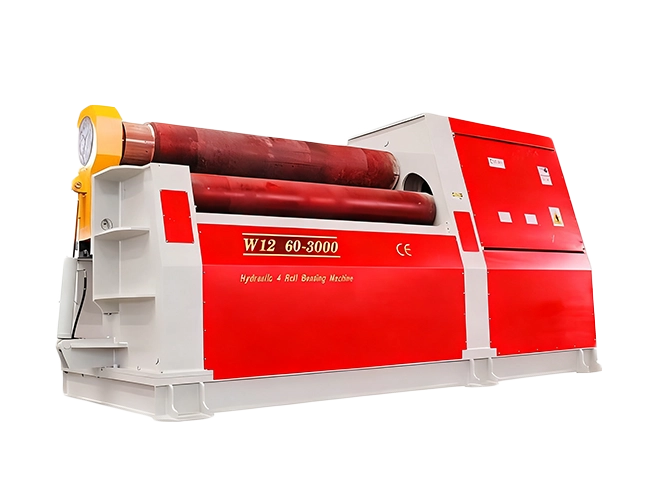
4-Roll Plate Roller Basics
A 4-roll design uses four rollers: one top roll, one bottom roll, and two side rolls. The key benefit is control. The plate is clamped between the top and bottom rolls, while the side rolls shape the curvature. This makes feeding, alignment, and repeatability easier—especially for beginners or shops training new operators.
When customers ask about an industrial metal plate roller for sale for productivity, 4-roll machines are often selected because they reduce manual handling steps. In many workflows, 4-roll machines allow easier pre-bending and more consistent rolling from part to part.
Where 4-Roll Fits Best
✅ Jobs that need better repeatability across batches
✅ Teams that want faster setup, simpler operation, and fewer “trial parts”
✅ Projects where alignment and pre-bend control directly affect fit-up quality
In practical terms, 4-roll can feel more “forgiving” in daily production, because the plate is held more securely during rolling.
3-Roll Vs 4-Roll: The Differences That Actually Matter
Most buyers do not fail because they chose the “wrong” roll count. They fail because they did not match the machine to the workflow. Here are the decision points that matter most.
✅ Pre-Bending: With 4-roll clamping and control, pre-bending is typically more repeatable for tight edge fit-up.
✅ Ease Of Training: 3-roll can be excellent, but new operators often need more time to reach stable, repeatable results. 4-roll processes are usually simpler to teach and standardize.
✅ Feeding Control: 4-roll clamping holds the plate firmly during entry, improving tracking and reducing alignment mistakes.
✅ Repeat Jobs: When you run the same diameter repeatedly, 4-roll workflows can minimize setup differences between batches.
✅ Cost Consideration: A 3-roll is often the better value for many fabrication shops, delivering strong capability at a lower investment level.
For buyers prioritizing throughput and repeatability, “how the part moves through the process” matters more than the number of rolls.
Practical Buying Checklist for Beginners
✅ 1) What is your most common thickness range, and what is the smallest radius you need to roll reliably?
Example A (Light–Medium, Small Radius Often):
You mainly roll 3–8 mm carbon steel into small tanks for dust collectors. Your common shells are Ø500–Ø900 mm. You also roll short rings for flanges.
• Meaning: Small diameters and frequent small radius work demand stable pre-bend control and consistent feeding.
• Typical fit: A 4-roll often reduces trial rolls because the plate is pinched and guided.
Example B (Medium–Heavy, Larger Radius Most Of The Time):
You roll 12–25 mm plates for large silos and structural cylinders. Most parts are Ø2000 mm+, long shells, low mix.
• Meaning: The application favors load capacity and structural rigidity (tonnage, roll diameter, and frame strength) over minimum-radius forming.
• Typical fit: A pyramid-type 3-roll can be the best ROI option when your shop has consistent workflows for plate handling, repositioning, and alignment control.
✅ 2) What Do You Need To Form: Cylinders Only, Or Also Cones And Complex Curves?
Example A (Cylinders Only):
Repeat straight cylinders for storage tanks and pipe sleeves, with no cone applications. Stable materials and recurring diameters.
• Meaning: Select for consistent throughput and repeatability rather than specialized forming range.
• Typical fit: 4-roll usually wins on fast alignment and fewer handling steps.
Example B (Mixed Geometry Jobs):
You frequently handle conical hoppers and reducer transitions, plus occasional ducting work that requires controlled, non-uniform radii. Each order is different.
• Meaning: You need flexible control, adjustable geometry, and predictable forming for non-standard shapes.
• Typical fit: Many shops still pick 4-roll for easier plate control, but a well-configured 3-roll can also work if cone rolling is a core skill in the team. The deciding factor is how often cones appear and how skilled the operators are.
✅ 3) How Important Is Edge Quality And Reduced Flat Ends For Your Downstream Welding And Fit-Up?
Example A (High Edge Quality Required):
You make pressure vessel shells where welding prep is strict. If flat ends are too long, your fit-up time increases, and you may need extra trimming or re-rolling.
• Meaning: Better pre-bending and fewer “flat end” corrections save real labor.
• Typical fit: 4-roll often helps reduce plate end flats because the plate is pinched and controlled during pre-bend cycles.
Example B (Edge Quality Is “Nice To Have,” Not Critical):
You roll protective covers and non-sealed ducts. Minor flat ends are acceptable because you weld with a larger gap tolerance or you always trim edges anyway.
• Meaning: Your workflow has enough tolerance that small rolling marks or edge variance won’t cause rework downstream.
• Typical fit: A 3-roll machine can be the practical, cost-efficient choice for this kind of production.
✅ 4) How Will You Staff The Station: One Dedicated Operator Or Rotating Team Members?
Example A (Dedicated Expert Operator):
A senior fabricator runs the roller every day. He can quickly dial in springback, maintain tracking, and complete cylinders efficiently—even when plate flipping and repositioning are part of the routine.
• Meaning: Skill can compensate for a more manual workflow.
• Typical fit: 3-roll can perform very well because the operator technique is stable.
Example B (Multiple Operators, Training Needed):
You rotate 3–5 operators across stations. Some are new. Your problem is inconsistency: one person produces round shells, another produces oval shells.
• Meaning: You need process stability that relies less on “feel.”
• Typical fit: 4-roll tends to be more beginner-friendly because pinching and guiding reduce alignment errors.
✅ 5) Repeat Runs Or Custom Builds?
Example A:
Same customer, same size—Ø1200 × 2000 mm shells—30–60 pcs/month. You want predictable cycle time.
• Meaning: Less handling = higher shift output.
• Typical fit: 4-roll usually pays back faster in labor savings and repeat consistency.
Example B (One-Off Custom, High Mix):
You do repair work and custom fabrication. Today it is a small duct, tomorrow a large cylinder, next week a cone. Quantity is low, variety is high.
• Meaning: Flexibility and cost control matter; speed is less important than “can do the job.”
• Typical fit: 3-roll can be a smart entry choice, as long as capacity and roll diameter match your thickest plates.
Choosing the Right Machine and Next Steps
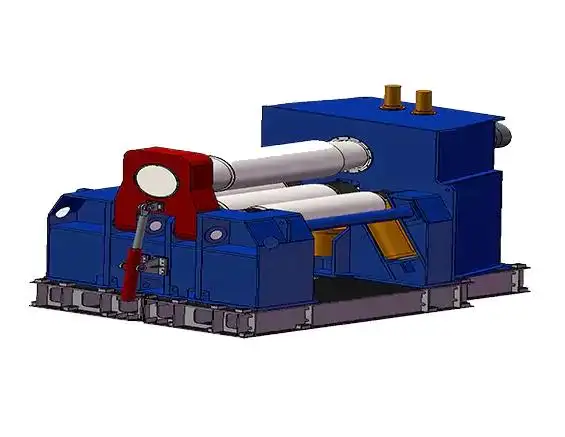
A 3-roll plate roller is often the right choice for general rolling, flexible job shops, and buyers who want strong value with proven performance. A 4-roll plate roller is often the right choice for shops that prioritize easier operation, better control, and more consistent repeatability—especially when multiple operators use the machine.
If you are evaluating an industrial metal plate roller for sale, the fastest way to choose correctly is to match the machine type to your parts and workflow. That is how you avoid expensive overspending or costly under-spec errors.
CTA (Call-to-Action): If you are comparing an industrial metal plate roller for sale for shipbuilding, tanks, or pressure vessel work, send JS RAGOS your plate thickness range, width, material type, and target diameters. We will recommend a suitable 3-roll or 4-roll configuration (linear or arc type), plus cone rolling and support options—then provide a clear quotation for your production needs.