

How to Avoid Sheet Metal Bending Interference in Press Brake Operations
By Author: Mark Hanks
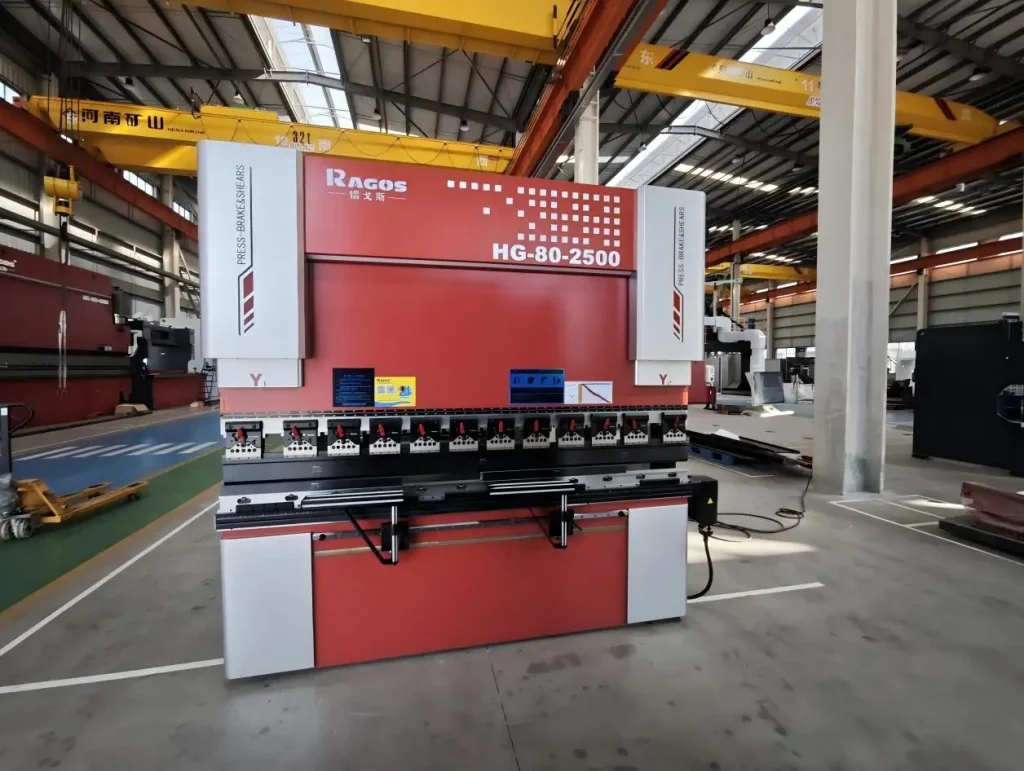
Sheet metal bending interference is one of the most common challenges during CNC press brake bending. It occurs when the workpiece collides with the punch, die, machine frame, or already bent flanges. At JS RAGOS, we help customers identify and eliminate bending interference through customized tooling, optimized bending processes, and practical design solutions. This guide explains the common types of bending interference and shares solutions based on our manufacturing experience.
1. 1.Why Bending Interference is Important
Bending is the most important operation in sheet metal. This operation relies on the plastic deformation of the metal to create parts of a specific geometry and dimensions. When compared with the processes of welding, riveting, or bolting, the process of bending has the following benefits.
• Greater precision and repeatability
• Reduced tooling and labor expenses
• Shorter cycle time
• Improved appearance by eliminating joints and seams
However, the use of more complex geometries creates a greater chance of bending interference. Without appropriate planning of the process, the selection of the right tools and the consideration of the right order of operations, bending interferences can make the fabrication of a part impossible. At JS RAGOS, we start addressing issues of interference at the design phase of the part to ensure efficient, seamless fabrication.
How V-Groove Bending Prevents Tool Collision
2. 2.What is Sheet Metal Bending Interference?
Bending interference occurs mostly on components that have been designed to undergo two or more bends. In such cases, the interference occurs due to a physical collision between a bent edge of a component in the process and the die, the punch, the machine frame or a feature of the component. The main influencing factors are:
• Part shape and dimensions
• Tooling (punch & die)
• Machine structure (bed width, ram stroke, back gauge travel)
• Bending sequence
Below are the three most common types of bending interference, illustrated with typical examples.
2.1 Interference Between Bent Edge and Tooling
This is the most frequent interference type. During the bending cycle, the previously bent flange can collide with the punch (upper tool), or the die (lower die), causing deformation or halting the process.
• Upper die interference – The bent edge strikes the punch as it rotates upward.
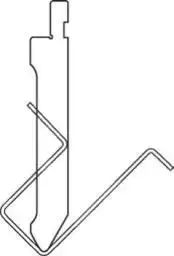
Figure 1: Upper punch interference during sheet metal bending
• Lower die interference – The part collides with the die shoulder or the lower tool.
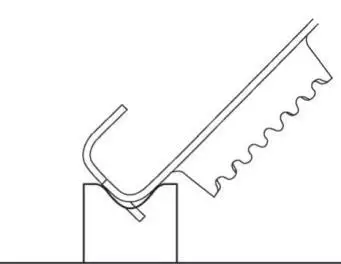
Figure 2: Lower die interference in press brake bending
�� Example: A tall flange on a “U”-shaped part can easily hit the punch. JS RAGOS recommends checking tool clearance early in the design phase.
2.2 Interference Between Part and Machine
This occurs with enclosed or oversized geometries, such as:
• Three-sided closed bends – After bending two parallel sides, the high vertical walls hit the upper die when attempting the third side. Also, the machine bed or back gauge may block part positioning.
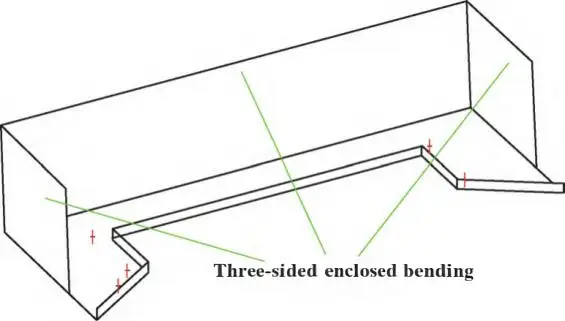
Figure 3: Three-sided enclosed bending interference
• “Z”-shaped bends – A simple offset (Z-bend) often fails: after the first 90° bend, the long leg points downward and strikes the machine table during the second bend.
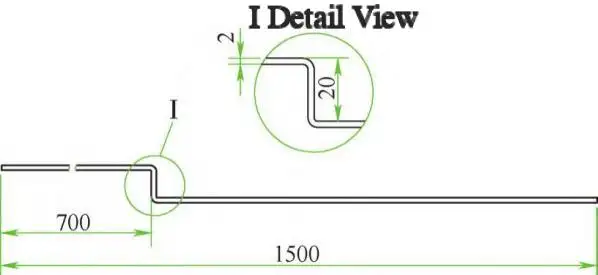
Figure 4: Z-shaped bending
✨ JS RAGOS insight: Many so-called “unbendable” parts can be saved by adjusting the bending order or using special tooling — see Section 3.
2.3 Interference with Other Part Features
In parts with tight assembly requirements, accumulated tolerances and springback can cause edges to collide or angles to fall short.
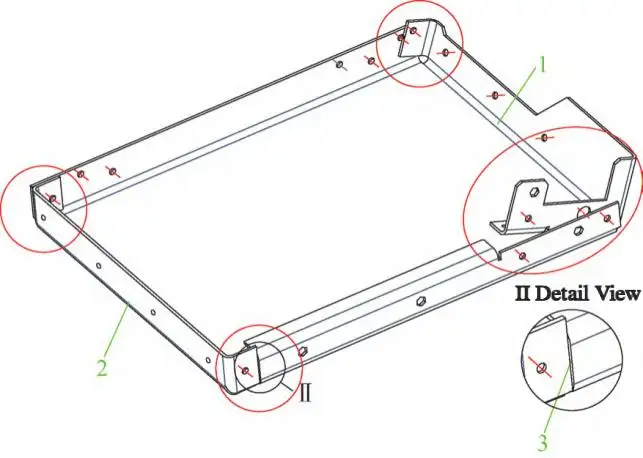
Figure 5: Bending with an assembly structure
�� Example: A box-like part with internal mating flanges. If the width tolerance is too negative (over-bent), the side flanges crash into each other. Without a proper gap at certain positions, the bend angle cannot reach 90°.
These cases demand a holistic approach: tolerance analysis, springback compensation, and sequence planning.
Common Types of Sheet Metal Bending Interference
| Interference Type | Typical Cause | Recommended Solution |
| Bent edge & tooling | Tall flanges collide with the punch or die | Use a gooseneck punch or customize tooling |
| Part & machine | Closed or oversized parts hit the machine frame or bed | Try better bending sequence or use a different machine with bigger throat or daylight |
| Part feature interference | Adjacent flanges or tight clearances cause collisions | Adjust tolerances, redesign parts, or compensate for springback |
3. Practical Solutions to Sheet Metal Bending Interference
Based on decades of manufacturing experience, JS RAGOS applies the following strategies — often in combination — to solve interference problems efficiently.
3.1 Optimize Tooling Selection & Modify Die Shapes
Choice of tooling is the first line of defense.
• Hooked / gooseneck punch – The most common solution for “U”-shaped parts. Its recessed design provides clearance for tall flanges. JS RAGOS offers a range of gooseneck punches and can recommend the right size based on your flange height and bottom width.
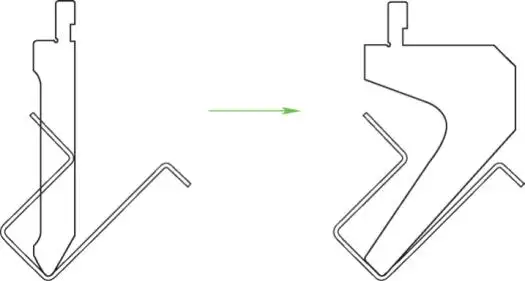
Figure 6 Gooseneck punch for U-shaped sheet metal parts.
• Modified standard tooling – Notch, mill, or drill clearance holes in the punch or die where interference occurs. However, always verify that the remaining tool body has sufficient strength to avoid premature wear or deflection.
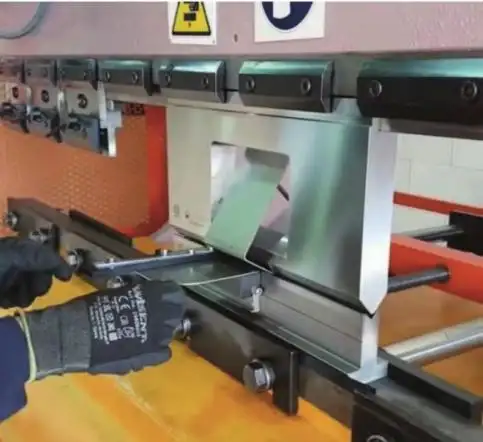
Figure 7: Modified Mold
When even a gooseneck punch cannot clear the part, JS RAGOS recommends a score line or V-groove bending (also called “routing before bending”).
How V-Groove Bending Prevents Tool Collision
V-groove bending refers to the machining of a v-groove at designated bending locations of a sheet metal which is subsequently bent to the desired shape using a press brake. The characteristic features of the V-groove bending process can be summarized in three aspects.
1)Characteristics of the V-Groove Bending Process
V-groove bending leads to a small edge radius and no bend marks on the workpiece.
Per the theories of sheet metal bending, the bend radius at the edge of a sheet metal workpiece is dependent on the thickness of the sheet metal. V-groove bending requires machining a groove of a given shape at the bending location. This operation is inherently removing thickness and increasing the bending area's edge. V-groove bending also requires a lower bending force due to the reduced thickness in the bending area. As the bending force does not impact the entire workpiece, no bending marks are produced on the workpiece even on surfaces that are decorative. Additionally, the process of V-groove bending requires a reduced force, thus, eliminating the possibility of indentations on decorative surfaces.
This process is especially applicable to the decorative finishes of high end metal work in hotels, banks, commercial centers, airports and various other premium locations.
2)Reduced Equipment Tonnage for Bending Operations
In the context of metal sheet bending, the bending force and tonnage associated with the bending operation are directly related to the sheet thickness. Higher sheet thickness results in the need for higher bending force and higher tonnage from the bending machine.
With the introduction of a V-groove prior to the bending operation, the thickness of the sheet is substantially reduced. This reduction, in turn, results in a lower bending force for the operation and allows the bending of thicker sheets on press brakes with lower tonnage.
This method leads to reduced cost of press brake machines, reduced energy costs, and savings in production space.
3)Bending of Complicated Workpieces and Manipulation of Springback
As shown in Figure 2, the workpiece cannot be formed using the regular bending techniques on a standard press brake. However, it is possible to form the workpiece by first machining V-grooves on the workpiece, followed by manual bending.
Moreover, the springback force and angle can be influenced and controlled by the thickness of the sheet after the V-groove has been cut. If the thickness after V-grooving is about 0.3 mm, then the springback angle is negligible and the springback is practically eliminated.
Score line / V-groove method:
• Press a shallow indentation (V-groove Depth≈ 80% X Sheet Thickness) along the bend line.
• The groove allows partial pre-bending (e.g., to 135° instead of 90°), avoiding tool collision in subsequent steps.
• Finally, flatten to 90°.
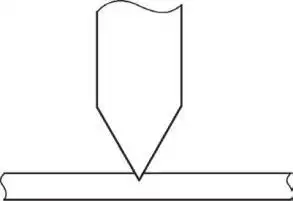
Figure 8: Wire Pressing Process
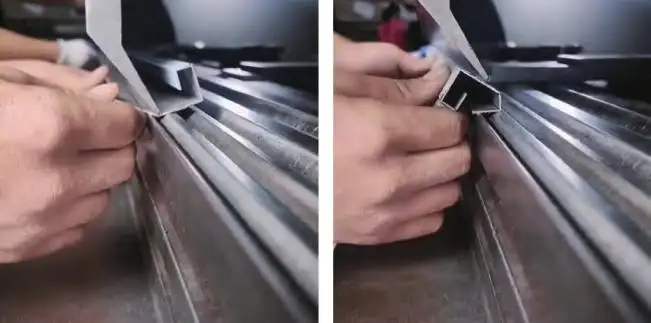
a) Grooving and pre-bending b) Grooving, bending, and correction
Figure 9: Grooving and Bending
�� Caution: Deep grooves can reduce strength or cause cracking — evaluate per application. JS RAGOS can run feasibility tests for your specific material and thickness.
3.2 Design a Smart Bending Sequence
Optimizing the bending sequence is often the most cost-effective method for eliminating interference in complex sheet metal parts. In many cases, a smart bending sequence can eliminate the need for expensive custom tooling meanwhile improving production efficiency.
For the Z-bend example:
Instead of bending both legs to 90° directly:
• Pre-bend the first leg to about 135°.
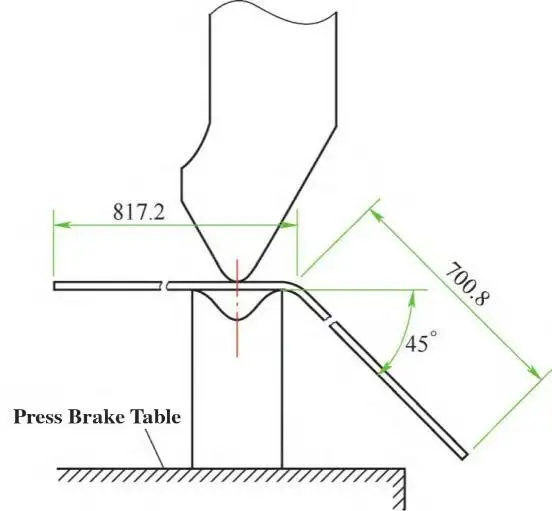
Figure 10: Schematic of pre-bending
• Bend the second leg fully to 90°.
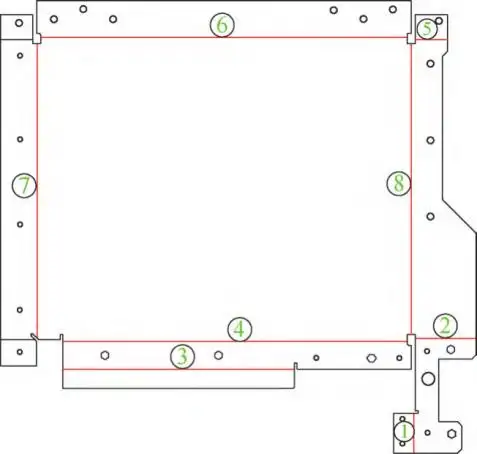
Figure 11: Bending Sequence
• Return to the first leg and finish it to 90°.
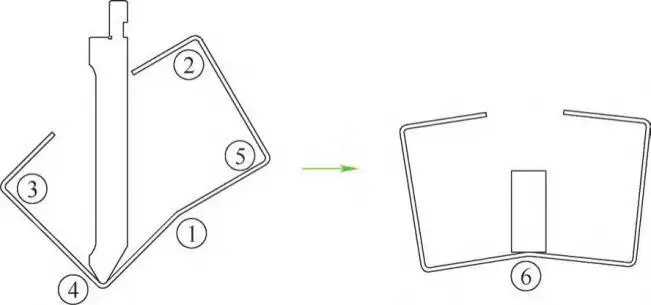
Figure 12: Process of pre-bending
For complex, multi-bend parts:
• Use reverse-order reasoning – determine the last bend first, then work backward. This ensures that critical flanges (which are hardest to access) are bent last, avoiding interference with the punch.
Pre-bending as a sacrificial operation:
Add a temporary reverse bend (small angle) where interference is predicted. After completing the main bends, the temporary bend is either corrected or removed.
JS RAGOS helps customers simulate bending sequences using CAD/CAM and field-tested knowledge — saving weeks of trial-and-error.
3.3 Choose the Right Bending Equipment
Not all press brakes are equal. Two main types:
• Up-forming (bottom-ram) presses – Suitable for thin sheets; the punch moves upward from below.
• Down-forming (top-ram) presses – The punch moves downward; better for thick plates and large workpieces.
Main machine parameters influencing interference:
• Open height & stroke – Inadequate space for extended clearance on tall flanges.
• Bed width – Wide beds can block parts that extend below the die.
• Back gauge travel range & layout – May conflict with long or asymmetric parts.
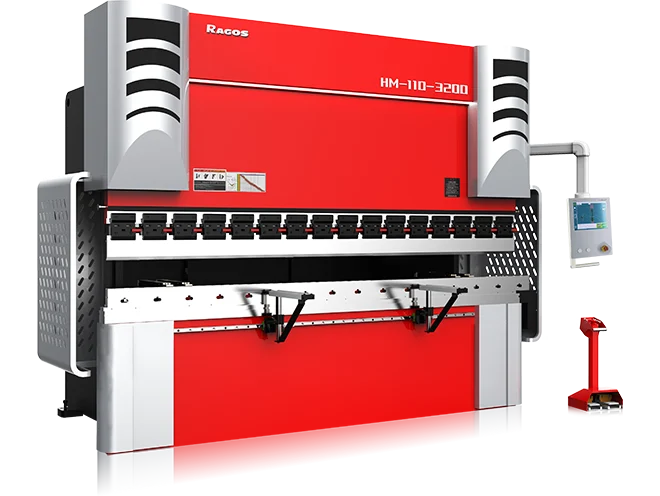
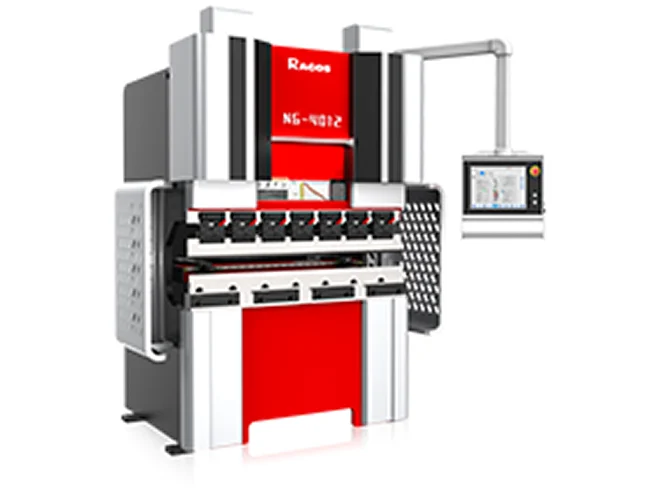
JS RAGOS operates a range of modern CNC press brakes (including models with advanced interference-avoidance software) and can advise on machine selection for your specific part family.
3.4 Design Custom / Non-Standard Tooling
For highly complex geometries, off-the-shelf tooling will not suffice. JS RAGOS designs and manufactures dedicated non-standard bending tools, including:
• Single-piece shaped dies (e.g., stepped punches, radius-tailored forms)
• Modular assemblies (multi-component moving tools that “expand” or “collapse” during stroke)
Custom tooling requires careful analysis of part geometry, material, batch size, and cost. JS RAGOS provides end-to-end service: feasibility study → 3D design → in-house production → try-out.
3.5 Improve Part Design for Bendability
Sometimes the best solution is to modify the product design without affecting its function or dimensions.
Real case from JS RAGOS (locomotive lamp cover):
The original design had two acute-angle flanges and a separate weld seam. After analysis, we swapped the weld seam and one flange:
• The previously acute flange became a straight bend (easy to form).
• The original flange became a weld seam (shortened by 45%).
Results:
• No bending interference.
• 55% reduction in weld length → lower cost, higher throughput.
• No special tooling required.
JS RAGOS offers DFM (Design for Manufacturability) reviews at the early prototyping stage to catch such opportunities.
4. Summary & Why Choose JS RAGOS
Sheet metal bending interference is inevitable as parts grow more complex, but it is never unsolvable. The key is to combine:
• Proper tool selection (standard, modified, or custom)
• A well-planned bending sequence (pre-bends, reverse logic)
• Awareness of machine limitations (and choosing the right equipment)
• Design optimization (changing features that cause self-interference)
As a dedicated manufacturer, JS RAGOS does not just write about solutions — we apply them daily on our shop floor.
Preventing sheet metal bending interference requires the right combination of tooling selection, bending sequence optimization, and bending controller capability.
Whether you need gooseneck punches, custom tooling, or complete CNC press brake solutions, JS RAGOS can help improve bending quality and production efficiency.
Contact JS RAGOS for a free review of your part or drawing. We'll help you analyse the potential bending interference and find out the best bending solutions before production.
FAQs
Q1: Why Does Bending Interference Occur?
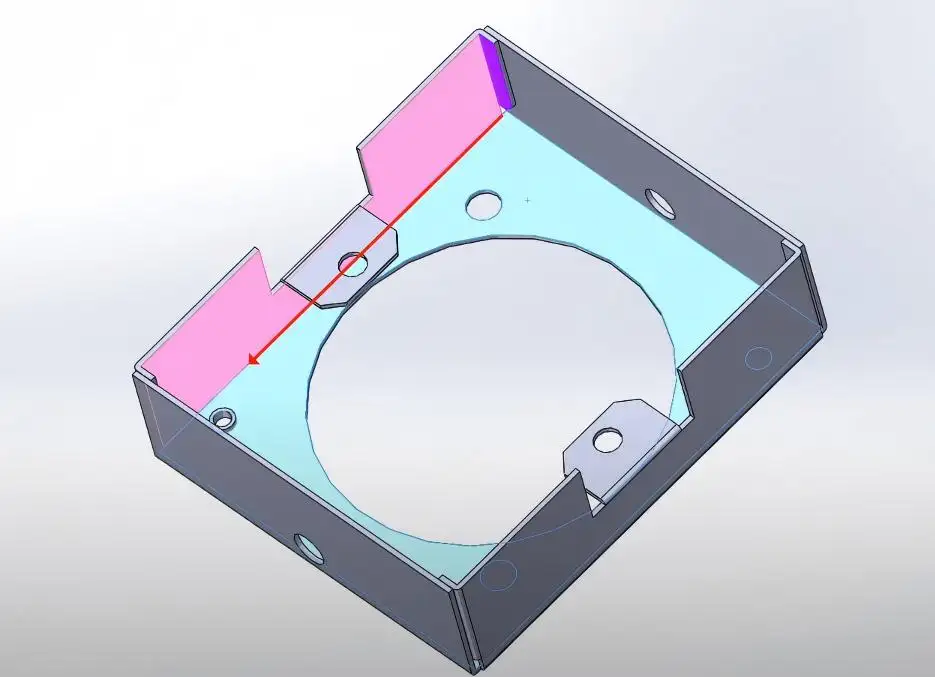
Most of the time in the sheet metal bending process, the occurrence of interference in smaller flanges and tabs can impact the workpiece quality. This increases defects, rework, lowers production efficiency, and increases costs.
For on-site solutions, this interference issue can be resolved by selecting and changing the bending tool to a different tool profile, which can help achieve the desired bending process.
Small tabs of bent components can show interference, which is illustrated in the below picture.
Q2: How Do You Prevent Press Brake Interference?
From the structure of the workpiece, different profiles of bending tools can be selected. You can also contact JS Ragos. Our team can review your part drawing and suggest a bending profile.
Q3: Can Gooseneck Punches Eliminate Interference?
Like other tools, Gooseneck punches can help solve bending interference problems, however, they also have their limitations. There is no tool profile that is a solution for all bending problems.
Q4: What Is the Optimal Bending Sequence for Complicated Sheet Metal Parts?
Looking at the evolution of press brake technology, we can see the development from NC press brakes to CNC press Brakes. The most advanced modern CNC press Brakes have the capability of 2D and 3D simulation, and the corresponding software for planning and programming is also available.
When working with a press brake supplier to specify a press brake, you must check to see if these functions are available. This allows the CNC controller to generate an optimized bending sequence automatically for each import of a 2D or 3D DXF or STEP file.
Q5: When Is Custom Tooling Necessary?
As shown in the figure, when a small gooseneck punch does not provide the necessary clearance, a larger gooseneck punch should be used to achieve the necessary clearance.