

10mm Sheet CNC Press Brake: Capacity Planning and Tooling Notes
A CNC press brake can safely bend 10mm sheet metal provided you accurately match the required machine tonnage to the material's tensile strength and bend length while ensuring the tooling is rated for high-pressure loads. Successfully processing 10mm plate is not just about raw power; it is about the intersection of machine capacity, V-die selection, and structural bending reliability. When these factors are aligned, a CNC press brake provides the precision and repeatability needed for heavy-duty industrial fabrication.
Can a CNC Press Brake Bend 10mm Sheet?
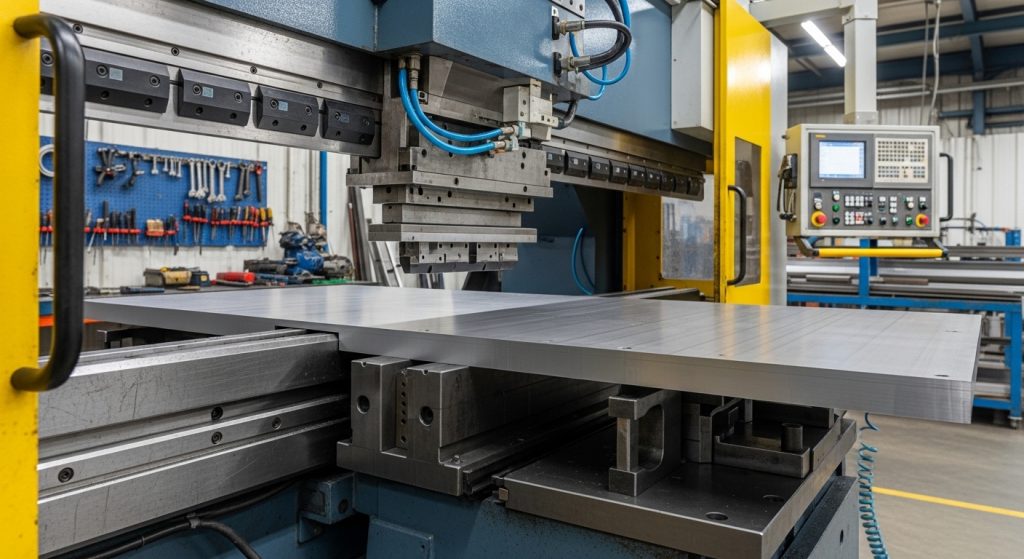
The short answer is yes, CNC press brakes are specifically engineered to handle 10mm sheet, which is often considered the entry point into heavy plate fabrication. However, the success of the operation depends on the machine's bending limits and the operator's understanding of physics. Unlike thinner gauges where you have a wide margin for error, 10mm plate demands a power requirement comparison between your machine’s maximum capacity and the actual resistance of the metal.
Operating at these thicknesses requires a focus on bending reliability. If a machine is pushed to its absolute limit for long durations, the long-term performance and structural integrity of the frame can be compromised. Therefore, professional shops typically look for a machine that offers at least 20% more tonnage than the theoretical minimum required for the job. This safety buffer ensures the hydraulics and mechanical components operate within a sustainable range, preventing premature wear.
How Much Tonnage Does a CNC Press Brake Need for 10mm Sheet?
Calculating the tonnage for 10mm sheet requires looking at the material thickness, the length of the bend, and the width of the V-die opening. For standard mild steel with a tensile strength of approximately 450 MPa, bending 10mm material over a recommended 80mm V-die typically requires about 80 to 100 tons of force per meter. If you are bending a 3-meter sheet, you are looking at a requirement of nearly 300 tons.
Real production tonnage ranges must also account for material strength impacts. If you switch from mild steel to high-tensile alloys, the power requirement comparison changes drastically, often doubling the necessary force. Maintaining long-term performance means choosing a machine that doesn't just "hit" the tonnage but manages it with stability. Under-calculating tonnage leads to "ram drift" or inconsistent angles, which ruins the accuracy of the CNC system's calculations.
How Does Bend Length Affect CNC Press Brake Capacity for 10mm Sheet?
The concept of "tonnage per meter" is the most critical factor when scaling up to longer sheets. A machine rated for 200 tons might easily bend a short 10mm bracket, but it will fail or stall if you attempt to bend a 10mm plate that spans the full 4-meter length of the bed. As the bend length increases, the load scaling is linear; every additional millimeter of material adds to the total resistance the hydraulic system must overcome.
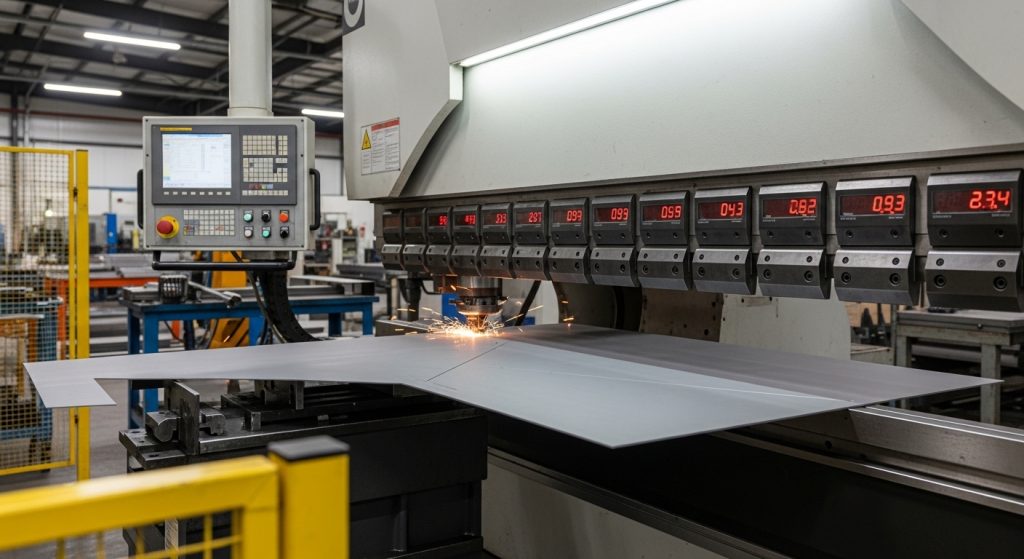
Load distribution also plays a vital role in bending reliability. Bending a heavy 10mm sheet in the center of the machine creates different stress patterns on the frame than bending off-center. Proper setup logistics involve centering the workpiece to ensure the cylinders exert equal pressure, preventing the "bowing" effect in the finished part. For long-length 10mm jobs, machines with integrated crowning systems are essential to compensate for the natural deflection of the bed under such high loads.
What Tooling Is Best for 10mm Sheet CNC Press Brake Bending?
Tooling selection for 10mm sheet is governed by the "8x Rule," which suggests the V-die opening should be at least eight times the material thickness. For 10mm plate, an 80mm V-die is standard, though a 100mm die may be used to reduce the required tonnage and minimize marking. Using a V-die that is too narrow will exponentially increase the pressure required, potentially cracking the die or damaging the machine's punch.
Punch selection is equally important for tool life vs load relationships. Heavy-duty, large-radius punches are preferred for 10mm sheet to distribute the load across a wider surface area of the metal, which helps prevent material fracturing at the bend line. In terms of setup logistics, operators must ensure that the tools are properly seated and rated for the specific tonnage. Investing in high-quality, hardened tooling is a prerequisite for long-term performance in heavy plate environments, as cheaper tools will quickly deform under 100+ ton pressures.
How Does Material Type Change 10mm Sheet CNC Press Brake Force?
The material "recipe" significantly alters how a CNC press brake behaves. While mild steel is the baseline, 10mm stainless steel is a different beast entirely. Stainless steel work-hardens and possesses higher tensile strength, generally requiring 50% to 60% more tonnage than mild steel for the same thickness. This creates a stark power requirement comparison where a machine perfectly suited for mild steel might be dangerously underpowered for stainless.
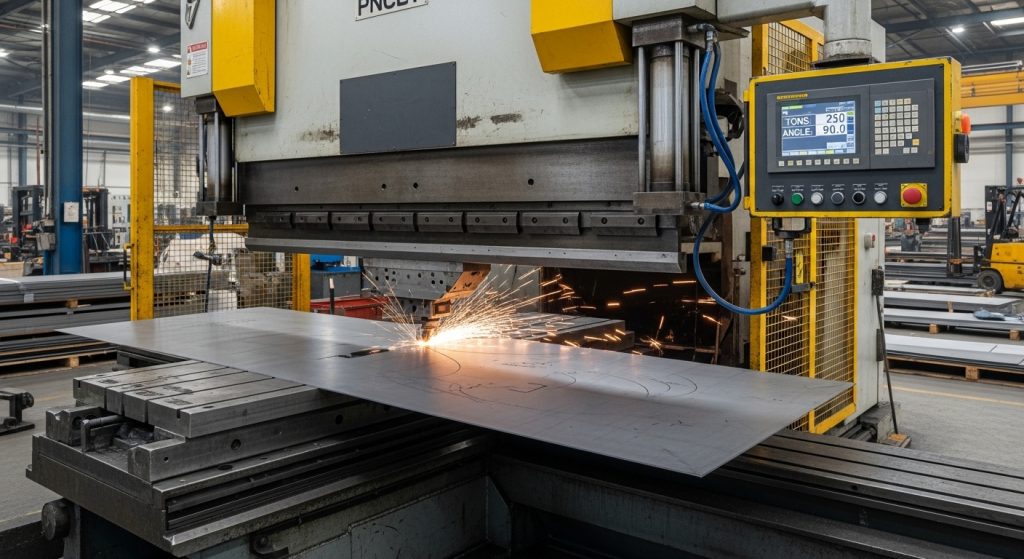
High-strength steels, such as Hardox or other wear-resistant plates, require even more specialized planning to maintain bending reliability. Conversely, 10mm aluminum requires less tonnage but presents challenges with "springback" and cracking. The CNC controller must be programmed with the specific material constants to ensure the depth of the punch is adjusted correctly. Without these adjustments, the machine might over-travel or under-bend, leading to wasted material and increased production costs.
Which CNC Press Brake Machines Are Best for 10mm Sheet Jobs?
When selecting a machine for consistent 10mm work, frame strength is the most important hardware consideration. Hydraulic press brakes are the industry standard for this thickness because they provide consistent high-pressure force throughout the entire stroke. While electric press brakes are gaining ground due to their precision and speed, they often face application limits when reaching the high tonnage required for thick, long-length 10mm plates.
The production duty cycle also dictates the choice. If your shop is running 10mm plate all day, a heavy-duty hydraulic system with a robust cooling unit is necessary to maintain long-term performance. The machine’s "throat depth" and "open height" must also be large enough to accommodate the large V-dies and the flange lengths typical of 10mm parts. Bending reliability in this sector is usually found in machines with "O-frame" or reinforced "C-frame" designs that minimize deflection.
Common Mistakes When Planning 10mm Sheet CNC Press Brake Jobs
The most frequent error in heavy plate bending is selecting an undersized machine. Many shops attempt to bend 10mm sheet on a 100-ton machine over a short length, only to find the machine's structural limits are pushed too far, leading to frame fatigue. Another mistake is ignoring the setup logistics of the bend length; failing to account for how tonnage requirements scale as the sheet gets longer often leads to stalled rams or blown hydraulic seals.
Using the wrong tooling is another common pitfall. Attempting to use a small V-die to achieve a "tight" radius on 10mm plate will result in massive pressure spikes. Finally, many planners forget to include a safety margin in their calculations. A power requirement comparison should always be based on the "worst-case" material thickness and strength (since 10mm plate can vary slightly in actual thickness). Without this margin, you risk inconsistent angles and potential equipment failure.
Pre-Job Checks Before Running 10mm Sheet CNC Press Brake Bending
Before initiating a 10mm bend, a systematic material verification is mandatory. Use calipers to check the actual thickness of the sheet and confirm the material grade. Following this, perform a tooling check: ensure the V-die and punch are clean, undamaged, and correctly rated for the tonnage the CNC controller is forecasting.
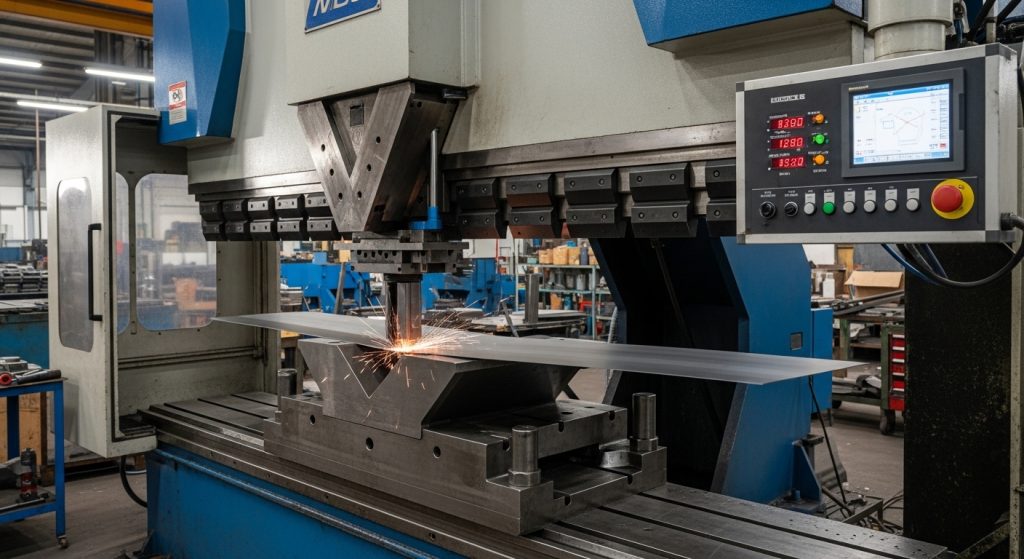
The following checklist should be followed for every heavy plate job:
- Machine Tonnage Check: Confirm the calculated load is within 80% of the machine's maximum capacity.
- Load Planning: Center the workpiece or use a multi-cylinder sync check to ensure even pressure.
- Program Validation: Run a "dry cycle" without the material to ensure the backgauge and ram move as expected.
- Safety Zone: Ensure all personnel are clear of the "whip-up" zone, as 10mm sheets can move with significant force during the bend.
Adhering to these steps ensures bending reliability and protects both the operator and the long-term performance of the CNC press brake.
When Should You Use an Electric CNC Press Brake for 10mm Sheet?
You should opt for an electric CNC press brake for 10mm sheet when the parts are relatively short and require extreme precision. Because electric motors provide more immediate feedback than hydraulic systems, they offer superior angle accuracy. However, a power requirement comparison shows that electric models usually max out at lower tonnages. If you are doing small, complex 10mm components, the energy efficiency and speed of an electric machine provide excellent long-term performance.
When Is a 3200mm CNC Press Brake Enough for 10mm Sheet Jobs?
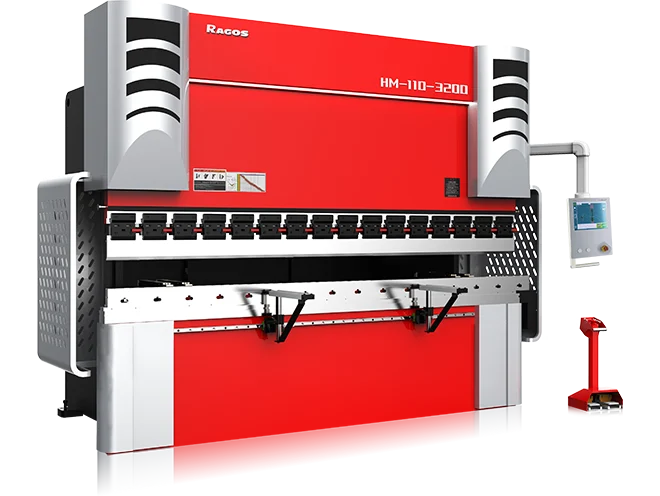
A 3200mm CNC press brake is often the "sweet spot" for general fabrication, providing enough length to handle standard 10-foot sheets of 10mm material. For setup logistics, this size is manageable for most shop floors while providing the stability needed for medium-length heavy bending. If your production rarely exceeds 3 meters in length, this machine size offers the best balance of capacity and investment cost.
When Do You Need a 4000mm CNC Press Brake for 10mm Sheet?
You need a 4000mm CNC press brake when your 10mm sheet jobs involve long structural sections, such as those used in chassis or large tank construction. The extra length allows for better load distribution across the bed, which is vital for maintaining long-term performance during heavy-duty cycles. For these longer spans, the setup logistics become more complex, often requiring sheet followers or crane assistance to handle the heavy material.
Why Stainless Steel 10mm Sheet May Need a 200T CNC Press Brake
Due to its high tensile strength, 10mm stainless steel requires significantly more force to deform than mild steel, which is why you may need a 200T CNC press brake to ensure bending reliability for even moderate lengths. Performing a power requirement comparison, always account for the fact that stainless steel "resists" the bend more aggressively, necessitating a more robust hydraulic system to ensure a clean, accurate angle without straining the frame.
When Do Heavy Plate Jobs Need 600T to 3000T Hydraulic Press Brake Machines?
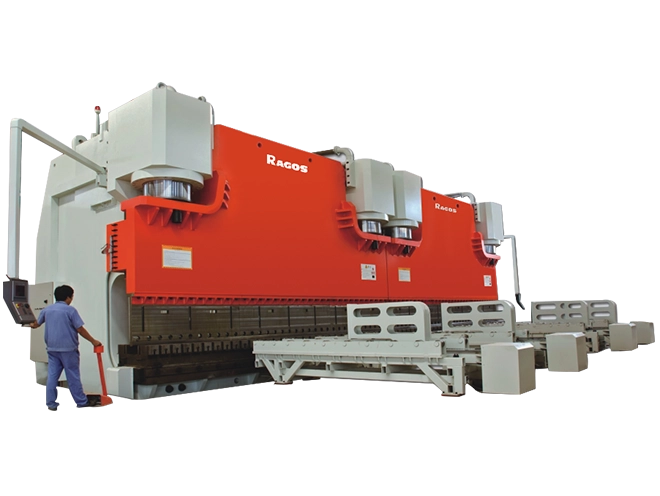
When moving beyond simple 10mm sheets into ultra-thick plates or extremely long bends over 6 meters, you enter the realm of heavy hydraulic press brakes ranging from 600T to 3000T. These machines are built for long-term performance in environments like shipbuilding, wind tower production, and heavy earthmoving equipment. They feature massive hydraulic cylinders and reinforced frames designed to handle thousands of tons of pressure while maintaining CNC precision.
3200mm vs 4000mm CNC Press Brake: Which Is Better for 10mm Sheet?
The choice between a 3200mm vs 4000mm CNC press brake depends on your typical workpiece length and your shop's setup logistics. A 4000mm machine offers more production flexibility, allowing you to bend longer sheets or even set up multiple tool stations side-by-side for staged bending. However, the 3200mm model is often more rigid for its size, which can be an advantage for high-pressure 10mm jobs where minimizing bed deflection is the priority for long-term performance.
Final Thought Successful 10mm bending is a balance of respect for the machine's limits and precise calculation of the material's needs. By matching the right tonnage with the correct V-die and machine length, you ensure a safe, productive, and highly accurate fabrication process.