

4000mm CNC Press Brake: When the Extra Length Pays Off
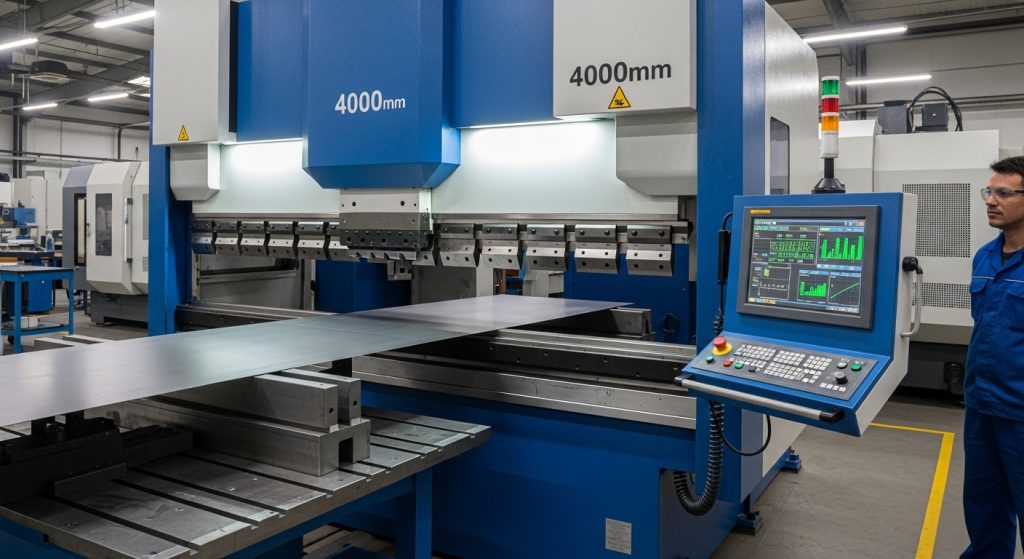
Standard 2500mm or 3200mm beds often reach their physical limits when faced with the modern demand for seamless, large-scale industrial components. A 4000mm CNC press brake exists to eliminate the "repositioning trap"—the costly and inaccurate process of bending long parts in multiple stages. When production involves panels that exceed standard 10-foot lengths, the extra bed span becomes a necessity to manage large sheet unsupported span risk.
Shorter machines often force fabricators into difficult decisions that compromise long edge bend uniformity challenge or result in significant panel sag compensation handling. This guide details how moving to a 4-meter platform provides the extended blank positioning stability required to turn complex, long-format designs into high-precision reality.
You should consider an upgrade when:
- You are bending architectural panels or vehicle skins longer than 3100mm.
- Your current "double-bending" process is creating a 15% or higher scrap rate due to alignment errors.
- Operator fatigue and safety risks are rising due to manual handling of overhanging sheets.
- You need to run multiple tooling setups simultaneously to finish a part in one pass.
Where 4000mm CNC Press Brake Machines Remove Long Panel Forming Risk
Bending a 4-meter sheet on a machine with a shorter bed creates a "forming zone stability envelope" problem. When the material extends far beyond the side frames, the weight of the overhang creates a gravity induced blank curvature drift, leading to inaccurate angles and physical kinks in the metal.
- Long Panel Instability: A 4000mm bed provides a structural load transfer channel that supports the material across its entire length, preventing the ends from "flapping" during the stroke.
- Repositioning Risks: Using a 3200mm machine for a 4000mm part requires two hits. This introduces a multi setup referencing error, where the second bend rarely aligns perfectly with the first.
- Full Span Advantages: With 4 meters of support, you achieve edge wave distortion suppression, ensuring that the flange remains straight from one end to the other without "oil-canning" effects.
Real Factory Scenarios That Force Shops Toward 4000mm CNC Press Brake Length
The decision to invest in a 4-meter machine is usually driven by specific high-value contracts that smaller machines simply cannot execute safely or profitably.
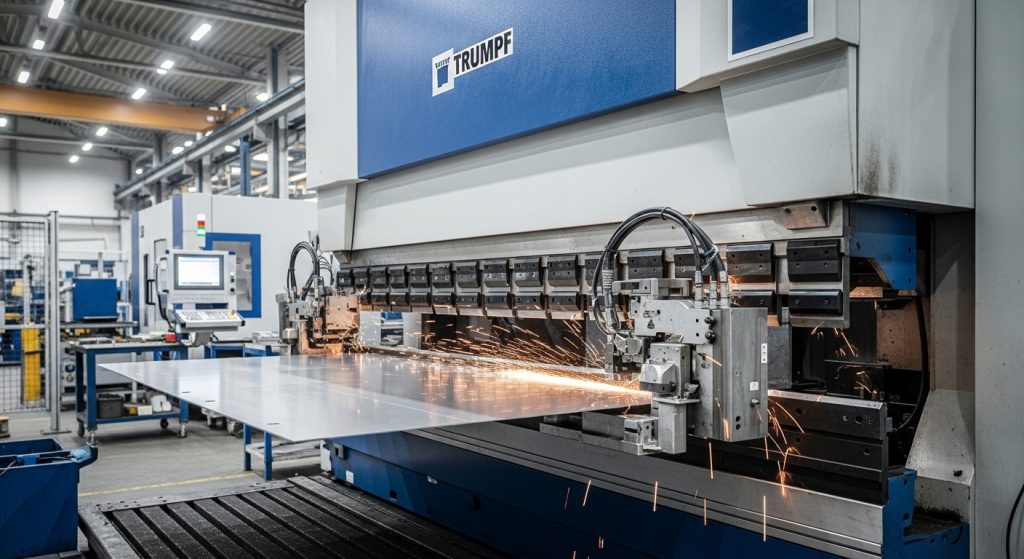
- Vehicle Body Side Skin Forming: Modern bus and trailer manufacturing requires side panels up to 4 meters to minimize seams, which improves aerodynamics and structural integrity.
- Industrial Cabinet Shell Bending: Large-scale electrical control rooms and data center enclosures often utilize 4-meter vertical spans to reduce assembly time.
- Infrastructure Metal Shell Fabrication: Bridge components and lighting poles require a heavy panel assembly integration that only a long bed can provide.
- Large Duct Section Fabrication: High-volume HVAC systems for stadiums or factories use 4000mm sections to minimize the number of joints, reducing air leakage and installation labor.
Running these jobs on a 4000mm machine ensures a long panel forming equilibrium that protects both the material and the operator from the unpredictable behavior of overhanging metal.
The Hidden Cost of Running Long Parts on Shorter Press Brake Beds
Many shops believe they are saving money by sticking with 3200mm machines, but the operational "friction" of handling long parts on short beds creates a significant drain on the bottom line.
| Cost Driver | Short Bed Press Brake | 4000mm CNC Press Brake |
| Reposition Labor | High (2-3 operators needed) | Minimal (1 operator + supports) |
| Bend Accuracy | Variable (bend repeatability deviation) | Stable (ram linear motion stability) |
| Tool Load | Concentrated (tool pressure hotspot) | Evenly Distributed (linear load propagation) |
| Scrap Rate | Higher due to alignment drift | Extremely Low |
Attempting to "cheat" the length of a machine results in an operator reposition time penalty that can double the production time per part. Furthermore, concentrated pressure on a short tooling setup increases the risk of tool pressure hotspot formation, which leads to premature tool failure and uneven wear on the machine's ram.
How Extra Bed Length Changes Real Tonnage Distribution
In a 4000mm machine, the force is not just about the total tons; it is about the distributed deformation pressure field. Engineering a 4-meter bend requires understanding the machine frame stress flow path to avoid "center-peaking" or "canoe" effects in the finished part.
The required tonnage for a 4000mm bend can be estimated using the simplified air bending formula:
$$P = \frac{1.42 \cdot \sigma_b \cdot S^2 \cdot L}{V \cdot 1000}$$
- $P$ = Pressure (Tons)
- $\sigma_b$ = Material Tensile Strength ($N/mm^2$)
- $S$ = Material Thickness ($mm$)
- $L$ = Bending Length ($4000mm$)
- $V$ = V-die opening ($mm$)
- Linear Load Propagation: As $L$ increases to 4000mm, the total pressure $P$ scales linearly, requiring a more robust hydraulic system to maintain ram linear motion stability.
- Full Span Balancing: The CNC must calculate a ram deflection compensation pattern (crowning) that is significantly more aggressive than on a 2-meter machine.
- Frame Stress Flow: The side housings must be spaced far enough apart to allow a long sheet neutral axis control, ensuring the frame doesn't "yaw" under asymmetrical loads.
Tooling Layout Strategies Only Possible on 4000mm CNC Press Brake Machines
The massive 4-meter workspace allows for complex tool interface linear continuity that is impossible on smaller beds.
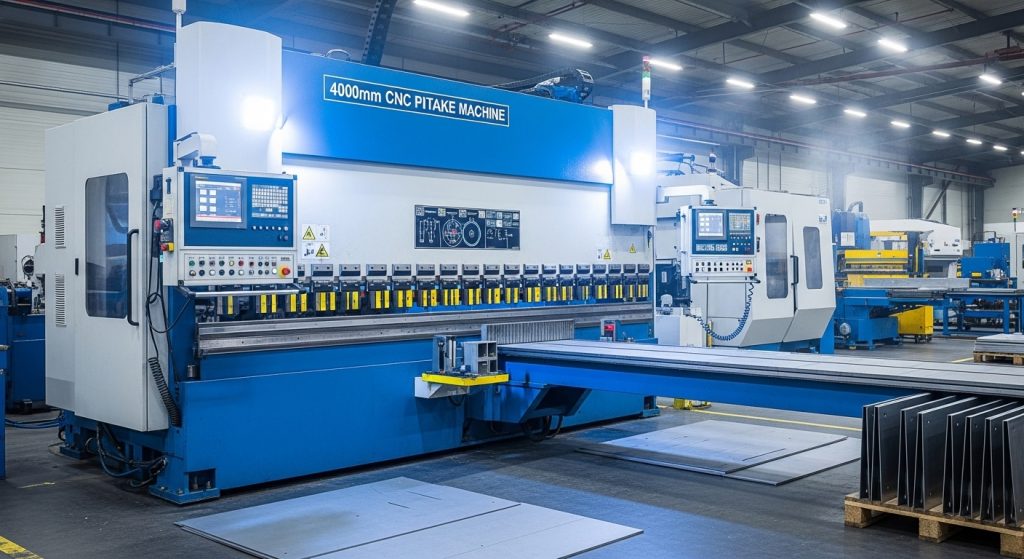
- Multi-Stage Layouts: You can set up a "roughing" die, a "finishing" die, and a "hemming" die all on the same 4000mm bed. This allows the operator to finish a complex part without ever stopping the machine to change tools.
- Long Die Seating Behavior: A 4000mm bed provides a die seating surface uniformity that ensures the tooling remains perfectly flat, even when bending heavy plate.
- Punch Alignment: The clamp load distribution rail on a 4-meter machine is engineered to maintain punch vertical travel tracking, preventing the "stagger" that can happen when multiple tooling segments are butted together over a long distance.
Why Long Panels Lose Geometry Accuracy Without Full Bed Support
When a sheet metal blank sags under its own weight, the "entry angle" into the die changes. This creates a gravity induced blank curvature drift that the CNC controller cannot always compensate for if the material is not fully supported.
- Sag Effect: Without the extended forming bed geometry, the center of the sheet drops, pulling the edges inward and causing an angle consistency loss gradient.
- Springback Shift: In long parts, the springback recovery deviation line is not uniform. The ends of the part often spring back differently than the center due to the lack of lateral support during the hit.
- Forming Repeatability: Achieving full span forming repeat precision requires the material to sit perfectly flat against the backgauges. On a 4000mm machine, multiple backgauge fingers (often 4 to 6) ensure the long edge is perfectly parallel to the bend line.
Production Throughput Gains When Reposition Steps Disappear
The primary ROI of a 4-meter machine is the production takt time compression. By eliminating the need to stop, move, and re-align a part, the flow of the shop changes fundamentally.
Before (3200mm Machine):
- Step 1: Bend left side of 4m panel.
- Step 2: Two operators manually rotate and slide the heavy panel.
- Step 3: Re-align against backgauges (often takes 2-3 minutes).
- Step 4: Bend right side and hope the middle seam aligns.
After (4000mm Machine):
- Single Pass Forming Sequence: Load the 4m sheet once.
- Setup Interruption Elimination: One hit, one perfect part.
- Batch Flow Continuity Index: High; the machine maintains a steady rhythm without the "clutter" of half-finished parts waiting for repositioning.
When a 4000mm CNC Press Brake Is the Wrong Financial Choice
Despite the benefits, the 4-meter platform is not for every shop. You must evaluate your facility spatial allocation constraint and job mix.
- Low Volume Operations: If your "long part" contracts only appear once a month, the machine idle utilization exposure may not justify the higher capital cost.
- Short Part Production: If 95% of your work is under 2 meters, a 4000mm machine is inefficient. The larger ram is slower to cycle and consumes more power per stroke.
- Space Restrictions: A 4000mm machine often requires a specialized foundation and significantly more floor space for material handling, increasing the capital recovery delay risk window.
How to Calculate ROI Before Buying a 4000mm CNC Press Brake
To justify the investment, use a labor handling reduction coefficient. If a 4-meter part takes 15 minutes on a short bed (with 2 people) and 4 minutes on a long bed (with 1 person), the savings are massive.
- Output Gain: Calculate the output per shift expansion multiplier. Most shops see a 30-40% increase in throughput for long parts.
- Labor Savings: Estimate the reduction in man-hours. Moving from a "two-man lift" to a "one-man slide" significantly cuts costs.
- Job Expansion: Use large part contract acquisition leverage to bid on infrastructure or transport jobs that were previously "no-quote" items.
Example: If a 4000mm machine saves $15 in labor/scrap per panel and you run 20 panels a day, the $7,200 annual saving is just the beginning; the real value is the $200k+ in new contracts you can now fulfill.
When Up Acting Press Brakes Improve Large Part Handling
For extremely large or heavy parts, an up acting press brake can be a game-changer. Because the lower beam moves upward, gravity actually helps keep the sheet flat against the die, reducing the need for complex sheet followers. This configuration is often preferred in 4-meter and longer applications where operator safety and material positioning are the top priorities.
When 3200mm CNC Press Brake Is Still the Smarter Choice
If your facility is tight on space or your production focuses on the 8-to-10-foot range, a 3200mm CNC press brake remains the most versatile "all-rounder." It offers a faster cycle speed for shorter parts while still providing enough length for standard industrial sheets, making it the better choice for shops with a high-mix, low-volume profile.
When Stainless Steel Long Parts Require Higher Forming Force Focus
Bending 4 meters of stainless steel requires a massive increase in tonnage due to the material's high tensile strength. In these cases, a 200T CNC press brake is often the minimum requirement to ensure the machine doesn't stall mid-bend. Accurate tonnage calculation is vital here to prevent the frame deflection from exceeding the crowning system's ability to compensate.
When Heavy Plate Fabrication Requires 600T–3000T Machines
When your 4-meter parts move from "sheets" to "plates" (12mm and above), you move into the territory of heavy hydraulic press brakes. These 600T to 3000T giants are built with massive throat depths and reinforced frames to handle the extreme stresses of shipbuilding, crane manufacturing, and heavy infrastructure.
3200mm vs 4000mm CNC Press Brake: The Upgrade Breakpoint
Choosing the right length is a balance of current needs and future-proofing. Our 3200mm vs 4000mm comparison breaks down the specific technical differences in backgauge travel, frame rigidity, and transport logistics to help you decide