

高精度金属ベンダー: 厳密な公差に適した機械を選ぶ方法
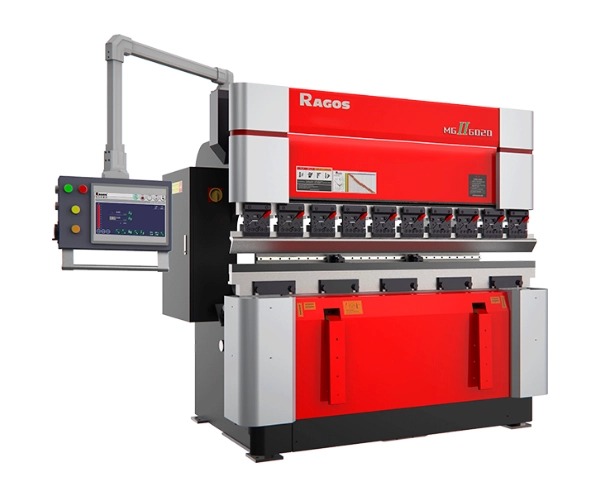
Ahigh precision metal bender produces consistent, repeatable bend angles within tolerances that standard bending equipment cannot reliably hold — typically ±0.1° or better on angle and ±0.01mm to ±0.03mm on ram positioning. For sheet metal fabricators producing electronics enclosures, 医療機器ハウジング, automotive interior panels, or architectural curtain wall components, that level of accuracy is not optional. It is the threshold below which parts fail assembly or reject at inspection.
This guide defines what genuine precision means in metal bending, which machine technologies achieve it, and how to match the right machine to your production requirements.
What Does "高精度" Actually Mean in Metal Bending?
Precision in metal bending has two distinct dimensions — positional accuracy そしてangular repeatability — and most buyers only ask about one.
位置精度 refers to how precisely the ram reaches its programmed depth on every cycle. A machine rated at ±0.01mm positional accuracy means the ram stops within 0.01mm of its target on every stroke. This determines how consistently the machine produces the same bend depth, which directly controls the formed part geometry.
Angular repeatability refers to how consistently the machine produces the same included angle across a batch of identical parts. A machine achieving ±0.1° angular repeatability means every part in a 500-part batch bends to within 0.1° of the programmed angle — before any springback compensation.
These two numbers are related but separate. A machine with excellent positional accuracy can still produce inconsistent angles if it lacks springback compensation — because thick or high-tensile materials return partially toward flat after the bending force releases. A genuine high precision metal bender addresses both dimensions: tight mechanical accuracy and automatic springback correction based on real material data.
The Four Technologies That Define a High Precision Metal Bender
1. Full Electric Servo Drive
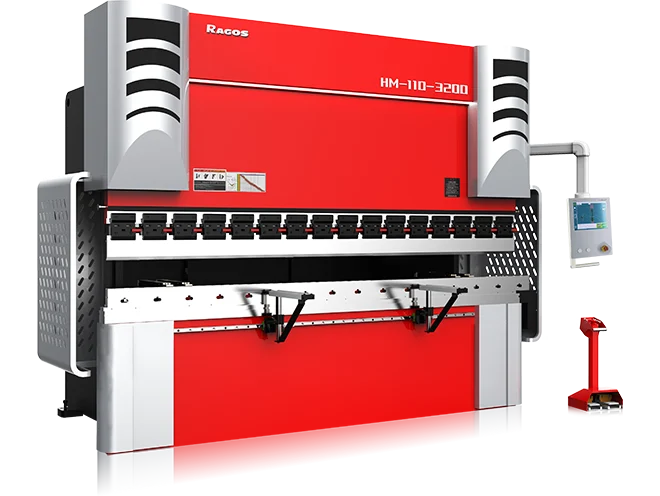
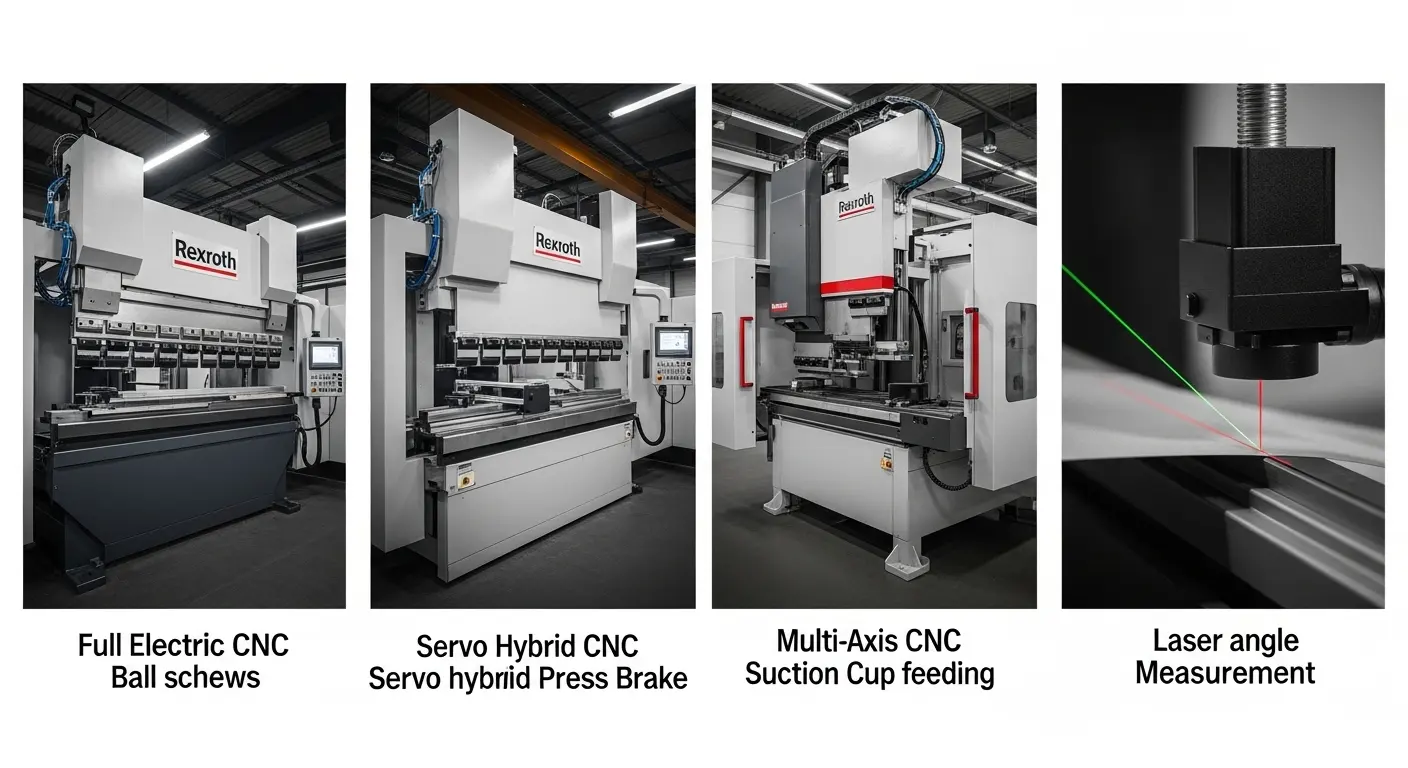
Full electric CNC press brakes use servo motors and precision ball screws to drive the ram, eliminating hydraulic variability from the positioning loop entirely. The result is positional accuracy up to ±0.001mm — the highest available in current commercial press brake technology. No warm-up drift, no hydraulic temperature effect on viscosity and response, no mechanical play in the pump-to-cylinder circuit.
Full electric systems are the best choice for thin-gauge precision work — stainless steel from 0.3mm to 3mm, アルミニウム合金, 銅, and titanium sheet. The current tonnage limit is around 100T, which makes full electric metal benders appropriate for parts in the light-to-medium gauge range. 100Tを超えるもの, the servo hybrid architecture delivers the next-best accuracy level.
2. Servo Hybrid Hydraulic Drive
A servo hybrid system uses a servo motor to drive the hydraulic pump on demand, combining hydraulic force capability with closed-loop servo positioning precision. The typical positional accuracy on a quality servo hybrid machine is ±0.005mm — significantly tighter than a conventional hydraulic machine's ±0.01mm, and sufficient for most precision production applications in the 80T–600T range.
The closed-loop feedback from a magnetic or optical grating ruler is what separates a genuine servo hybrid high precision metal bender from a standard hydraulic machine with a servo motor label. Confirm the grating ruler resolution and brand before purchasing — this single specification reveals whether the precision claim is engineering-backed or marketing language.
3. Multi-Axis CNC Panel Bender
For complex multi-step bending — multiple angles, multiple directions, multiple fold sequences on a single sheet — a panel bender delivers precision across the full forming sequence that a press brake operator-repositioning cycle cannot reliably match.
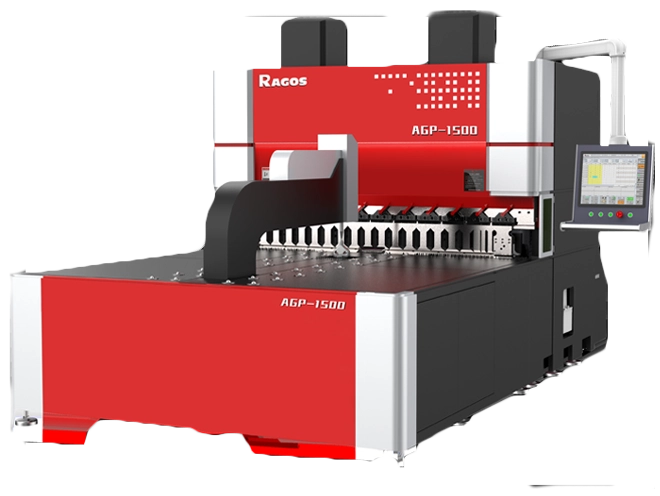
A panel bender clamps the sheet with pneumatic sheet-holders that maintain accurate positioning through the entire program without the operator needing to reposition the material between bends. The JS RAGOS panel bender series runs in 13-, 15-, および18軸構成, with bending beam positioning accuracy of ±0.03mm across all axes and a Delem DA-66T controller that supports offline 3D bending simulation.
For applications including kitchen cabinet doors, electrical enclosure sides, server rack panels, and office furniture components, ザJS RAGOS panel bender machine produces complex formed profiles at consistent precision levels that manual repositioning on a press brake cannot match at speed.
4. Laser and Camera Angle Measurement Systems
The most important precision enabler in any high precision metal bender — press brake or panel bender — is a real-time angle measurement system. Without one, the machine programs an angle and assumes the part achieves it. With one, the machine measures the actual angle in real time and adjusts.
Three measurement technologies are currently in use:
- Laser-based systems (データ-M, ビジョンコンポーネント): Project a laser line onto the sheet surface during bending; a camera reads the reflection angle in real time. Accuracy typically exceeds ±0.1°. Requires no contact with the part, making it suitable for delicate thin-gauge materials.
- Camera-based tactile systems: Cameras observe tooling geometry and calculate part angle from the geometric relationship between punch tip and die opening. Fast and reliable for standard V-bending applications.
- Tactile probing: A physical probe touches the formed part and measures the angle. Highly accurate but slower — better suited for sampling than in-cycle measurement.
JS RAGOS press brakes above 100T use the Laser Check angle measurement system (developed in partnership with Data-M and Vision Components), providing in-cycle springback compensation to ±0.1° without manual intervention.
High Precision Metal Bender Applications by Industry
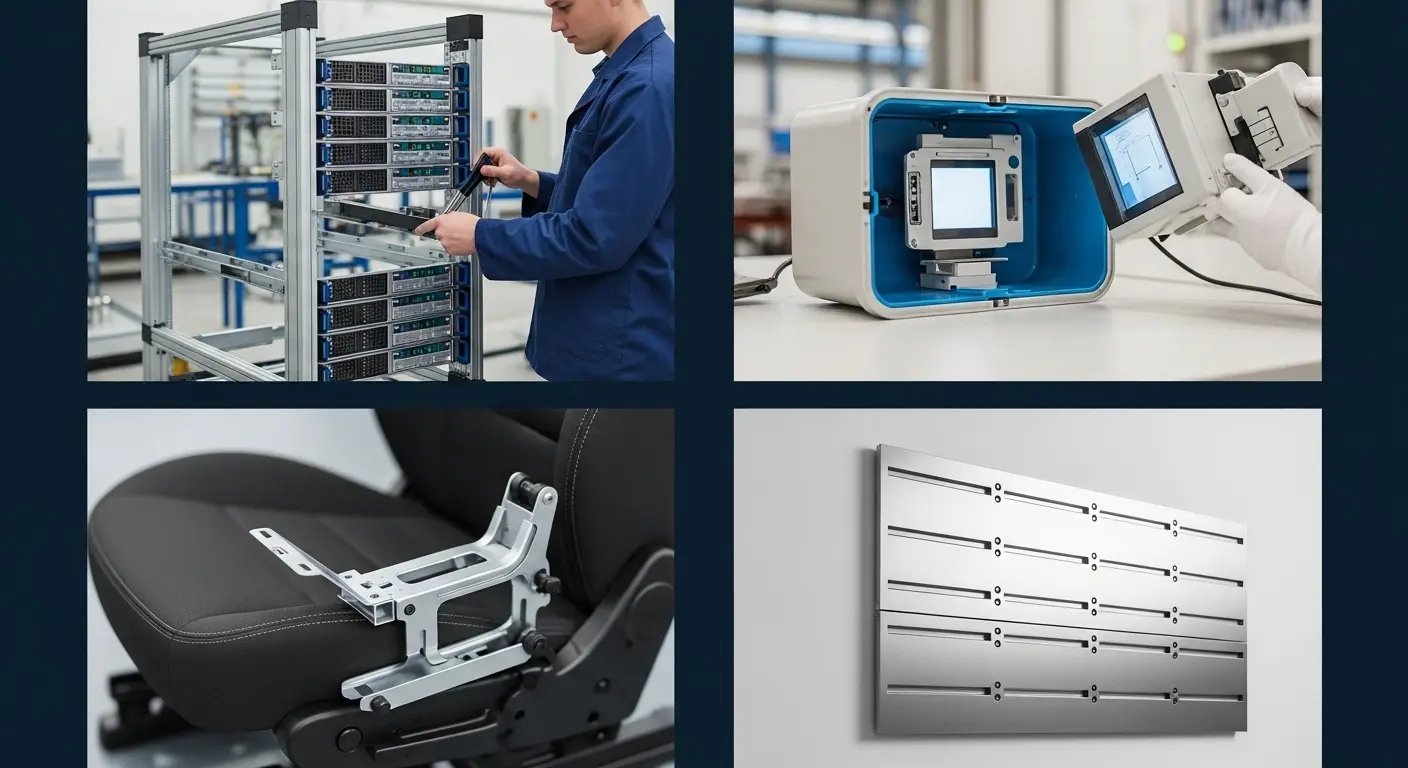
Not every fabrication shop requires the same precision specification. The industries where high precision metal bender capability is non-negotiable:
Electronics and server enclosure manufacturing. Rack units, server chassis, and switch gear enclosures require bend tolerances of ±0.1° or tighter for panel alignment across multi-part assemblies. A 0.3° error on a single panel in a 42U rack can prevent proper rack mounting of every unit above it.
医療機器製造. Clean-room compatible sheet metal housings, surgical equipment enclosures, and imaging device frames often carry dimensional tolerances in the ±0.05mm range — levels achievable only with full electric or high-spec servo hybrid machines with angle measurement systems.
Automotive interior and structural components. Seat track brackets, door panel frames, and dashboard support structures require angular repeatability across production batches of thousands of parts. Precision metal benders with servo feedback and offline programming eliminate batch-to-batch angle drift.
Architectural and curtain wall panel fabrication. Aluminum and stainless cladding panels for building facades require consistent bend angles across panels that run up to 6,000mm in length — making automatic crowning and grating ruler position feedback essential, not optional.
Precision instrument manufacturing. Control panels, measurement instrument housings, and laboratory equipment enclosures involve multi-step profiles with multiple bend lines per part. Consistent multi-axis positioning is the only production path for these applications at commercial volume.
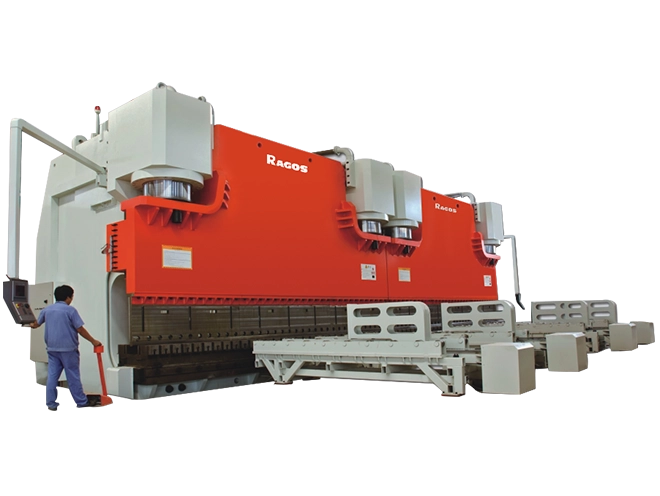
For buyers in the 100-ton class needing precision structural steel bending, ザJS RAGOS 100-ton CNC press brake for steel plate work covers tonnage, コントローラーの選択肢, and angle measurement availability for mid-range precision production. For the 300-ton class for heavy-gauge precision work, ザJS RAGOS 300-ton CNC press brake covers frame specification, 戴冠, and DSVP options.
What Specifications Actually Determine High Precision in a Metal Bender?
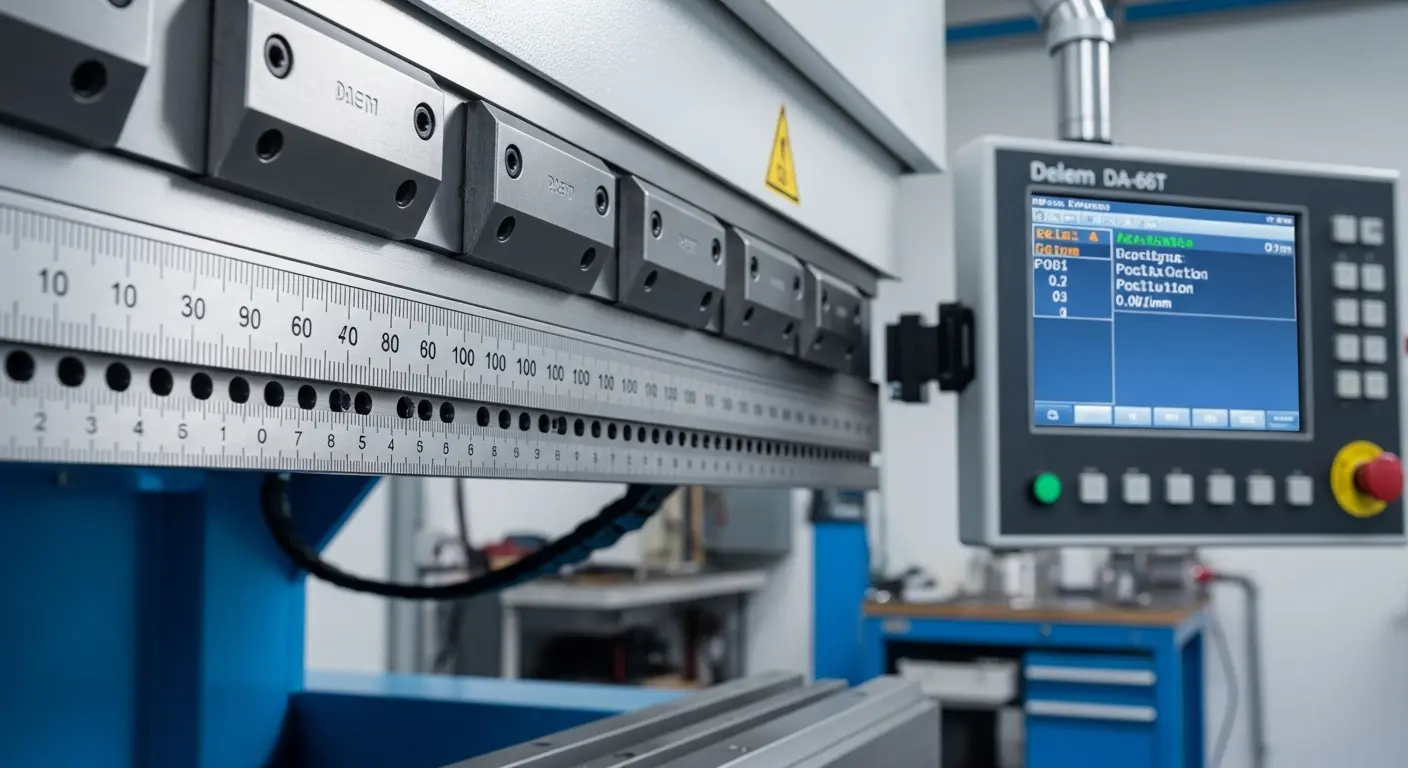
Precision is not a feature — it is the sum of several interconnected specifications. 評価する際にはhigh precision metal bender, check these specific points rather than accepting general "高精度" marketing claims:
Ram positioning resolution. The minimum increment the control system can command the ram to move. Resolution of 0.001mm means the system can command movement in 0.001mm steps — essential for tight depth control. Ask for the grating ruler brand, model, and resolution as a specific document, not a spec sheet category.
Backgauge positioning accuracy. The backgauge positions the sheet against a mechanical stop before each bend. Accuracy of ±0.02mm or better is the precision benchmark. Lower accuracy here produces inconsistent flange lengths, which accumulates into dimensional error across multi-bend parts.
Parallelism between ram and bed. Even with accurate depth control, a ram that is not precisely parallel to the bed produces different angles at each end of the same plate. This is controlled by the synchronization system — hydraulic cylinders synchronized by an electrohydraulic proportional valve system, or dual servo motors on full electric machines. Ask specifically how the manufacturer controls and verifies ram-bed parallelism at full tonnage load.
Offline programming software compatibility. High precision production at commercial volume requires offline part programming — creating and testing bending programs without tying up machine time. デレム DA-66T, DA-69T, and ESA S630 controllers support full offline programming with 3D bending simulation. Systems without offline programming capability require on-machine program development, which reduces available production time and introduces operator variation.
Tooling quality. The punch tip radius, die opening tolerance, and surface hardness directly limit the precision achievable regardless of machine accuracy. Hardened and precision-ground tooling — 42CrMo steel, hardness 50–60 HRC, ground to ±0.01mm — holds shape across long production runs. Soft or unground tooling deforms under sustained use and progressively degrades part accuracy.
Panel Benders for High Precision Multi-Step Profiles
A CNC press brake excels at single-axis bending with precise depth control. A panel bender excels at multi-step, multi-direction bending on the same sheet without repositioning — which is where the precision advantage of a panel bender becomes most apparent in real production.
Every time an operator repositions a sheet on a press brake for the next bend step, a small positioning error enters the process. On a two-bend part, this error is manageable. On a part requiring six to twelve bend steps — a server panel, a cabinet door with returns, or an electrical enclosure lid — the accumulated positioning error grows with each repositioning.
A panel bender eliminates this problem. The sheet stays clamped throughout the entire forming sequence. Every bend step runs from a fixed, known sheet position, so errors do not accumulate across the program.
The JS RAGOS 18-axis panel bender supports both up-folds and down-folds within a single program cycle, automatic tool change, and suction-cup CNC automatic feeding — reducing manual handling to zero on standard panel formats. ザpanel bender with suction cup CNC automatic feeding covers how the automated feeding system works for high-volume precision panel production without operator intervention at the machine.
For a broader overview of panel bender capabilities, アプリケーション, and configuration options, ザJS RAGOS panel bender overview page covers all configurations from 13-axis to 18-axis with bending capacity, material compatibility, and controller options in detail.
Choosing the Right High Precision Metal Bender for Your Production
The right machine depends on your material range, part complexity, 生産量, and precision requirement. Here is a practical matching guide:
| Production Profile | Recommended Machine | Precision Level |
|---|---|---|
| Thin-gauge precision (<3ミリメートル, stainless/aluminum) | Full electric CNC press brake | ±0.001mm positioning |
| Mixed gauge production (1–6mm, 高ボリューム) | Servo hybrid CNC press brake | ±0.005mm positioning |
| Multi-step complex profiles (キャビネット, パネル, エンクロージャ) | CNC panel bender (13–18 axis) | ±0.03mm, no repositioning error |
| Heavy-gauge structural precision (6–20mm) | Servo hybrid with angle measurement | ±0.1° angular, auto-corrected |
| All of the above across shifts | Full electric + panel bender combination | Each machine at its precision ceiling |
For buyers evaluating available machine options and wanting to compare models, 構成, and pricing, ザbest CNC press brake machine buying guide covers the full JS RAGOS lineup from standard hydraulic to servo hybrid and full electric configurations. Buyers also evaluating sheet metal press brakes for sale with specific precision specs can explore the sheet metal CNC press brake for sale range for available configurations.
For buyers needing a 100-ton class machine with precision CNC bending capability — a common first step up from basic hydraulic systems — the JS RAGOS 100-ton CNC press brake covers controller options, 軸数, and angular measurement compatibility for that tonnage class.
Frequently Asked Questions About High Precision Metal Benders
What is a high precision metal bender?
A high precision metal bender is a CNC press brake or panel bender engineered to produce consistent, repeatable bend angles within tight tolerances — typically ±0.1° on angle and ±0.001mm to ±0.03mm on ram position. Precision at this level requires a servo or servo hybrid drive system, a high-resolution grating ruler for position feedback, a high-quality controller with closed-loop correction, and optionally a real-time angle measurement system that compensates for material springback automatically.
What is the most precise type of metal bender currently available?
A full electric CNC press brake with dual ball screw servo drives and an optical grating ruler achieves the highest positional accuracy currently available — up to ±0.001mm. For applications requiring precise multi-step bending without repositioning error, a CNC panel bender with pneumatic sheet-holding clamps and automatic feeding achieves the best combination of angular accuracy and multi-step consistency.
How much does a high precision metal bender cost?
Entry-level servo hybrid CNC press brakes with precision grating rulers start around $30,000–$45,000. Full electric CNC press brakes in the 40T–100T range typically price between $45,000–$90,000 at factory-direct pricing. High-end multi-axis panel benders start around $90,000–$150,000+ depending on axis count, automation features, and feeding system. The precision premium over a basic hydraulic machine is typically 30–60%.
What is springback and how does a precision metal bender compensate for it?
Springback is the partial return of a bent part toward its original flat position after the bending force releases, caused by the elastic recovery of the material. Thick and high-tensile materials spring back more than thin, soft sheet. A high precision metal bender compensates for springback by over-bending — bending past the target angle by a calculated amount so the part springs back to exactly the target. Advanced systems use real-time laser angle measurement to calculate and apply the correct springback compensation automatically, without operator calculation or trial bending.
Can a high precision metal bender maintain accuracy over long production runs?
Yes — provided the machine uses hardened and precision-ground tooling, maintains stable hydraulic oil temperature (critical for hydraulic systems), and runs real-time angle feedback for springback correction. Tooling wear is the most common long-run accuracy degradation source. Precision-grade 42CrMo tooling, hardened to 50–60 HRC, maintains dimensional accuracy across significantly longer production runs than standard tooling. Regular tooling inspection intervals should be part of any precision production quality plan.