

Why S-Curve Motion Control Matters in Servo Electric Press Brakes
By Author: Mark Hanks
In considering servo electric press brakes, buyers often evaluate machines based on rapid approach speed and return stroke speed. Often customers overlook other characteristics of a machine. Two machines that share the same maximum stroke speed can behave differently during operation. One machine could start and stop smoothly while the other exhibits vibration during a direction reversal.
These differences may result from motion profile planning, mechanical design, servo tuning, or load conditions. Maximum speed tells only part of the story.
S-curve motion planning determines how velocity increases and decreases during machine operation. By limiting jerk—the rate of change of acceleration—it generates an S-curve motion profile that provides smoother motion commands during ram startup, deceleration, and stopping. In servo electric press brakes driven by servo motors and ball screws, this helps reduce dynamic shock to the mechanical transmission system caused by abrupt motion commands.
What Changes When the Ram Accelerates?
As the ram speeds up from rest to the rapid approach phase, the motor has to generate enough torque to accelerate the ram. When the ram moves from rapid approach to bending speed, the motor has to decelerate to the desired speed according to the commanded motion profile. The torque generated by the motor acts upon the drive system and the ram.
Three motion parameters must be distinguished:
| Term | Definition | What It Describes |
| Velocity | Rate of change of position with respect to time | How quickly the ram moves |
| Acceleration | Rate of change of velocity with respect to time | How quickly ram velocity changes |
| Jerk | Rate of change of acceleration with respect to time | How abruptly acceleration changes |
Even when ram velocity remains continuous, acceleration can change abruptly. In a mechanical system with inertia and elasticity, such changes may excite structural vibration, making it difficult for the actual motion to follow the commanded trajectory immediately.
Therefore, evaluating motion smoothness requires examining not only velocity but also how acceleration is applied and removed.
Trapezoidal and S-Curve Motion Profiles
A trapezoidal velocity profile has phases of acceleration, constant or uniform velocity and deceleration. For the acceleration phase, a constant acceleration model is used. Acceleration becomes zero when the desired velocity is reached; deceleration begins later, as required by the remaining travel distance.
An ideal trapezoidal velocity profile has discontinuities in acceleration at the transitions between the phases. A real machine cannot instantly respond to changes and the resulting motion is influenced by servo response and mechanical compliance.
With S-curve motion planning, we can achieve smooth changes in acceleration in different motion phases. During the initial phase, acceleration starts to rise and eventually flattens. Depending on the available travel distance, acceleration may remain constant briefly before gradually returning to zero as the target velocity is reached. Deceleration uses corresponding smooth transitions.
The resulting velocity profile is smoother, and the mechanical system is subjected to more gradual acceleration and deceleration demands.
However, S-curve motion planning can be implemented in different ways. A common piecewise-constant-jerk profile produces continuous acceleration, but jerk may still change at segment boundaries. Therefore, adopting an S-curve motion profile does not mean that every motion variable is completely continuous or that mechanical vibration is eliminated.
Where S-Curve Planning Fits in a Bending Cycle
A typical bending cycle includes rapid approach, deceleration, bending, any required dwell, unloading, and the return stroke. The exact sequence depends on the machine configuration and programmed bending operation.
S-curve motion planning predominantly influences the dynamic shifts among these stages.
A gradual increase in acceleration can reduce startup shock. The controller must slow the ram down as it reaches the bending stage based upon the remaining travel distance to reach the required speed before the next process stage. Sufficient deceleration distance is also required at the end of the return stroke to stop the ram at its programmed return position.
Short-stroke bending programs require some consideration. If the available travel distance is limited, the ram may have to begin its deceleration prior to reaching the maximum speed as documented in the machine's technical data. In some cases, the velocity profile may contain no constant velocity phase.
Maximum speed alone is not a reliable basis for estimating short-stroke cycle time. Deceleration and acceleration largely influence the total motion and cycle time.
Additionally, motion profiles must be generated to stay within the machine process limits and safety requirements. S-curve planning applies to motion transitions. Safety-related speed limits, protective devices and stopping functions remain the responsibility of the machine’s safety systems.
Why It Matters in a Dual-Drive Electric Press Brake
In a dual-drive servo electric press brake, the left and right sides of the ram are driven by separate servo motors and mechanical transmission systems. Both sides follow coordinated reference trajectories, while keeping the positional deviation between the Y1 and Y2 axes within acceptable limits.
Because of varying levels of friction and assembly conditions, as well as load conditions, between the two sides, even if identical motors and ball screws are used, differences exist between the two sides. This is especially true during aggressive commands, where the control system must track at high rates, amplifying the differences between the two sides.
Instead of making aggressive commands, reference trajectories can be made smoother. A smoother trajectory will ease the dynamic tracking requirement, and help both sides follow the coordinated trajectory.
Actual Y1/Y2 synchronization performance still depends on position feedback, servo parameters, control strategy and mechanical condition.
If one side is experiencing an abnormal guideway condition and/or has unstable position feedback and/or has a mechanical failure in the transmission system, changing the S-curve motion profile will not help resolve the issue.
For more information on how positional deviations between the two axes are calculated and corrected, see How Y1/Y2 Dual-Axis Synchronization Works in a Servo Electric Press Brake.
Does S-Curve Control Improve Cycle Time?
Not necessarily. Motion smoothness and cycle time involve a trade-off.
Under identical velocity and acceleration limits, using smoother acceleration transitions may result in longer acceleration and deceleration times and/or longer travel distances to reach the target velocity.
If only a single no-load stroke is analyzed, an S-curve motion profile will not necessarily provide better performance.
Overly aggressive motion commands may cause overshoot and result in longer settling times. Appropriate tuning may reduce these effects and improve actual cycle time performance.
Whether the total cycle time is reduced must be established through measurement rather than inferred from the type of motion profile.
Total production time also includes backgauge positioning, workpiece repositioning, operator handling, bending dwell time, and program transitions. In high-mix, low-volume production, these operations may account for more time than an individual ram acceleration or deceleration phase.
Machine comparisons should therefore include both ram motion time and total part production time.
What S-Curve Control Can and Cannot Improve
Properly configured S-curve motion planning can reduce dynamic excitation caused by abrupt changes in acceleration, helping improve motion behavior during startup, stopping, and velocity transitions.
Its actual effect depends on ram mass, transmission inertia, mechanical stiffness, servo response, and operating load.
Machine evaluations should therefore focus on measured operating performance rather than treating the presence of S-curve motion control as an independent performance guarantee.
S-curve motion planning does not directly determine:
• The machine's rated bending capacity.
• The final bend angle of the workpiece.
• The permissible Y1/Y2 synchronization error.
• The service life of ball screws or bearings.
• The reduction in total production cycle time.
These outcomes require supporting evidence from mechanical design, closed-loop control performance, process conditions, or physical machine testing.
Component service life, in particular, cannot be assigned a specific extension period simply because the motion profile is smoother.
How to Evaluate Motion Quality During a Machine Demonstration
A machine demonstration using actual production parts provides more useful information than a high-speed no-load demonstration.
Select one short-stroke bending program and another program requiring a relatively large return stroke. Conduct repeated trial bends using the corresponding workpiece materials and tooling.
This shows motion behavior for different travel distances and actual loading conditions.
To best evaluate the demonstration, do the following:
• Startup, deceleration, and return stroke stopping: Determine if there is a pronounced vibration or abnormal impact noise.
• Position settling: Determine if there is an excessive amount of settling time required before the next operation can be performed after the ram has reached its target position.
• Repeated operation: Determine if there is variability in the results of the finished part and/or consistency in the motion of the ram.
• Short-stroke performance: Determine if the program performs as designed and required rather than relying on the results of a demonstration of a long-stroke, no load, operation.
• Load variation: Determine if coupled motion between the left and right sides of the machine is stable with varying loads within the manufacturer’s permitted limits.
Ask the supplier to explain the motion using records of commanded position, actual position, tracking error, and motor current, if the controller supports that function.
Visual inspection can help find abnormalities; however, it is not a substitute for actual measurements.
Acceleration and jerk parameters should be adjusted only by qualified personnel in accordance with the machine's technical documentation.
Parameters taken from another press brake, even one with the same rated bending capacity, may not be suitable for the machine being evaluated.
Questions to Ask the Supplier
When purchasing a servo electric press brake, buyers should go beyond asking whether the machine supports S-curve motion control.
The following questions provide a more useful basis for technical evaluation:
1.Which motion phases use S-curve motion planning or other smoothed motion profiles?
2.Are limits separately set for velocity, acceleration, and jerk?
3.How does the controller replan acceleration and deceleration when the available travel distance is limited?
4.Have the motion parameters been tuned to the ram mass and the mechanical transmission?
5.Can the supplier provide complete cycle-time measurements and repeated-operation records using representative production parts?
6.What controls have been implemented to avoid excessive tracking error and Y1/Y2 synchronization error?
These questions help establish how motion planning is matched to the machine design.
Check the Complete Motion System
Servo-electric press brakes use a variety of techniques for motion control. Only one of these is S-curve motion planning.
It generates the commanded motion trajectory. The servo drives and motors execute the commands, the mechanical transmission moves the ram, and position feedback allows the controller to monitor actual motion against the reference trajectory.
Machine evaluation should consider these elements together with actual workpiece testing.
Smooth operation, suitable cycle times, acceptable finished-part quality, and the ability of service personnel to explain and diagnose machine motion provide a more reliable basis for purchasing decisions.
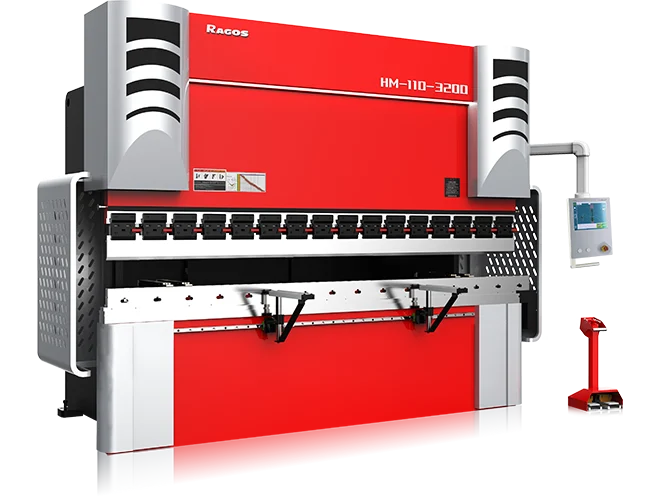
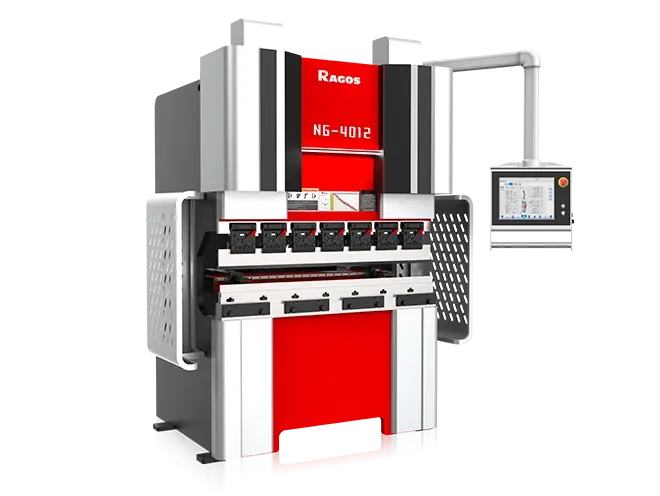
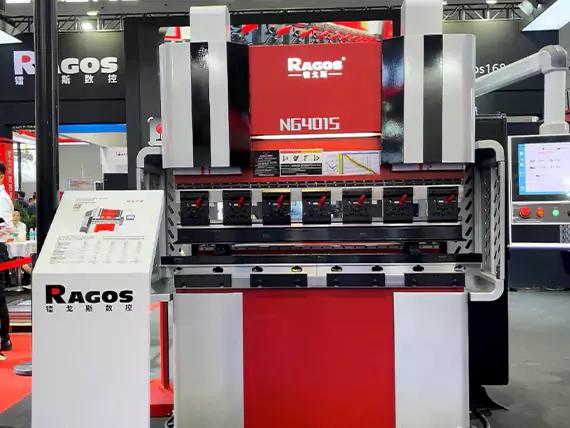
See the JS RAGOS Servo Electric Press Brake for configuration details, and send us your component drawings, material specs, sheet thickness, bending length, and cycle time requirements. These will help define the required ram stroke, drive design and suitable trial-bending parameters.
Frequently Asked Questions
Q1: What Is Jerk in Press Brake Motion Control?
Jerk is the rate of change of acceleration with respect to time. Limiting jerk allows acceleration to increase or decrease gradually, reducing dynamic excitation caused by abrupt acceleration changes.
Q2: Does an S-Curve Always Make a Press Brake Faster?
No. Under identical velocity and acceleration limits, smoother transitions may require additional time or travel distance. Actual cycle time must be measured while accounting for vibration, settling time, workpiece handling, and programmed operations.
Q3: Can S-Curve Planning Eliminate Vibration?
Not necessarily. Motion profiles influence vibration, but mechanical stiffness, connection integrity, operating loads, and servo tuning also affect machine behavior. Abnormal vibration requires investigation to identify its underlying cause.
Q4: Is S-Curve Planning the Same as Servo Control?
No. S-curve motion planning defines the desired motion trajectory for the motor and ram. Servo control adjusts drive output based on motion commands and position feedback to make actual motion track the reference trajectory. The two functions work together.
Q5: Can S-Curve Planning Correct Y1/Y2 Synchronization Errors?
S-S-curve motion planning can reduce the dynamic demands caused by aggressive acceleration and deceleration. However, correcting Y1/Y2 synchronization errors still requires reliable position feedback from both axes, appropriate synchronization control, and proper mechanical condition.