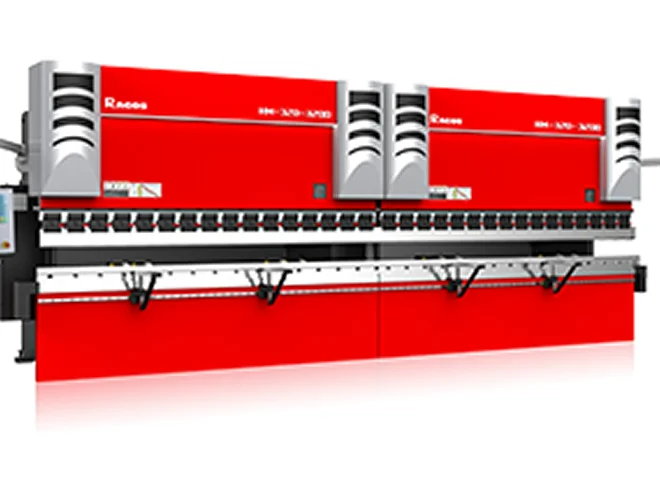
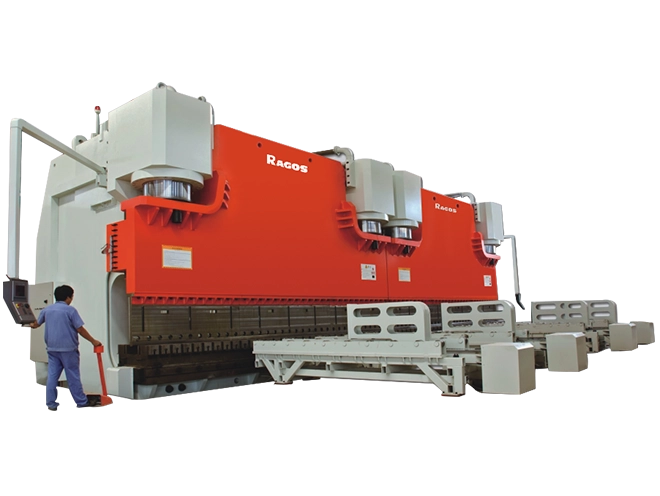
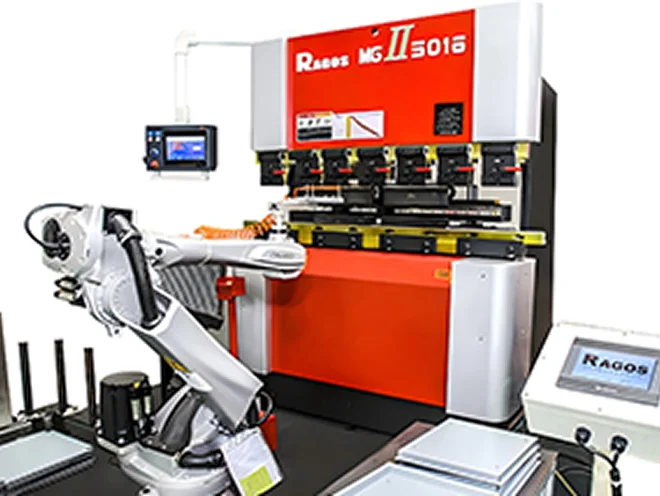
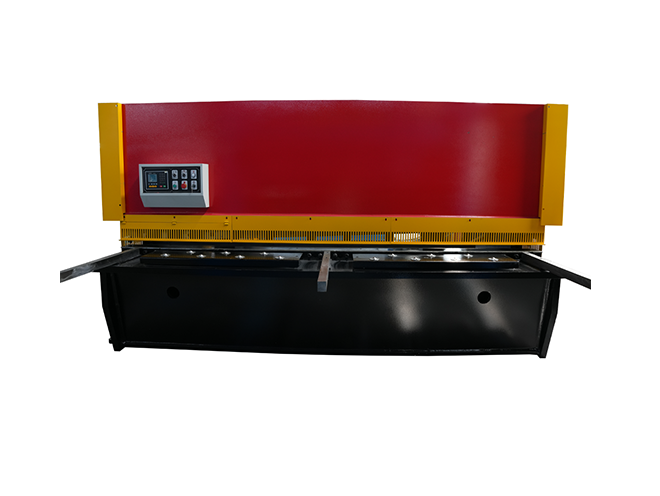




Heavy Duty Press Brake for Steel Plate: How to Spec It Correctly
Bending steel plate is a high-energy process that fundamentally differs from sheet metal work. While sheet bending focuses on surface aesthetics and precision, plate forming requires deep plate forming stress penetration to overcome the massive through-thickness deformation resistance of heavy sections.
Specifying a heavy duty press brake is not just about choosing a high number on a tonnage chart; it is about matching the machine's structural architecture to the physical behavior of the metal. If the machine cannot handle the plate neutral axis shift behavior, the resulting high load forming contact pressure will inevitably lead to frame fatigue or catastrophic tooling failure.
- Plate vs. Sheet: Plate requires full plastic deformation throughout the thickness, not just at the surface.
- Structural Integrity: The machine frame must manage the energy path to prevent torsional twisting under off-center loads.
- Spec Risk: Under-specifying leads to "banana" bends or cracked dies that can become safety hazards.
- Force Matching: Tonnage must be calculated with a safety buffer that accounts for material yield strength variations.
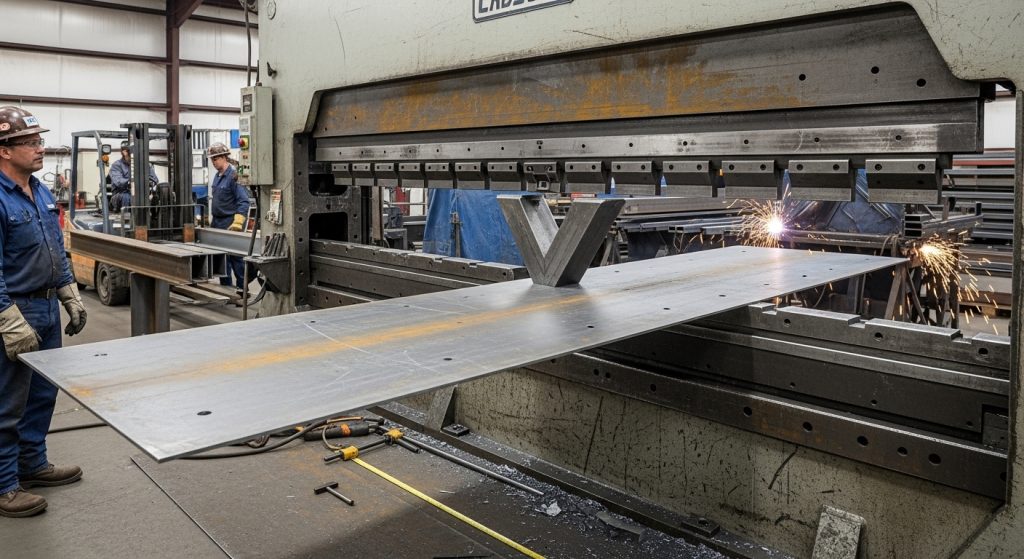
Where Heavy Duty Press Brakes Become Mandatory for Steel Plate Work
Standard machines often fail when pushed into the heavy section plate forming envelope. Heavy duty models are mandatory when the structural grade yield load resistance of the material exceeds the elastic limits of standard frames. In these scenarios, the plate edge stress concentration zone is so intense that standard components would deform permanently.
- Shipbuilding and Marine: Forming massive hull plates and internal bulkheads.
- Infrastructure: Creating structural beam segments and bridge components where plate integrity is non-negotiable.
- Heavy Equipment: Chassis fabrication for mining and construction machinery that operates within a narrow thick section deformation window.
True heavy duty fabrication requires a machine designed for constant, high-load cycles where the frame's fatigue life is calculated in decades, not just a few thousand strokes.
How Steel Plate Thickness Drives Heavy Duty Press Brake Tonnage Requirements
The force required to bend steel plate escalates exponentially with thickness. The section thickness force multiplier means that doubling the plate thickness requires far more than double the tonnage. Engineers must use a load safety factor buffer range to account for the "work hardening" that occurs during the stroke.
Plate Force Escalation Table (Approximate for S355 Steel)
| Plate Thickness (mm) | Recommended V-Opening (mm) | Tonnage per Meter (T/m) | Force Gradient |
| 12mm | 100mm | 85T | Baseline |
| 20mm | 160mm | 145T | 1.7x Increase |
| 30mm | 250mm | 210T | 2.5x Increase |
| 50mm | 400mm | 350T | 4.1x Increase |
The basic formula for estimation is $F = \frac{k \cdot S \cdot L \cdot t^2}{V}$, where $F$ is force, $t$ is thickness, and $V$ is the die opening. As $t$ increases, the forming force escalation gradient becomes the primary factor in machine selection.
Machine Architecture That Separates True Heavy Duty Press Brakes From Standard Models
A heavy duty press brake is defined by its frame load path rigidity. Unlike lighter models, the bed and ram are significantly deeper to provide bed deflection compensation geometry. The hydraulic cylinder load symmetry ensures that even under maximum pressure, the force is distributed evenly across the ram guides.
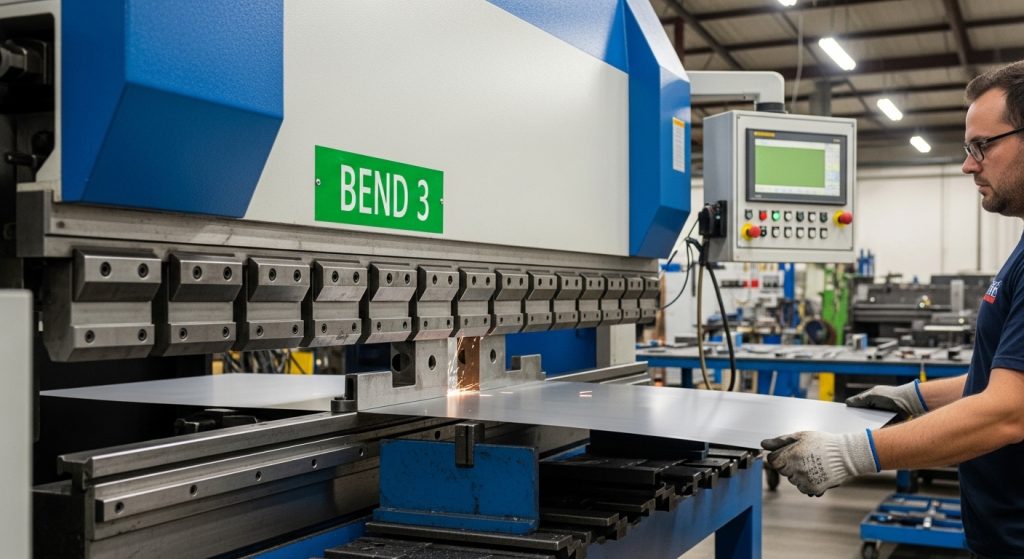
- Frame Rigidity: Oversized side housings and deep throat depths allow for large flanges without sacrificing ram parallel load control.
- Cylinder Design: Heavy-duty seals and high-pressure pistons designed for 24/7 industrial duty cycles.
- Bed Reinforcement: Massive steel slabs welded and stress-relieved to handle the concentrated point loads of large V-dies.
- Integrated Crowning: Active systems that react to the specific tonnage of each stroke to maintain a straight bend line.
Tooling Engineering for Steel Plate on Heavy Duty Press Brakes
Tooling for heavy plate is all about die opening load dispersion. Using a die that is too narrow increases tool contact pressure endurance requirements beyond the limits of standard tool steel, leading to surface galling resistance interface failure.
| Material Type | Punch Radius | Die Opening (V) | Risk Level |
| Mild Steel | $1.0 \times t$ | $8–10 \times t$ | Low |
| High-Tensile (S700) | $3.0 \times t$ | $12 \times t$ | Medium |
| Wear-Resistant (AR450) | $5.0 \times t$ | $12–15 \times t$ | High |
The punch nose stress radius control is critical; a sharp punch on a heavy plate will act like a knife, initiating a crack in the material rather than a bend.
Why Crowning Systems Become Critical in Heavy Plate Bending
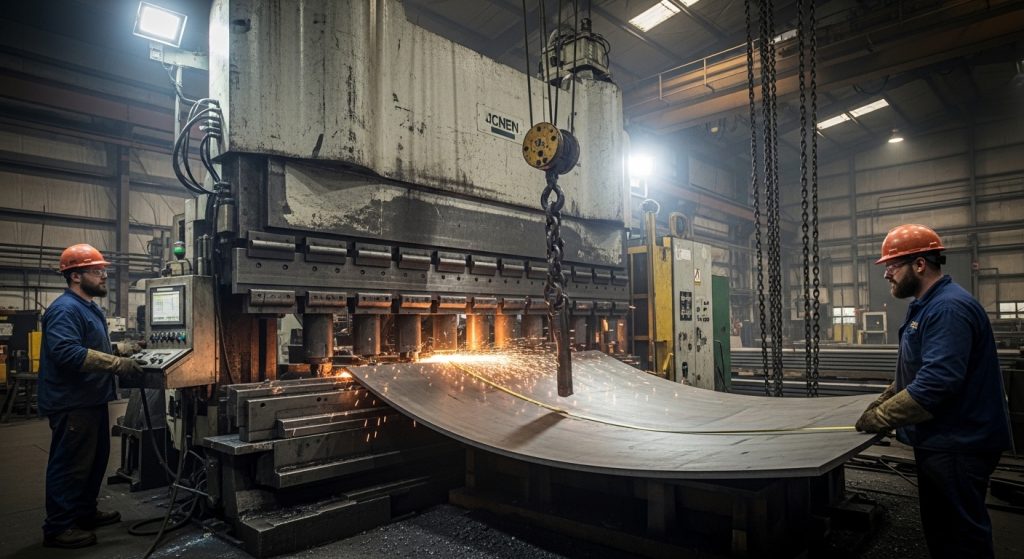
As the ram pushes down, the bed and ram naturally flex apart in the center—this is the bed elastic deflection curvature. Without correction, the plate will have a wider angle in the middle than at the ends. A dynamic crowning pressure modulation system compensates for this by slightly "bowing" the bed upward.
This full span bend compensation control is vital for plate work because the forces are so high that manual shimming is impossible. Without it, the angle variation gradient correction becomes a bottleneck, requiring expensive and time-consuming rework or secondary grinding.
Multi Cylinder Synchronization and Why It Matters Above Heavy Tonnage
In high-tonnage machines, maintaining a level ram is a matter of ram tilt deviation suppression. If one side of the plate is slightly harder than the other, the resistance will be uneven. A synchronized cylinder pressure harmonization system uses high-speed valves to balance the flow instantly.
- Hydraulic Flow Balance: Ensures the ram moves perfectly vertical regardless of off-center loading.
- Load Vector Distribution: Manages the forces to prevent the ram from "twisting" within the guides.
- Stability: Critical for large-format plates where a minor deviation at the cylinder translates to a large error at the plate edge.
Failure Risks When Steel Plate Jobs Run on Under-Spec Press Brakes
Pushing a machine past its intended frame stress yield exceedance limits creates micro fatigue crack nucleation. These cracks are often invisible until they result in a tool overload shear failure or a cracked machine frame.
| Failure Mode | Warning Signs | Engineering Consequence |
| Tool Fracture | Loud "crack" or pinging sound | Flying metal debris (Safety Hazard). |
| Frame Fatigue | Permanent ram/bed deformation | Loss of machine accuracy; eventual frame snap. |
| Plate Cracking | Visible surface tears in bend | Plate fracture propagation; scrapped high-value part. |
Running at 95% capacity constantly is a high-risk strategy; industrial best practice suggests staying within 80% of the rated tonnage for plate work.
Spec Checklist: How to Select Heavy Duty Press Brake for Steel Plate
Before finalizing a purchase, ensure the spec compliance validation checklist covers these engineering fundamentals:
- [ ] Tonnage Requirement: Calculated for your hardest material, not just mild steel.
- [ ] Load Envelope: Does the machine have the open height for your large V-dies and deep flanges?
- [ ] Tooling Compatibility: Verified tooling compatibility verification matrix for your specific plate thicknesses.
- [ ] Structural Class: Is it a "heavy duty" build or just a standard frame with larger cylinders?
- [ ] Crowning Method: Active hydraulic or mechanical wedge system suited for plate loads.
- [ ] Duty Cycle: Rated for the number of bends per hour your production requires.
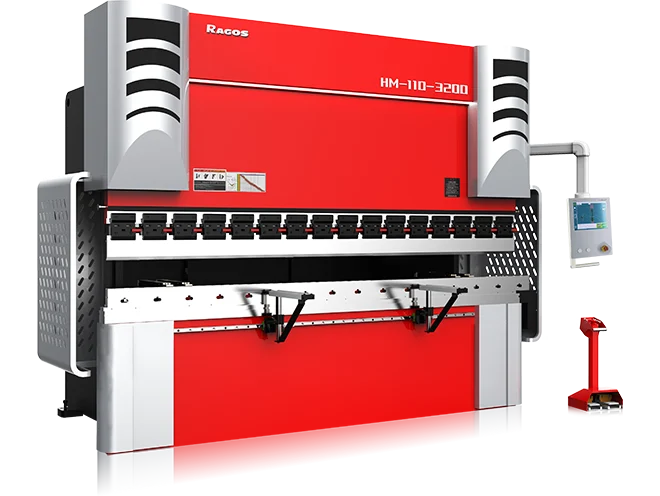
Selecting heavy duty press brake models involves understanding the limits of your current fabrication. While a 3200mm press brake is often the standard for general plate work, larger projects frequently require the 4000mm press brake to handle extended lengths without compromising on tonnage. Utilizing a press brake capacity chart is the first step in planning, but you must also factor in how die opening changes tonnage; a larger V-die can reduce the required force but will increase the minimum flange length.