

What Happens When Y1 and Y2 Are Not Synchronized on an Electric Press Brake?
By Author: Mark Hanks
A dual-drive electric press brake uses two servo drive systems and mechanical transmissions to move the left and right sides of a common ram. Both axes must follow their reference trajectories while maintaining coordinated positions. If their actual positions are not the same, a Y1/Y2 synchronization error occurs.
During procurement, it is not sufficient to check if the ram can repeatedly reach a specified position. It is possible for the two axes to end up at similar positions during motion synchronization despite experiencing momentary desynchronization during acceleration, deceleration or load changes. Assessment of synchronization performance requires evaluation of the entire motion cycle.
What a Y1/Y2 Synchronization Error Means
Y1 and Y2 generally represent the position axes on the left and right side of the ram that are controlled by a servo drive. If the two axes use the same coordinate direction, the same position reference datum, and the same target position, the position synchronization error is defined as:
Synchronization error = Y1 - Y2
This defines the relative position difference of the two sides. When both sides have the same measured position, the difference is zero. A non-zero difference indicates that the position of the two sides is not the same.
Synchronization error may have any sign, depending on the direction of the coordinate system used. The sign alone does not identify which side is physically higher or lower without knowing the coordinate convention. It is necessary to check the direction of the coordinate system of the machine to determine which side is higher.
Actual control systems may also use position values which are calibrated or offset-compensated. As such, during machine acceptance, it is important to refer to the manufacturer's definition of synchronization error.
Synchronization Error vs. Tracking Error
Position synchronization error and tracking error describe different control characteristics.
Position Synchronization Error: Compares the measured positions of the left and right axes.
Tracking Error: Compares the actual position of an axis to its desired position.
Assuming a common target position (Yref):
• Left tracking error = Yref - Y1
• Right tracking error = Yref - Y2
• Synchronization error = Y1 - Y2
For instance, assuming both axes trail behind the target position by the same amount, the synchronization error would be small, but the ram is not accurately following the reference trajectory.
One side approaching the target position while the other trails results in a position mismatch of the two axes. A good control system that uses both trajectory tracking and dual axis synchronization would alleviate the concerns mentioned above.
This is especially important during procurement. Positioning error, dual axis synchronization error and workpiece bend angle error are three different criteria and not interchangeable.
For the complete control sequence, see how Y1/Y2 synchronization works.
Why Identical Drives Can Respond Differently
While identical motors and transmission configurations can provide similar nominal performance, actual operating conditions can vary.
Mechanical systems respond to loads, friction and inertia. Within a mechanical system, the load on one side can change. If this occurs, the motor on that side of the system must change the output torque to follow the reference trajectory. If both sides of the system respond in the same manner, there should be no problem. If they do not, a deviation may occur.
Sending identical commands to both servo motors does not, by itself, guarantee identical actual movement. Position feedback is necessary for the controller to determine how accurately each axis follows its command.
For a dual-drive system, a more useful procurement question is whether the controller can detect a disturbance affecting one side and coordinate corrective action in response to the resulting position difference.
How Uneven Loading Affects Synchronization
When the left and right sides experience different loads, the two drives may need to produce different motor torque outputs. The synchronization control strategy must maintain trajectory tracking and position coordination under these conditions.
This does not mean that a dual-drive structure can accommodate unlimited off-center loading. Permissible eccentric loading positions, localized loads, and bending lengths remain subject to the design limits of the frame, ram, mechanical transmission, and control system.
During procurement, buyers should provide suppliers with representative loading conditions, including:
• Whether workpieces are frequently positioned toward one side of the working table.
• Whether segmented tooling is used.
• How different bending positions are distributed across the working length.
Permissible off-center loading should be addressed in the technical agreement. Permissible unbalanced loads should not be inferred from terms such as "dual servo" or "automatic synchronization."
What Position Mismatch Means for the Ram
If measurement datums are consistent and position feedback is accurate, then an indication of differing left and right ram positions means the two sides are not coordinating their movement. Geometrically this would affect the height relationship of both ends of the ram and its parallelism.
However, position synchronization error cannot be directly converted into a fixed bend angle error without considering the machine, tooling and material.
The final bending angle depends on thickness and the strength of the material being bent, springback, condition of the tools, and other structural deformations. Even with the two sides of the ram being positionally synchronized, differences in the physical properties of the material can also introduce angular differences.
Thus a difference in the bending angles at the two ends of the workpiece does not necessarily mean that there is a synchronization error. Other conditions like process variations should be taken into account in diagnosis.
How Cross-Coupled Control Helps Coordinate Both Axes
Cross-coupled control takes into account the position difference between the two axes and uses it to take coordinated corrective action.
When a disturbance is noted on one side, the controller takes into account not just the tracking error on that axis, but also the synchronization deviation between the two axes. With this information, the controller can issue coordinated control actions and adjust the outputs on both axes, rather than treating each drive as an independent positioning system.
However, the name of a control algorithm does not establish actual machine performance. The same control concept can produce different results depending on mechanical structure, feedback configuration, and servo parameter settings.
During procurement, buyers should ask suppliers to explain their actual position feedback and synchronization control architecture, supported by test results from the corresponding machine configuration.
Motor Speed Synchronization Is Not Ram Position Synchronization
Technical specifications should clearly identify whether synchronization data refers to the motors or the ram.
| Measurement | Comparison | Typical unit |
| Motor speed synchronization | Actual rotational speeds of the two motors | r/min |
| Ram position synchronization | Actual positions of the left and right sides of the ram | mm |
Motor rotation is converted into linear ram movement through the mechanical transmission system. Speed synchronization and position synchronization are related, but they are not interchangeable.
Even if both motors have the same instantaneous rotational speed, their accumulated displacement may differ due to previous motion deviations.
When evaluating ram parallelism, buyers should examine the corresponding left and right position feedback rather than relying exclusively on motor speed curves.
How to Compare Synchronization Specifications
See how linear scale feedback for Y1 and Y2 provides the position measurements used by the controller.
A synchronization error value is meaningful only when its measurement method and test conditions are clearly defined.
During quotation and machine acceptance, ask the supplier to confirm:
Does the specification describe motor speed deviation or ram position deviation?
Where are Y1 and Y2 measured?
• Which speeds, stroke positions, and loading conditions are included in the test?
• Will the value reported be maximum synchronization error? Steady-state error? Difference in final stopping position?
• Does the test consider asymmetric loading within the manufacturer’s permitted limits?
• How does the control system behave when the synchronization deviation exceeds the configured threshold?
Avoid using figures obtained from different measurement methods and loading conditions to rank machines. The final position difference under no-load conditions cannot be compared to the maximum synchronization error recorded during a loaded motion.
Check Synchronization with Your Actual Parts
The ability of a dual drive system to synchronize movement is governed by the position feedback system, control strategy, and mechanical transmission system. Knowledge of a machine using two servo motors will not indicate the level of synchronization under actual operational loads.
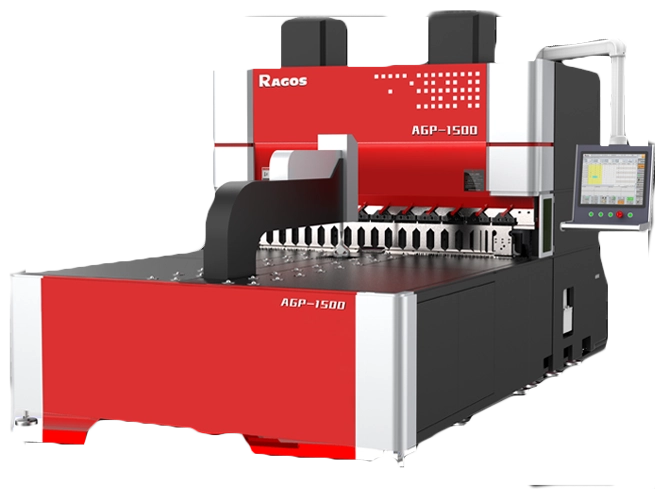
For configuration comparisons, buyers can give the material type and thickness, bending length, tooling arrangement and off-center loading conditions for the JS RAGOS Servo Electric Press Brake.
Machine testing should evaluate both motion records of both sides of the ram and the dimensions and angles of the finished parts, against criteria mutually agreed upon.
Frequently Asked Questions
Q1: Does a Small Synchronization Error Guarantee Accurate Bending?
No. Synchronization error describes the positional coordination of both sides of the ram. Finished-part accuracy also depends on material properties, tooling, structural deformation, and process settings.
Q2: Can Two Identical Servo Motors Still Become Unsynchronized?
Yes. Actual loads and mechanical responses may differ between the two sides. Position feedback and synchronization control are needed to coordinate their movement.
Q3: Does the Same Final Position Prove Synchronization Throughout the Stroke?
No. Temporary deviations may occur during acceleration, deceleration, and load changes. Dynamic synchronization performance must be evaluated throughout the motion cycle.
Q4: Is There One Acceptable Synchronization Error for Every Press Brake?
No universal value applies to every machine model. Permissible deviations must correspond to the machine design, measurement method, operating conditions, and manufacturer's technical requirements.