


CNC Press Brake for Aluminum Sheet: Prevent Marks and Cracks
If you want to produce high-quality aluminum components for the aerospace, automotive, or electronics industries, you cannot use the same aggressive settings you use for mild steel. Aluminum demands a lighter touch, polished tooling, and a CNC system that can manage delicate force applications. This guide will walk you through the essential steps to configure your CNC press brake for perfect aluminum fabrication.
Why Is Aluminum Different From Steel in the Bending Process?
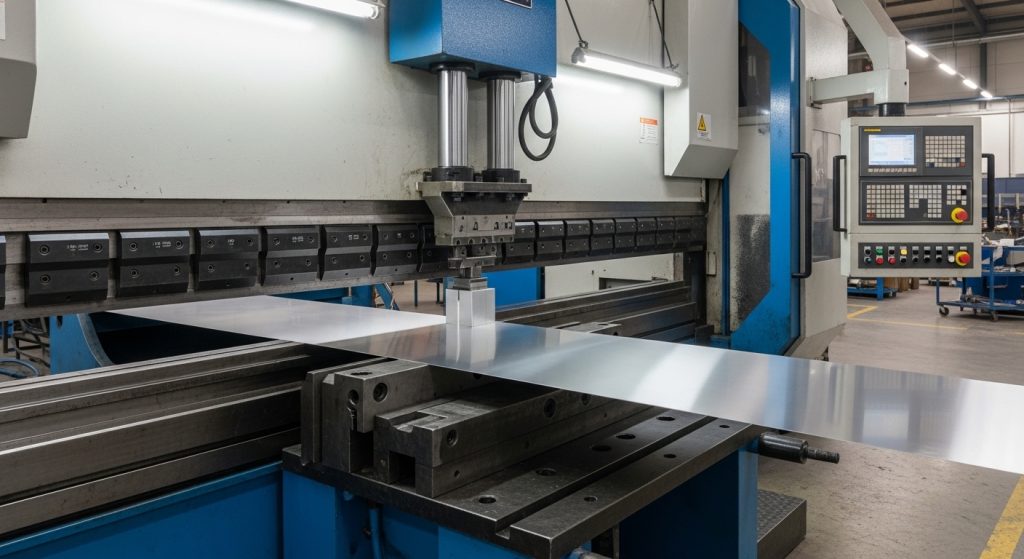
Aluminum is different from steel because of its lower density and higher ductility, which leads to a lower yield strength. While this means it requires less force to bend, it also means the material is much more sensitive to "point loading" and surface friction. Unlike the rugged nature of a sheet steel press brake environment, aluminum work feels more like precision engineering.
Key Material Differences
- Lower Tonnage: Aluminum generally requires about 40% to 50% of the force needed for mild steel.
- Surface Sensitivity: Aluminum is soft enough that the shoulders of a V-die can easily "bite" into the surface, leaving permanent marks.
- Grain Sensitivity: Aluminum has a very pronounced grain structure. Bending "with the grain" is a primary cause of cracking in the outer radius.
- Work Hardening: While it starts soft, aluminum hardens quickly as it is deformed. This makes "re-bending" or correcting an angle difficult without risking a fracture.
What Are the Key CNC Press Brake Requirements for Aluminum?
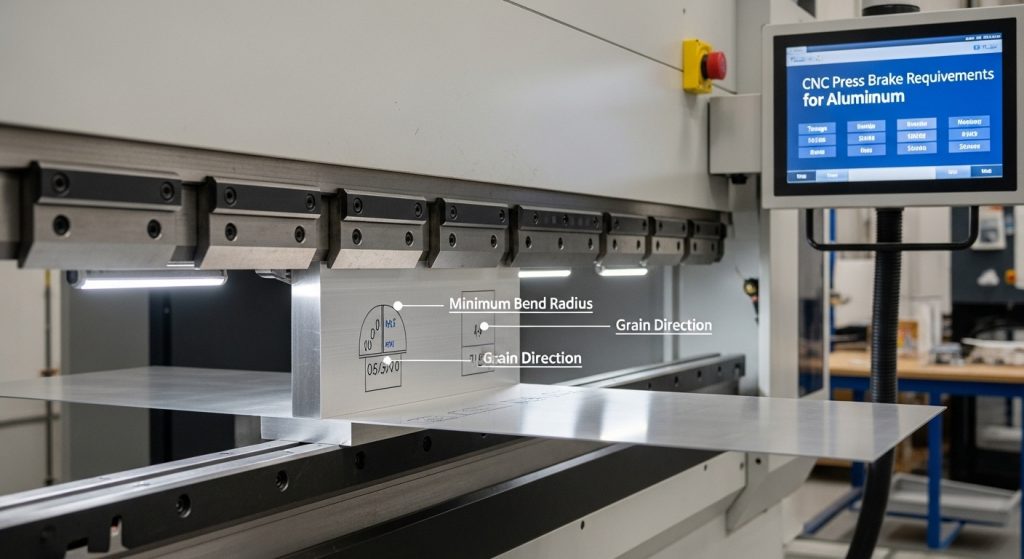
To prevent marks and cracks, your CNC hydraulic press brake must offer more than just raw power. It needs sophisticated software and high-resolution hardware to manage the "finesse" required for non-ferrous metals.
Why Is Precision Force Control Necessary?
Because aluminum requires so little tonnage, a machine with poor pressure resolution might "overshoot" the target force. This leads to over-bending or crushing the material. A high-quality CNC system allows for incremental tonnage adjustments, ensuring the ram delivers exactly what is needed for a 2mm or 5mm sheet without excess. This is particularly vital in furniture hardware bending where small decorative parts can be ruined by a few kilograms of extra pressure.
How Does Speed Control Affect Surface Quality?
Fast bending can "shock" the aluminum, leading to microscopic fractures at the bend line. Using a CNC to slow down the "pressing speed" allows the aluminum molecules to slide and relocate more naturally. Slower speeds also reduce the friction between the sheet and the die, which is the number one cause of surface scratching. A modern machine used in hvac press brake work allows the operator to define a slow-speed zone precisely where the punch meets the material.
Why Is Tool Alignment More Critical for Aluminum?
Even a 0.1mm misalignment between the punch and die will show up as an uneven line on the aluminum surface. Because the material is soft, it "takes the shape" of any imperfection in the tool setup immediately. This is why high-end shops often utilize automated tool clamping systems on their 4000mm press brake units to ensure centered loading across long spans.
How Do You Choose the Right Tooling for Aluminum?
The choice of tooling is where most aluminum projects are won or lost. If you use the same pitted, rough dies you use for boiler plate bending, your aluminum parts will look like they’ve been dragged across a gravel road.
Recommended Tooling for Aluminum
- Polished Tooling: Punches and dies should be ground and polished to a mirror finish. This allows the aluminum to slide smoothly over the die shoulders without "galling" (where aluminum bits stick to the steel).
- Larger Punch Radius: Never use a "knife" punch on aluminum. Use a punch with a radius at least equal to the material thickness ($R \ge T$). For harder grades like 6061-T6, the radius should be even larger.
- Larger V-Die Opening: Use a wider V-die than you would for steel. While steel follows an 8x thickness rule, aluminum often benefits from a 10x or 12x opening to spread the force and prevent marking.
Why Larger V-Openings Prevent Cracking
A narrow V-die forces the material to undergo a very sharp change in direction over a short distance. This puts extreme tension on the outer fibers of the bend. By using a wider die, you create a more gradual curve, which keeps the tension below the material's breaking point. This is a critical strategy for electrical enclosure bending where 90-degree corners must be perfectly crack-free to maintain an airtight seal.
What Is the Typical Tonnage for Air Bending Aluminum?
Understanding the tonnage requirements helps you select the right machine for the job. While a large machine might be used for industrial tasks, the actual pressure used for aluminum will be quite low compared to steel.
| Thickness (mm) | Approx Ton Per Meter (Aluminum) | Comparison to Mild Steel |
| 2mm Aluminum | 12 – 18 Ton | ~45% of MS |
| 5mm Aluminum | 40 – 60 Ton | ~50% of MS |
| 10mm Aluminum | 70 – 90 Ton | ~50% of MS |
What Are the Most Common Aluminum Bending Risks?
Mistakes in aluminum bending are expensive because the material cost is higher than mild steel. Avoiding these three common pitfalls will save your shop thousands in scrap.
1. The "Too Sharp" Radius
If you try to achieve a perfectly sharp 90-degree corner, the outside of the aluminum will likely "orange peel" or crack open entirely. This is especially true for heat-treated alloys like 6061-T6. Always prioritize a healthy bend radius. If the radius looks slightly larger than a steel part, it’s probably safer for the aluminum’s structural integrity.
2. Ignoring Grain Direction
Aluminum sheets are rolled at the mill, creating a "grain" that runs the length of the sheet. If you bend parallel to this grain, the material is significantly more likely to crack. This is similar to bending a piece of wood—if you bend along the grain, it splits. Always try to bend perpendicular (across) the grain direction to ensure maximum strength.
3. Cross-Contamination from Steel
If your dies have iron filings or carbon steel scale on them, these particles will embed themselves into the aluminum. This causes "galvanic corrosion" later in the product's life, leading to white powdery spots and structural failure. This is why many shops have a dedicated set of tooling used only for aluminum projects.
How Can You Prevent Marks and Scratches on the Surface?
For many aluminum applications, such as high-end panels or decorative display frames, the visual finish is the most important spec.
- Use Protective Film: Order aluminum with a PVC or laser film. Keep it on during the bend. This is common practice in architectural and medical cabinetry.
- Urethane Tape/Pads: Apply "no-mar" tape to the shoulders of your V-dies. This prevents metal-on-metal contact. It effectively creates a "soft" cushion that protects the aluminum from the hard steel edges of the die.
- Clean the Dies: Wipe your tooling after every 5-10 bends. Aluminum "pickup" on the die acts like sandpaper and must be removed to maintain a mirror finish.
Which Industries Use CNC Press Brakes for Aluminum?
Aluminum's weight-to-strength ratio makes it a favorite in high-tech sectors:
- Electrical Enclosures: Used for outdoor cabinets because of natural corrosion resistance and weight reduction.
- Automotive: Body panels and structural brackets for weight reduction and fuel efficiency.
- Aerospace: Requires the highest precision and absolute zero cracking tolerance. This often involves bending 7075-series alloys which are extremely difficult to manage.
- Signage: Large-scale outdoor displays that need to be light enough for easy mounting but strong enough for wind resistance.
Practical Shop Tips for Aluminum Success
- The 3x Rule for T6: If you are bending 6061-T6 (a very common but brittle grade), use a punch radius that is 3 times the material thickness ($3 \times T$) to avoid any risk of cracking.
- Warm the Metal: In cold winters, aluminum becomes more brittle. If you are having cracking issues, simply warming the sheets to room temperature (about 20-25°C) can make them much more ductile and easy to form.
- Check the Alloy: 3003 and 5052 aluminum bend beautifully and are very forgiving. 6061 and 7075 are "temperamental" and require precise calculation. Always verify your material grade before setting your CNC parameters.
Advanced Strategies for High-Volume Aluminum Production
When you are running thousands of aluminum parts, the small nuances of your CNC press brake settings become the difference between profit and loss.
Managing Springback in Aluminum
While aluminum is softer than steel, it actually has more predictable springback if you maintain a consistent temperature. Most aluminum grades will spring back between 1 and 2 degrees. Using a CNC system with an integrated angle measuring system can automatically adjust the ram depth in real-time to compensate for these variances, ensuring every part comes off the machine at exactly 90 degrees.
Lubrication Strategies
In some high-speed aluminum bending operations, a specialized "evaporative lubricant" is sprayed onto the die shoulders. This provides a microscopic film that prevents aluminum "cold-welding" to the steel die. Because it evaporates, it doesn't leave a greasy residue that needs to be cleaned before the parts move to powder coating or anodizing.
Handling "Whip-Up" on Large Aluminum Panels
On a 4000mm press brake, bending a large aluminum sheet can cause the material to "whip up" quickly. Because aluminum is light, it moves faster than steel. This can cause the material to "kink" if it isn't supported correctly. Using hydraulic sheet supports that follow the angle of the bend is the best way to prevent this kinking and protect the operator.
Troubleshooting Common Aluminum Bending Issues
Problem: Cracking on the Outside of the Bend
- Solution: Increase the punch radius. Check that you are bending across the grain. If the alloy is T6, consider using a wider V-die.
Problem: Dark Lines on the Material Face
- Solution: Your die shoulders are likely dirty or have "aluminum pickup." Clean and polish the dies. Use urethane tape to provide a barrier.
Problem: Angle Varies from One End of the Part to the Other
- Solution: Ensure your machine is properly leveled. On a long 4000mm press brake, check that the crowning system is correctly calibrated for the low tonnage of aluminum. Sometimes the crowning system needs to be "backed off" because aluminum doesn't require as much compensation as steel.
Final Thought: Finesse Over Force
Mastering aluminum on a CNC hydraulic press brake is a transition from being a "heavy hitter" to being a "precision craftsman." Success doesn't come from how much force you can apply, but from how accurately you can control it. By using polished tooling, respecting the grain direction, and utilizing the speed and force controls of your CNC system, you can produce aluminum parts that are structurally sound and aesthetically perfect.
Investing in a high-quality CNC press brake is the first step toward expanding your shop's capabilities into the lucrative world of aluminum fabrication. When you treat aluminum with the respect its unique properties demand, your scrap rate drops, and your part quality soars.