

Piegatrici per macchinari da costruzione: Guida completa all'acquisto per la formatura a piastre a grande uso
Unconstruction machinery plate bender is a heavy-duty forming machine used to shape thick steel plate into the structural components that make up excavators, bulldozer, Gru, Caricabatterie, e altre attrezzature da costruzione. The plate thicknesses involved — typically 8mm to 50mm in structural grades and wear-resistant steel — place demands on bending equipment that standard sheet metal machines simply can't meet.
Questa guida copre i tipi di macchine, component applications, material specs, and selection criteria that matter for construction machinery fabrication.
What Is a Construction Machinery Plate Bender?
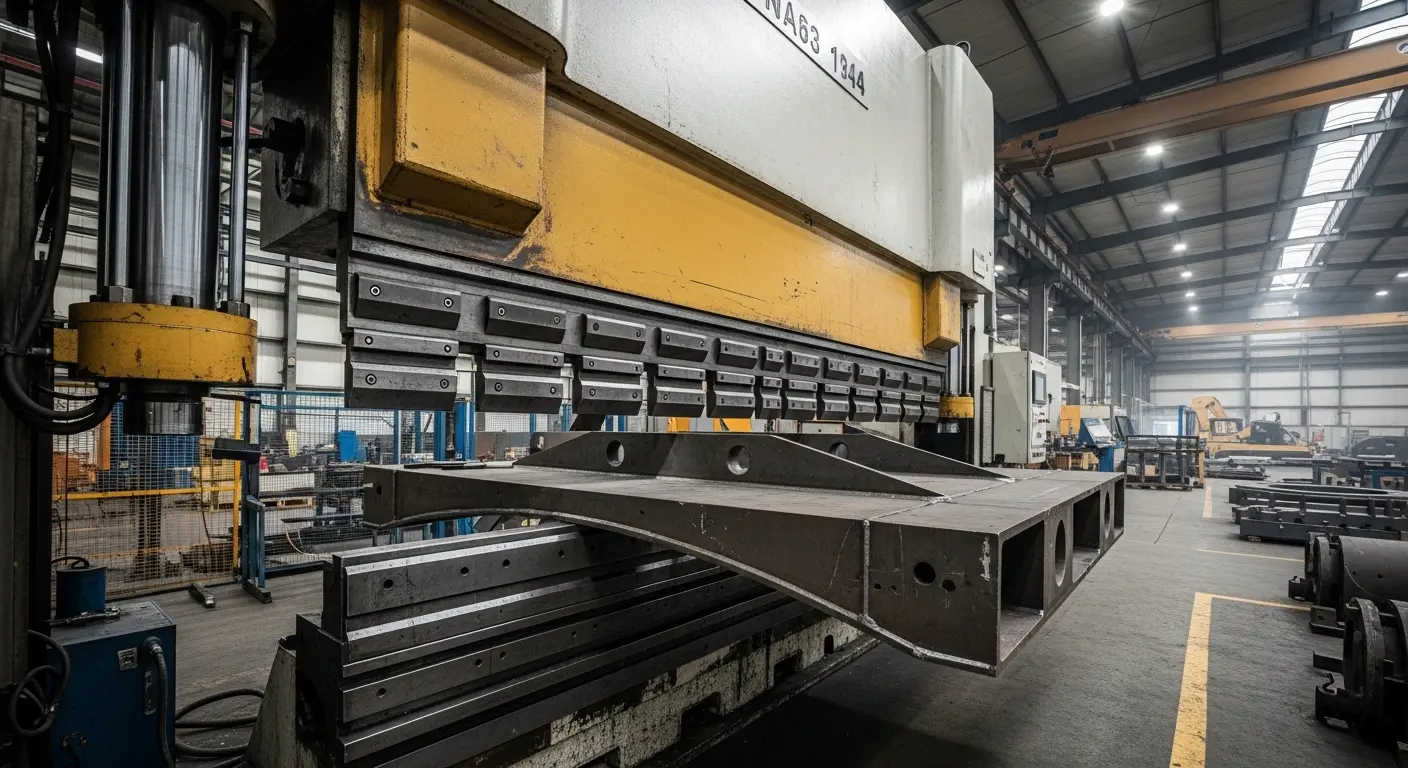
Unconstruction machinery plate bender is a CNC hydraulic press brake, heavy-duty plate rolling machine, or combination of both, configured to form thick structural steel plate into the profile, flange, or radius shape required for construction equipment components.
Two primary machine types serve construction machinery manufacturing:
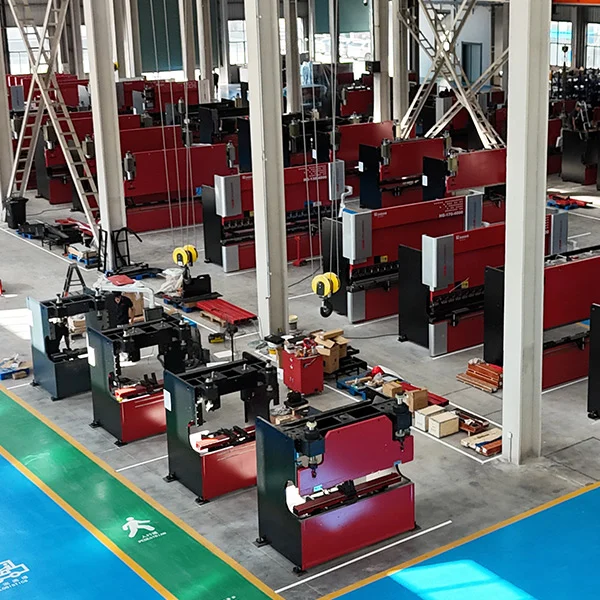
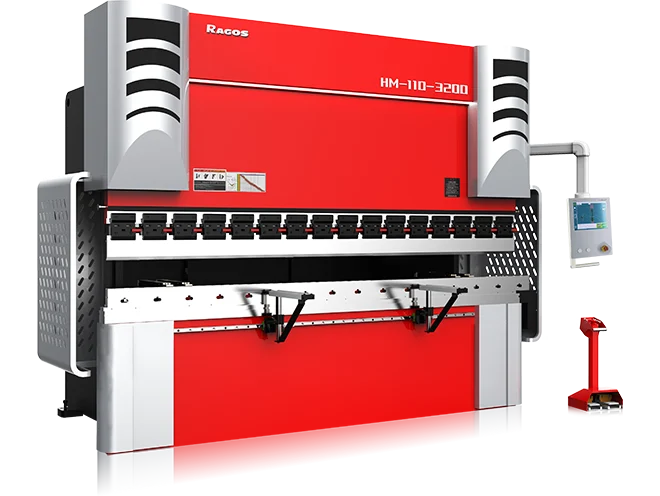
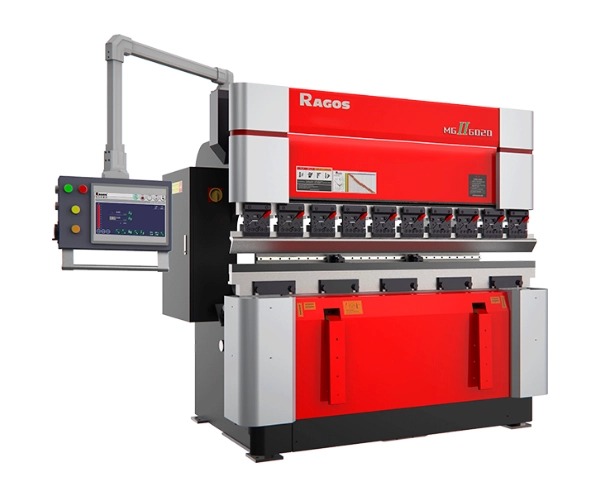
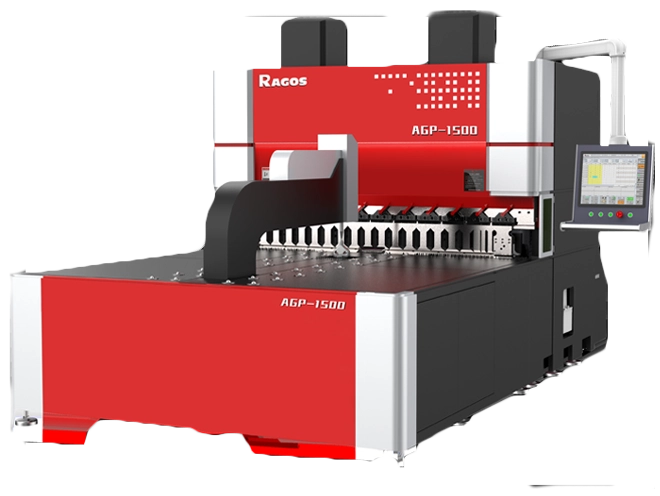
CNC Heavy-Duty Press Brake — Uses a punch and die set to form angular bends in thick plate. Handles boom arm flanges, chassis brackets, mounting plates, counterweight forms, and flat-to-angled transitions. Provides precise angle control and back gauge positioning across multi-bend sequences.
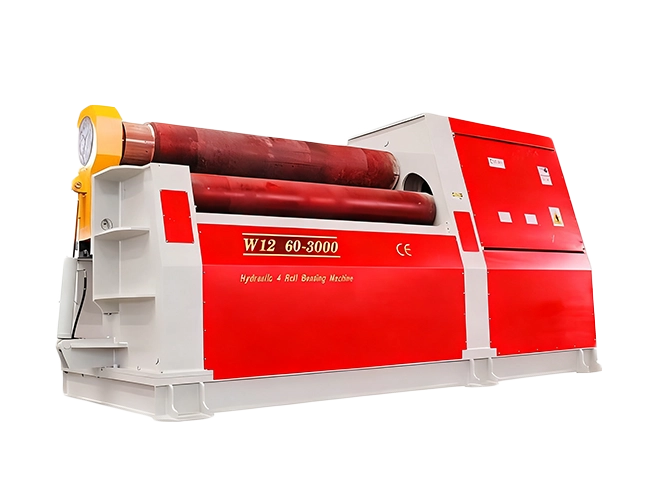
CNC Plate Rolling Machine (Plate Bender/Roller) — Uses two or three driven rollers to progressively curve flat plate into cylindrical or curved forms. Handles bucket shells, cylindrical counterweights, curved boom sections, and cylindrical pin housings. Different in principle from a press brake — it produces curves, not sharp angular bends.
Most construction machinery fabricators run both machine types. The press brake handles angular plate work. The plate roller handles curved and cylindrical forms. Unconstruction machinery plate bender that covers the full component range requires both tools in the production line.
Construction Machinery Parts That Require Plate Bending
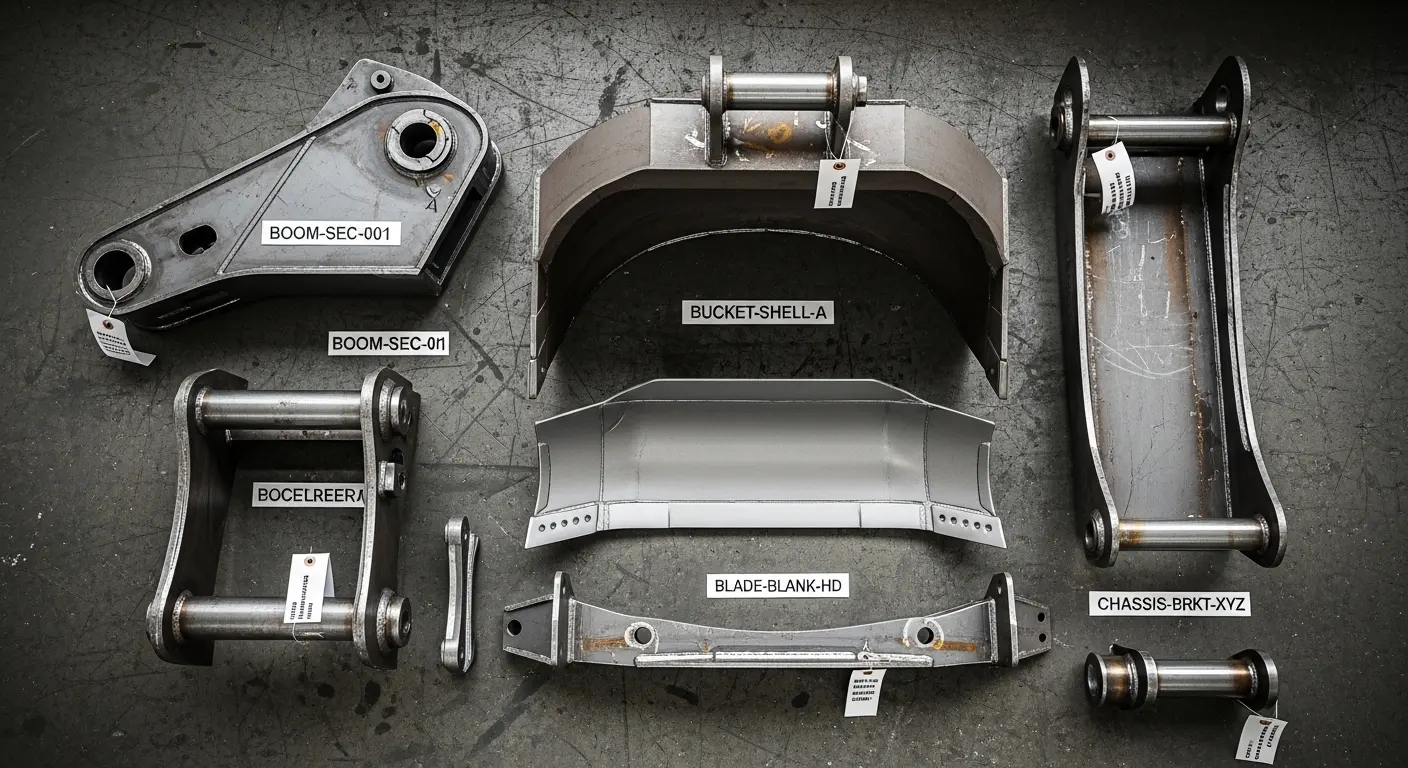
Understanding every component that goes through a construction machinery plate bender shapes your entire machine specification.
Excavator boom arms and stick arms — Long structural box profiles in 12–25mm high-strength steel (S460, S690). Require angular bending for flange profiles and precise dimensional accuracy for weld fit-up. Boom arm sections are typically 3–6m long, which sets your minimum bending length requirement.
Bucket shells — Curved and angular plate components in 10–20mm mild steel or 8–16mm wear-resistant steel (Hardox, AR400). Require both angular bending (side walls, Rinforzi per pavimenti) and curved forming (shell radius). A bucket for a 30-ton excavator uses plate up to 20mm thick — that's significant tonnage to form accurately.
Bulldozer and grader blades — Long, curved plate components in AR400/500 wear-resistant steel. Require precise radius forming on a plate rolling machine. Blade lengths of 3–5m are standard. The hardness of wear-resistant grades demands premium tooling and careful bending speed control to avoid cracking.
Chassis frames and undercarriage components — Heavy box-section frames in S355 or S460 structural steel at 15–40mm. Require high-tonnage press brake work for flange bends, gusset plates, and mounting bracket profiles.
Counterweights and ballast blocks — Often formed from thick mild steel plate (20–50mm) into simple angular or curved forms. Tonnage requirements are high due to material thickness — a 50mm mild steel plate bend over 2m requires 600T or more.
Hydraulic cylinder mounts and pin plates — Precision components in 20–40mm structural steel. Require tight angular accuracy (±0.5° or better) for correct pin alignment during assembly.
Why Construction Machinery Bending Is Different
General sheet metal fabrication rarely exceeds 6mm. Construction machinery fabrication routinely runs at 15mm, 25millimetro, e sopra. That difference changes everything about your construction machinery plate bender Requisiti.
Plate thickness means exponentially more force — Bending tonnage doesn't scale linearly with thickness. Doubling plate thickness from 10mm to 20mm roughly triples the required force for the same bend length and material grade. S355 structural steel at 20mm over 3m requires approximately 400–500T. At 30mm, that exceeds 700T. Undersized machines either can't complete the bend or do so under strain that shortens machine life rapidly.
High-strength steel is unforgiving — S460 and S690 grades used in modern excavator booms have yield strengths of 460–690 MPa. Spring-back at these strengths is aggressive — 3–6° per 90° bend in some grades. Your CNC controller must have a spring-back compensation database for each grade, or every angle requires manual correction and rework.
Wear-resistant grades crack if mistreated — Hardox 400 and AR500 steels resist wear by being hard — and hard steel is more brittle. Bending too fast, using too small a punch radius, or bending in cold conditions can initiate cracks in the plate. Minimum bend radius for Hardox 400 is typically 2–3× material thickness. Your machine's bending speed and tooling selection must account for this.
Structural tolerance requirements — A boom arm that's 2° off on its flange angle creates misalignment at the pivot pin, requiring field correction or rework during assembly. Construction machinery tolerances are tighter than they appear — assembly accuracy depends on bending accuracy at every stage of fabrication.
CNC Press Brake vs Plate Rolling Machine for Construction Parts
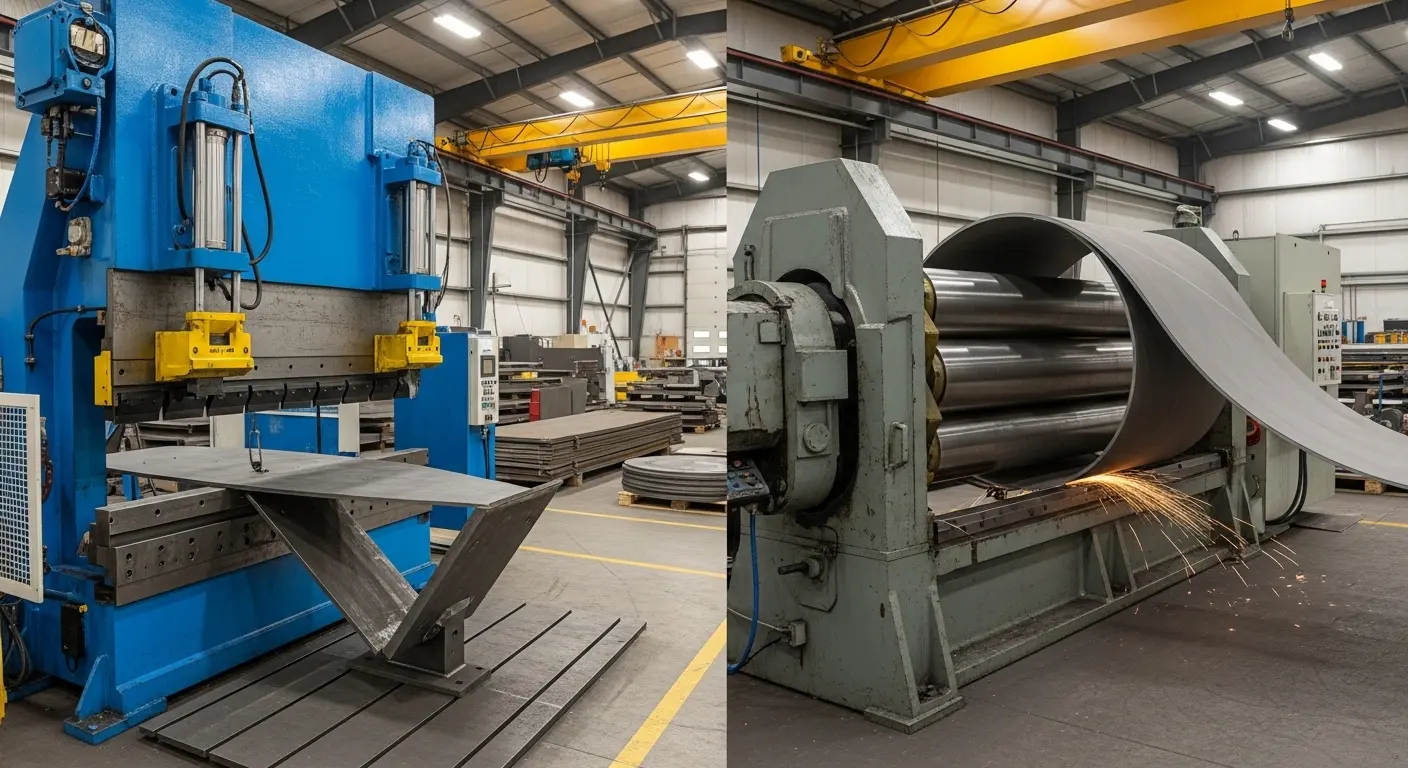
Both machine types are used in construction machinery fabrication. The right choice depends entirely on the part geometry you need to produce.
| Caratteristica | CNC Heavy-Duty Press Brake | Macchina per laminare piastre |
|---|---|---|
| Miglior tipo di pezzo | Flanged brackets, boom sections, chassis frames, angular plate | Bucket shells, curved booms, cylindrical counterweights, pin housings |
| Geometry produced | Angular bends, Flangie, box profiles | Cylinders, curves, Coni, continuous radius |
| Plate thickness range | 5mm – 100mm+ | 4mm – 300mm+ |
| Precisione | Excellent for angles (±0.1°–±0.5°) | Good for radii — depends on machine and operator |
| Complessità di configurazione | Moderate — tooling, back gauge | Lower for simple cylinders; higher for cones |
| Automation potential | High — CNC, back gauge servo | Moderate — CNC controls on premium models |
| Costo in capitale | Lower at mid-tonnage | Higher for heavy industrial rollers |
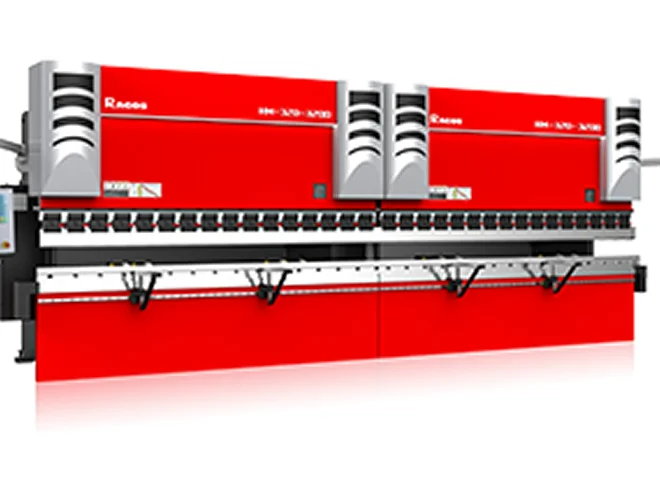
For fabrication shops that produce mostly angular construction components — boom flanges, chassis plates, mounting brackets — a heavy-duty CNC press brake for steel plate work delivers the precision and repeatability construction assembly lines require.
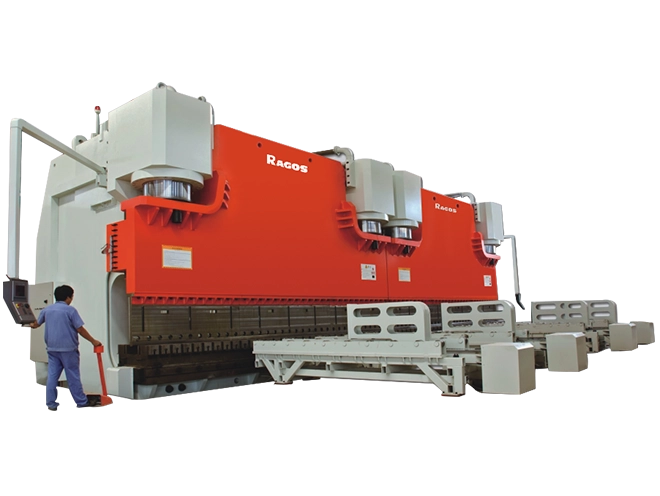
For very high tonnage structural work — chassis frames and large counterweights above 400T bending force — the 600-Freno a pressione CNC tonnellate handles construction machinery plate work that mid-range machines can't approach.
Key Specifications for a Construction Machinery Plate Bender
Quando si valuta unconstruction machinery plate bender, these specifications determine whether the machine handles your full component range.
Tonnage — based on your thickest, Materiale più duro
Calculate required tonnage for your worst-case component: thickest plate, hardest material grade, longest bend length. Add a 25–30% safety margin. For S355 at 25mm over 3m, plan for 500–600T minimum. For S690 or Hardox at the same thickness, add a 40–50% multiplier for material strength.
Bending length — must match your longest component
Excavator boom sections and bulldozer blade forms regularly exceed 3m. A machine with a 3200mm bed handles most construction components. For longer boom arms or large crane structures, un4000mm CNC press brake bed oppure untandem press brake configuration provides the working length without repositioning.
Throat depth — for large flanges on box profiles
Box-section boom arms have flanges that must clear the machine frame. A 400–600mm throat depth is standard for construction machinery press brakes. Confirm your largest flange depth before selecting a machine.
Compenso per la coronazione
Over 2m+ bending lengths with plate above 15mm, frame deflection causes the centre of the bend to open wider than the ends. Active hydraulic crowning is mandatory for consistent angular accuracy on long construction plate components.
CNC controller with material-specific spring-back tables
S690, Hardox, and other high-strength grades each have distinct spring-back behavior. A controller that stores per-grade spring-back correction eliminates manual angle correction on every job change.
Lunghezza della corsa e altezza aperta
Thick plate requires large V-dies. A V-die for 30mm plate needs a 250mm opening. Your machine's open height must accommodate the punch, il, and part flange height combined.
High-Strength and Wear-Resistant Steel: What Your Plate Bender Needs
Construction machinery uses steel grades that most fabrication shops rarely touch — and each one behaves differently under the punch.
S355 / A36 Structural Steel — The standard grade for chassis frames, mounting plates, and secondary structural components. Resistenza alla trazione 490–630 MPa. Ritorno anticipato, well-understood bending behavior. A solid starting point for calibrating your machine and tooling.
S460 / S500 High-Strength Structural Steel — Used for boom arms, stick arms, and load-bearing structural components. Tensile strength 550–680 MPa. Spring-back is notably more aggressive than S355 — plan for 3–4° overbend on 90° angles. Minimum punch radius 2× material thickness.
S690 / Weldox 700 — Used where weight reduction matters — modern excavator booms, lightweight crane components. Tensile strength 770–940 MPa. Very aggressive spring-back (5–7° per 90°). Requires a CNC controller with high-strength steel spring-back data and careful bending speed management to avoid micro-cracking at the bend zone.
Hardox 400 / AR400 Wear-Resistant Steel — Used for bucket floors, side cutters, dozer blade inserts, and cutting edges. Hardness 370–430 HB. Brittle in cold conditions — minimum bending temperature above +5°C for most grades. Minimum bend radius 3–5× material thickness depending on plate thickness. Never use tight dies on Hardox.
Hardox 500 / AR500 — Higher-hardness grade (450–540 HB) for extreme wear applications. Even tighter minimum bend radius requirements. Some thicknesses of Hardox 500 are not recommended for cold bending — warm forming may be required above 20mm.
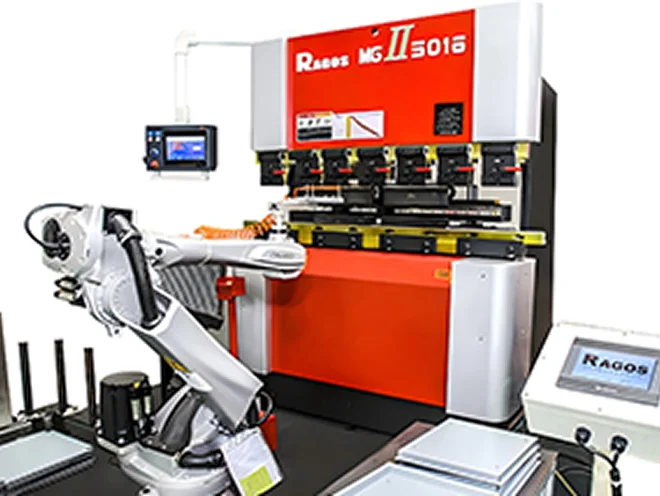
For shops working across multiple grades, unCNC press brake with a programmable material database stores spring-back correction values per grade and thickness — saving significant setup time across job changes. Evaluating options across leading builders? The guide to I principali produttori di freni a pressione CNC covers the major players and their construction-sector capabilities.
Weld Prep and Assembly Fit-Up in Construction Machinery Fabrication
Unconstruction machinery plate bender doesn't just form parts — it sets up every downstream process that follows.
Weld fit-up accuracy — Excavator boom sections are MIG or SAW welded on dedicated fixtures. If the flanged plate components don't match the fixture dimensions within ±0.5mm, the welder either forces the part into position (introducing residual stress) or scraps the component. Bending accuracy directly determines weld preparation quality.
Bevel and edge preparation — Many construction machinery plates require beveled edges for full-penetration welds. The sequence is: cut plate to size (plasma or laser) → bevel edges → bend to profile → fixture weld. Any bending distortion introduced after edge preparation compromises the weld joint geometry.
Batch consistency for assembly lines — Construction machinery OEMs produce hundreds of identical boom sections, buckets, and chassis frames. Every bent component in a batch must match the same angle and flange dimensions within tolerance. CNC press brakes with back gauge servo control and stored programs deliver this batch-to-batch consistency. Manual or basic NC machines cannot maintain it reliably across long production runs.
Stress relief after bending — Some high-strength and wear-resistant grades develop residual stress at the bend zone during forming. For critical structural components, stress relief heat treatment after bending and before welding is specified. Confirm this requirement with your material supplier for each specific grade and thickness combination you work with.
How to Choose the Right Construction Machinery Plate Bender
Usa questo sistema in cinque fasi prima di contattare qualsiasi fornitore.
Passo 1: List your thickest and hardest components
Identify the component that requires the most force — typically your thickest plate in your highest-strength grade over your longest bend length. That single worst-case combination drives your minimum tonnage requirement.
Passo 2: Calculate tonnage with the correct multiplier
Use your material tensile strength relative to mild steel to apply a tonnage multiplier: S355 = ×1.0 baseline; S460 = ×1.3; S690 = ×1.7; Hardox 400 = ×1.8–2.0. Add 25–30% safety margin to the result. For S690 at 20mm over 3m, this puts you above 600T.
Passo 3: Determine your bending length requirement
Measure your longest component and add 200–300mm for overrun. For boom arms and chassis rails above 3m, plan for a 3200mm minimum — or evaluate a 4000mm configuration or tandem setup.
Passo 4: Confirm material-grade controller support
Check whether the CNC controller the machine ships with supports spring-back correction databases for S690 and Hardox grades. Ask the supplier to demonstrate this feature with actual material data, not just a claim.
Passo 5: Plan your full plate processing line
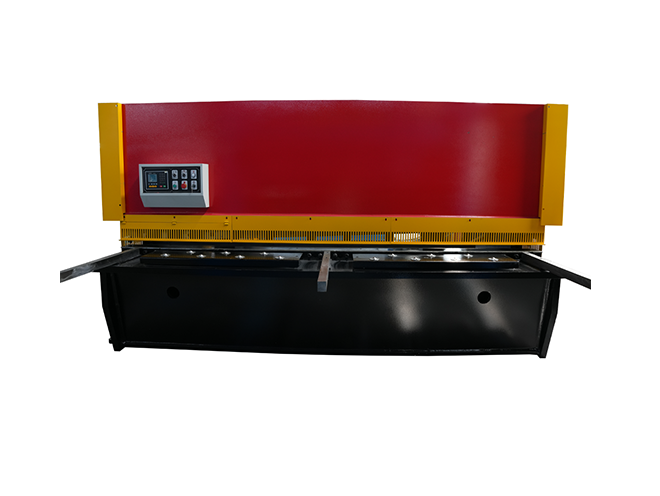
Unconstruction machinery plate bender doesn't work alone. It needs upstream cutting (plasma or laser for thick plate), a shearing machine for straight cuts, and downstream welding equipment. Leelectric metal shearing machine for plate preparation handles blanking upstream, while an affordable metal plate roller for curved components handles cylindrical and curved forms alongside the press brake in a complete construction fabrication line. For complete tonnage calculations for a 100-ton baseline machine, Le100-ton CNC press brake for structural steel work shows what that capacity tier handles in practice.
Frequently Asked Questions About Construction Machinery Plate Benders
What is a construction machinery plate bender?
A construction machinery plate bender is a heavy-duty CNC press brake, plate rolling machine, o entrambe, used to form thick structural steel plate into the components that make up construction equipment — including excavator boom arms, bucket shells, bulldozer blades, chassis frames, and counterweights. These machines handle plate from 8mm to 50mm+ in structural, high-strength, and wear-resistant steel grades.
What tonnage do I need for construction machinery plate bending?
Tonnage depends on plate thickness, Grado del materiale, e lunghezza della curvatura. S355 structural steel at 20mm over 3m requires approximately 400–500T. High-strength S690 at the same dimensions requires 600T+. Wear-resistant Hardox 400 requires a further 40–50% multiplier. Always add a 25–30% safety margin above your calculated maximum.
What is the difference between a plate roller and a press brake for construction machinery?
A press brake produces angular bends in thick plate — flanges, box profiles, chassis frames, and bracket forms. A plate rolling machine produces curved and cylindrical forms — bucket shells, curved boom sections, and cylindrical counterweights. Construction machinery fabrication typically needs both machine types because different components require different forming geometries.
Can standard CNC press brakes handle construction machinery plate work?
Standard mid-range CNC press brakes (80–200T) handle light construction components in S355 up to 8–10mm. For structural boom arms, chassis frames, and wear-resistant bucket components above 12mm in high-strength grades, heavy-duty press brakes in the 400T–600T+ range are required. Standard machines under-spec for this work either fail to complete bends or degrade faster than their rated service life.
What steel grades are used in construction machinery plate bending?
Common grades include S355 and S460 for chassis frames and structural supports, S690/Weldox 700 for modern lightweight boom arms, and Hardox 400/500 or AR400/500 wear-resistant steel for bucket floors, cutting edges, and dozer blades. Each grade requires different spring-back correction, minimum bend radius, and tooling selection.