

What Is Press Brake Crowning and How Does It Work?
Press brake crowning is a compensation method used in sheet metal bending to counteract "deflection," which is the natural tendency of a machine’s upper and lower beams to bow under high pressure. When you bend a long piece of metal, the center of the bend often ends up with a wider angle than the ends because the machine flexes outward in the middle. Crowning solves this by creating a slight opposing curve in the bed or the ram, ensuring that the pressure remains uniform across the entire length of the workpiece. By neutralizing this mechanical flex, crowning allows fabricators to achieve consistent, high-precision linear bends without manual shimming or wasted material.
Why Does Press Brake Deflection Happen?
Every press brake, regardless of its build quality, experiences some degree of structural "yawning" or deflection. When the hydraulic cylinders apply force at the ends of the ram, the center of the beam naturally resists that force less effectively than the points directly under the cylinders.
This physical phenomenon results in a "canoe effect," where the middle of your part isn't pushed as deeply into the die as the ends. Without a crowning system, long parts will consistently show an inconsistent angle—tight at the edges and loose in the center. Understanding these mechanical limits is a core part of evaluating Sheet Metal Bending Machine CNC: Key Specs Buyers Compare.
How Does Press Brake Crowning Work?
Crowning works by "pre-loading" or curving the machine's table or ram in the opposite direction of the expected deflection. Think of it like a bridge designed with a slight upward arch so that it becomes perfectly flat only when the weight of traffic is on it.
Mechanical Crowning Systems
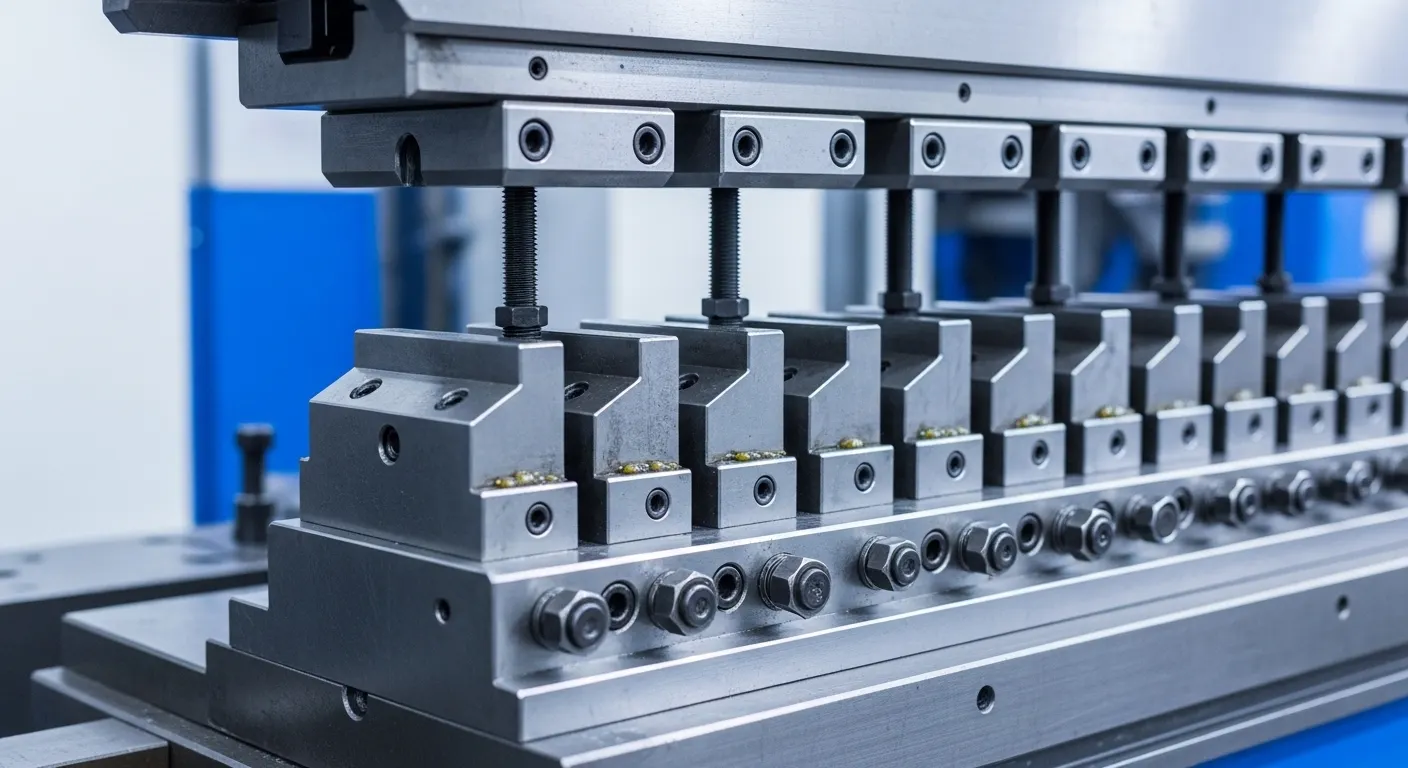
Mechanical crowning usually involves a series of sliding wedges located beneath the lower die. A CNC motor moves these wedges against each other to increase or decrease the height of the table at specific points (usually concentrated in the center). This creates a physical "hump" that offsets the machine's flex.
Hydraulic Crowning Systems
In hydraulic systems, the machine features extra cylinders built into the lower table or the upper ram. As the bending force increases, the CNC controller activates these cylinders to push back against the deflection in real-time. This is often preferred for high-speed operations because it adjusts automatically based on the pressure detected by the sensors.
People Also Ask: When is crowning necessary?
Crowning is necessary whenever you are bending parts longer than 1.5 to 2 meters or using high-tonnage pressure on thick materials. If your part shows a "boomeranging" angle—where the center angle is wider than the ends—you need crowning to achieve a straight, uniform bend.
For shops dealing with precision parts, crowning isn't just an "extra" feature; it is a requirement for maintaining tolerances. This is especially true when moving from a 4-Axis vs 8-Axis CNC Press Brake, as higher-axis machines are often designed for complex, long-form work where crowning is critical.
People Also Ask: Can I bend without a crowning system?
Yes, you can bend without an automated system by using "shimming," which involves placing thin strips of paper or metal under the die in the center to manually create a crown. However, this is a slow, "trial-and-error" process that significantly increases setup time and scrap rates.
Manual shimming is common on older, manual machines. On modern equipment, however, the time saved by an automated crowning system usually pays for the machine upgrade within a few months of production.
Mechanical vs. Hydraulic Crowning: A Quick Comparison
| Feature | Mechanical (Wedge) Crowning | Hydraulic Crowning |
| Adjustment Speed | Moderate (Motorized wedges) | Instant (Pressure-based) |
| Precision | Very High (Wedges are stable) | High (Dynamic response) |
| Maintenance | Low (Keep wedges clean/greased) | Moderate (Check seals/fluid) |
| Consistency | Excellent for repetitive jobs | Superior for varying material thicknesses |
How CNC Controls Manage Crowning
Modern CNC controllers take the guesswork out of the process. When an operator enters the material type, thickness, and length into the controller, the software calculates the required "compensation value" automatically.
The machine then adjusts the crown before the ram even touches the metal. This level of automation is why understanding What Does an 8-Axis CNC Press Brake Mean? is so important—extra axes often include dedicated control over crowning and independent cylinder movement for maximum precision.
Frequently Asked Questions
The canoe effect is a defect where a long metal part has a wider bend angle in the middle than at the ends, caused by machine deflection.
Yes. Thicker materials require more tonnage, which causes more machine deflection. Therefore, thicker materials generally require a more aggressive crown adjustment.
While most crowning systems are integrated into the lower table (bed), some specialized machines use "ram crowning" to adjust the upper beam instead.
If you apply too much crowning, the center of the part will have a tighter angle than the ends, creating the opposite problem of deflection.
Conclusion
Press brake crowning is the "secret sauce" of high-precision metal fabrication. By understanding how your machine flexes and using crowning to fight back against that physics, you can eliminate scrap and produce perfect parts every time.